
CNC Processing Service Canberra: What to Check Before You Order
A sourcing guide for Canberra engineering teams that need machined metal and plastic parts without a local machine shop. It covers the seven checks we would run on any supplier: tolerance and inspection method, machine envelope, material range, certification, minimum order quantity, quoting clarity, and lead time. Read it before you send a drawing package out for quote.
In this article
- 1
- 2
- 3
- 4
- 5
- 6
- 7
- 8
- 9
- 10
Key takeaways
What each check tells you about a supplier
Run these against every quote you collect.
| Check | What to ask for | Red flag |
|---|---|---|
| Tolerance capability | Machine type and gauge used for ±0.005 mm | Tolerance quoted with no inspection method |
| Part size envelope | Max travel and rotary table diameter | Large parts quoted without a machine spec |
| Material range | Alloy grades actually stocked, not a list | Exotic alloys quoted as 'available' only |
| Certification scope | Certificate number and expiry date | Logo on a page with no scope statement |
| MOQ | Whether one prototype is accepted | Setup fee hidden until after drawing review |
| Quote format | Unit price, setup, finish, freight split out | One lump sum with no line items |
| Lead time basis | Days from DFM approval or from PO | A ship date with no start date |
The short version
Pick a supplier on method, scope, and written lead time, not on the lowest unit price. A quote that separates setup, finishing, and freight, names the machine, and states when the clock starts is worth more than a number with no line items.
Tolerance and inspection method
Any supplier can type ±0.005 mm on a quote. The useful question is which machine holds it and how they prove it. A 3-axis mill with a worn ball screw will drift on a deep pocket long before the operator notices. A simultaneous 5-axis center cutting a one-setup part avoids the re-fixturing error that stacked tolerances come from, which matters when a bore and a face both carry a tight callout.
Ask what gauge is used on the feature you care about. A micrometer reads an outside diameter to ±0.001 mm in the right hands. A CMM reads position and true position across a datum scheme. A pin gauge reads a hole. If your drawing uses GD&T, the CMM report should mirror your datum structure, not a simplified one.
Then ask what ships with the parts. We inspect 100% before shipment and can supply raw material check notes, in-process readings, and final inspection reports on request. If a supplier cannot say what a report contains, assume the tolerance is nominal, not verified.
- 1Fine finishRa 0.2–0.8 μm for sealing faces and bearing bores.
- 2High finishRa 0.8–1.6 μm covers most mating surfaces.
- 3As machinedRa 1.6–3.2 μm is fine for brackets and covers.
Machine envelope and part size
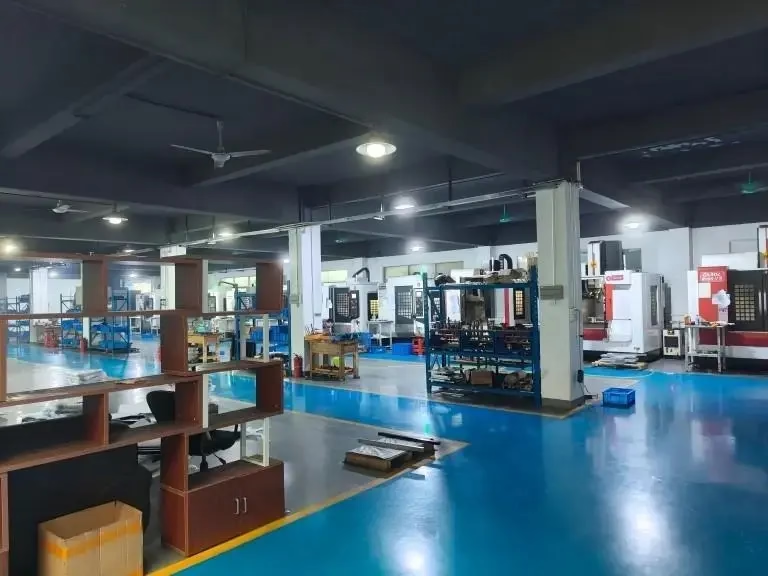
Size drives machine choice more than any other variable. A 4,000 mm long rail cannot be cut on a 500 mm table, and a supplier who quotes it anyway is either farming it out or hoping you will not ask. Our largest travel is 4,000 × 400 × 150 mm. Medium work runs on 750 × 1,150 × 550 mm and 600 × 600 × 600 mm envelopes, and compact work on 500 × 500 × 450 mm and 500 × 310 × 200 mm.
Rotary work is a separate question. A Ø400 mm rotary table supports 4-axis indexing and continuous 5-axis contouring. If your part has features on five faces, or a compound angle that would need three setups on a 3-axis machine, ask whether it can be cut in one setup. Each extra setup adds a datum shift and a chance for chips to sit under a clamp.
For thin-wall parts, the envelope is not the limit. Deflection is. A 1.5 mm wall in aluminium at 4,000 mm length will chatter unless the supplier roughs, stress-relieves, and finishes in separate passes. Ask how they handle it before you approve the process.
Material range and stock reality
A material list is easy to publish. Stock is harder. The useful question is which grades sit on the shelf and which are ordered per job, because ordered stock adds days to the front end of your lead time. For aluminium we run 6061, 6061-T6, 2024, 5052, 5083, 6063, 6082, 7075, and ADC12. Stainless covers 303, 304, 316, 316L, 420, 430, 431, 440C, and 17-4PH (SUS630).
Steel grades include 1018, 1045, 4130, 4140, 4340, A36, and tool steel. Copper and brass run across C101, C103, C110, beryllium copper, C27400, C28000, and C36000. Titanium and special alloys cover TA1, TA2, TC4 (Ti-6Al-4V), Inconel, and magnesium AZ31B / AZ91D. Plastics include ABS, PC, PMMA, POM, PA, PEEK, PP, HDPE, and carbon fibre.
Titanium and Inconel are where suppliers separate. Both work-harden, both generate heat at the cutting edge, and both punish a light rigid setup. If your part is Inconel with a deep pocket, ask for the toolpath strategy and the coolant pressure, not just the material name on a quote.
Certification scope and what it covers
Certificates are scope documents. ISO 9001:2015 is a general quality management standard and applies to almost any machine shop. IATF 16949:2016 adds automotive-specific requirements around traceability and change control. ISO 13485:2016 adds medical device process controls. ISO 27001:2022 covers information security, which matters when you send proprietary CAD files to an overseas supplier.
Ask for the certificate number and the expiry date. Ask which site it covers. A group certificate that names a different plant than the one cutting your parts is not evidence about your parts. We hold all four and can send copies with the quote.
For defense and aerospace work in the Canberra region, certification is often only the entry ticket. The next question is whether the supplier has a documented process for first article inspection and whether they will hold a revision of your drawing, not just the latest one.
MOQ, setup cost, and quoting clarity
Minimum order quantity is where small engineering teams get squeezed. Many shops will not open a machine for fewer than 50 parts. We have no minimum order quantity, from one prototype to 10,000+ part runs. That matters for a Canberra team validating a design before tooling spend.
Read the quote structure, not just the total. Unit price, setup, programming, finishing, and freight should each appear as a line. If finishing is folded into the unit price, you cannot compare two suppliers fairly, because one may be quoting anodizing and the other a bare machined surface.
Ask how revisions are handled. A drawing change after programming starts should trigger a written delta, not a new lump sum. Ask too whether the quote includes first article inspection or charges for it separately.
Lead time, shipping, and what starts the clock
Lead time means different things to different suppliers. Some count from purchase order, some from drawing approval, some from receipt of material. Pin that down before you compare numbers. Our sequence is quotation and free DFM analysis within 12 hours, production starting within 24 hours, and parts shipping in 3–5 days.
Canberra adds a freight layer that a Southeast Asian or Chinese supplier has to plan for. Parts travel by air or sea, clear customs, and then move inland. Ask whether the quoted lead time ends at the factory gate or at your dock, and who handles the customs paperwork.
Historical late-delivery probability across our orders sits below 2%. That is a history, not a guarantee, and we do not promise a delivery date on a page. What we can do is give you a start date and a ship date in writing, and flag risk early when a material is short.
Confidentiality and file handling
Canberra work often includes defense-adjacent, medical, and research hardware where the drawing itself is sensitive. Ask how uploads are stored, who can open them, and how long they are retained. We treat uploads as secure and confidential and can sign an NDA on request.
ISO 27001:2022 is the standard that covers this systematically: access control, incident handling, and supplier security. If a supplier cannot describe their file access policy in plain terms, that is a signal about how they handle everything else.
Also ask who owns the CAM program and the fixture design. If you switch suppliers later, you want the setup knowledge to be reproducible, not locked in one person's head.
Step by step: qualifying a supplier
Seven steps, in the order that saves the most time.
- 1Send a drawing package with GD&T intactInclude the STEP file, the 2D drawing with datum callouts, material spec, finish spec, and quantity. Missing datum structure is the most common cause of a slow quote.
- 2Request DFM feedback with the quoteAsk for specific notes: thin walls, deep pockets, tool reach, tolerance stack risk. A quote with no DFM comment means no one read the part.
- 3Ask which machine and gauge holds the tightest calloutName the feature. If the answer is vague, the tolerance is aspirational. For ±0.005 mm features, expect a CMM report with the datum scheme you specified.
- 4Confirm the size envelope against the partCompare the longest dimension and the rotary requirement. 4,000 mm maximum processing size covers most rail and frame work; a five-face part needs a 5-axis center.
- 5Check certification scope and expiryGet the certificate number and the site it covers. Match it to the plant that will run your parts.
- 6Request the quote as line itemsUnit price, setup, finishing, inspection, freight. Then ask what a drawing revision costs after programming starts.
- 7Agree the lead time basis in writingState whether the clock starts at PO, at drawing approval, or at material receipt, and whether the date is factory gate or delivered.
Questions we get from Canberra buyers
Can you hold ±0.005 mm on a part made in China and shipped to Canberra?
Yes, on features that suit the process. ±0.005 mm (±0.0002 in) is a machining capability, not a shipping one. The risk is not the freight, it is whether the drawing calls out the right datum and whether the report proves the feature.
We inspect 100% before shipment and can include final inspection reports. For tight stacks, ask for the CMM report before the parts leave.
What is the smallest quantity you will run?
One part. There is no minimum order quantity, and the same quoting line handles a single prototype and a 10,000+ part run.
For a one-off, setup dominates the price. Sending a STEP file with a clear finish callout keeps that setup time down.
Which materials are hard to source quickly?
Titanium grades and Inconel are typically ordered per job rather than stocked, which adds front-end days. Magnesium AZ31B and AZ91D also move more slowly than aluminium.
If your schedule is tight, tell us the material at quote stage so the lead time reflects real stock, not an assumption.
Do you sign an NDA for defense-related work?
Yes. An NDA is available on request, and uploads are handled as secure and confidential. Our information security process follows ISO 27001:2022.
Send the NDA with your drawing package and we will return it signed before any file is opened for quoting.
What finishes can be applied before shipment?
Anodizing in clear, colour, hardcoat, and conductive versions; electroless nickel, zinc, silver, and gold plating; powder coating and black oxide; bead blasting, tumbling, brushing, and polishing; and laser marking or engraving with a minimum character height of 1.5 mm.
Specify the finish on the drawing. A finish added after quoting changes both price and lead time.
How do you handle a drawing revision after production starts?
We stop, quote the delta in writing, and wait for your approval before cutting further. Parts already machined to the old revision are not silently reworked.
Keep the revision number in the filename. It is the fastest way to avoid cutting the wrong drawing.
Send your drawing and get a real answer
Quotation and free DFM analysis within 12 hours. Production can start within 24 hours of approval, and parts ship in 3–5 days.
12-hour quoteNo MOQ100% inspectionNDA on request
More from the shop floor
We publish setup notes, tooling trials and inspection data from the factory floor.











