
CNC Processing UK Services: 5 Essential Checks Before You Commit
This guide is for UK-based engineers and buyers comparing CNC processing UK services, whether the work stays in Britain or goes to an overseas partner. Read it and you can judge a supplier on tolerance, lead time, order size, paperwork and quote clarity before you release a purchase order.
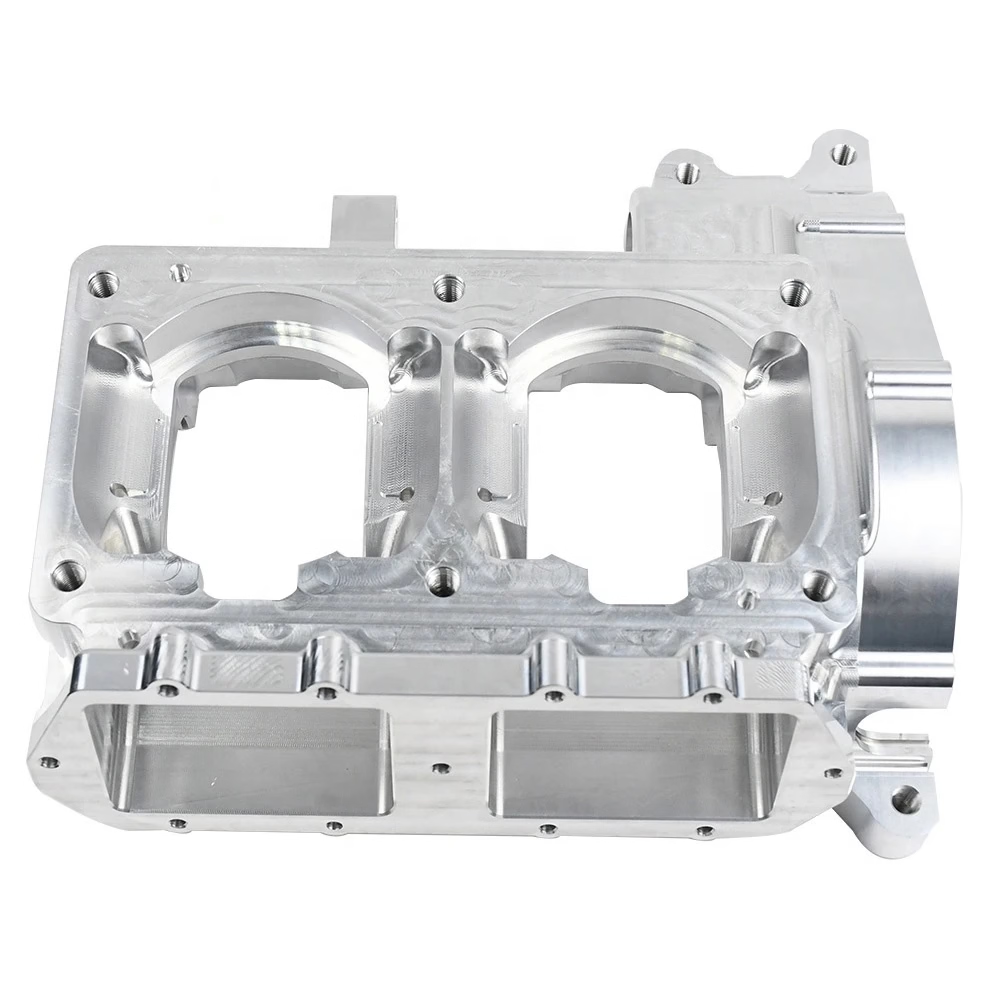
What matters most
CNC processing UK services: what to compare
Match the column to the question you actually need answered.
| Check | What to ask | Good answer | Red flag |
|---|---|---|---|
| Tolerance | Can you hold ±0.005 mm across the batch? | Method and gauge stated up front | "We will see" on the first article |
| Lead time | Quote in 12 hours, parts in 3–5 days? | Both numbers in writing | Only a ship date, no quote date |
| Order size | One part and 10,000 parts? | No minimum order quantity | MOQ forced before a prototype |
| Paperwork | Which certificates apply to my part? | Scope line named per certificate | A logo page with no scope |
| Quote detail | Material, finish and inspection listed? | Line-by-line quote | One lump price, no breakdown |
| Size range | Can you take a 4,000 mm part? | Travel limits published | "Send it and we will try" |
| Confidentiality | NDA and secure upload? | NDA on request | Files sent by open email only |
Tolerance and finish: the numbers behind CNC processing UK services
Tolerance is the first thing a drawing asks for and the last thing a buyer verifies. A supplier who quotes ±0.005 mm should also tell you how that number is measured: which gauge, at what temperature, and on how many parts per batch. If the answer stops at "our machines are accurate", you are buying a claim, not a process.
Finish is the second half of the same question. As-machined surfaces sit around Ra 1.6–3.2 μm, a standard high-quality cut lands at Ra 0.8–1.6 μm, and fine work reaches Ra 0.2–0.8 μm. Tell the supplier which faces actually need the fine finish. Polishing every surface adds cost and can round an edge that the drawing wants sharp.
Part size drives the machine choice more than the material does. A 4,000 × 400 × 150 mm travel envelope covers long rails and frames, while 750 × 1,150 × 550 mm and 600 × 600 × 600 mm cover most enclosures and housings. Compact work at 500 × 500 × 450 mm runs best on small, fast machines where the spindle spends its time cutting rather than travelling.
One more number is worth asking about: the qualification rate. A shop reporting 99.99% is telling you how often parts pass inspection the first time. That figure matters most when you order a batch of 500 and cannot afford to sort them yourself.
Lead time, order size and quote format
Lead time is two numbers, not one. The first is how long the quote takes. The second is how long the metal takes. A supplier who answers a request for quotation and free DFM analysis within 12 hours, and can start production within 24 hours, has separated those two clocks. Ask for both dates in writing so you can plan assembly around them.
Some shops quote fast and then sit on the order until the batch is large enough to be worth setting up. That is why order size is a selection criterion, not a detail. A partner with no minimum order quantity can run one prototype and a 10,000+ part run on the same paperwork. You keep the same supplier from first article to volume, and you skip a second round of supplier qualification.
Read the quote as a document, not a total. A usable quote names the material grade, the finish, the inspection step and the quantity break. A single lump price invites disputes later, when the anodizing turns out to be excluded or the first article was never budgeted.
Delivery history is the last input. A shop that reports a historical late-delivery probability below 2% is describing its own record, not a promise about your order. Treat it as one data point and check whether the buffer sits before or after final inspection.
If your parts ship in 3–5 days from a partner in Dongguan, the transport leg is yours to plan. Build it into the schedule rather than treating it as a surprise.
Certificates, industries and material fit
Certificates answer different questions. ISO 9001:2015 covers the quality management system. IATF 16949:2016 speaks to automotive and EV supply chains. ISO 13485:2016 applies to medical devices. ISO 27001:2022 covers information security, which is what protects your drawings and CAD files. Ask which one applies to your part and read the scope line.
Industry context helps you judge whether a shop has seen parts like yours. Aerospace work leans on titanium and tight geometry. Automotive and EV work leans on aluminium and repeatability. Medical devices bring stainless and documentation. Robotics and automation mix aluminium, steel and plastics in one assembly. Electronics and industrial machinery add heat sinks, brackets and frames.
Material availability decides more schedules than machine time does. Aluminium 6061 and 7075 are routine. Stainless 303, 304, 316L and 17-4PH are routine. Titanium TA1, TA2 and TC4 (Ti-6Al-4V) take longer to cut and cost more per hour. Inconel and magnesium AZ31B or AZ91D need a shop that has cut them before.
Carbon fibre and PEEK sit in a different category again. Both machine well but wear tooling fast, so the quote should reflect a tool-change allowance. If it does not, the shop is guessing.
Uploads should be secure and confidential, and an NDA should be available on request. If your drawings are covered by a customer agreement, settle that before the first quote, not after the first shipment.
How to vet a CNC processing supplier in 6 steps
Run these in order. Each step produces a document you can compare against the next supplier.
- 1Send one drawing and one questionAttach a single part with its tolerance and finish callouts. Ask for material advice and a quote date. A useful reply comes back with a DFM note, not just a price.
- 2Time the quoteNote when the reply lands. Within 12 hours is a working shop. A week means your order will queue behind someone else's.
- 3Ask for the tolerance methodRequest the gauge, the inspection stage and how many parts per batch are checked. 100% inspection before shipment is the answer you want.
- 4Test the size envelopeGive the largest dimension of your part and ask for the machine travel. 4,000 mm is the outer limit; 750 × 1,150 × 550 mm covers most work.
- 5Confirm order size and finishState whether this is one prototype or 10,000 parts, and which faces need which Ra band. Watch whether the price changes shape.
- 6Close the paperwork loopRequest the certificate scope, the NDA and the inspection report format. Secure uploads and a signed NDA should both be routine.
Frequently asked questions
Can a UK buyer work with an overseas CNC shop without losing control of quality?
Yes, if the inspection plan is agreed before cutting starts. Ask for raw material check, in-process monitoring and final inspection as separate stages, with reports on request.
The distance does not remove the specification. It only moves the conversation earlier, into the quote and DFM stage.
What tolerance should I expect on a first prototype?
A shop quoting ±0.005 mm should hold it on the features the drawing controls. Prototype and production parts come off the same machines, so the tolerance does not loosen just because the quantity is one.
If a feature is not toleranced, say what it is for. That lets the shop spend time on the faces that matter.
How do I compare quotes when the prices are far apart?
Put the quotes side by side on material grade, finish, inspection and quantity breaks. A low price with no finish line usually means finishing is excluded.
Then check the two lead time numbers. A cheaper quote that takes a week to arrive may cost you more in schedule risk than it saves.
Do I need an NDA before sending CAD files?
Send an NDA if the part is customer-owned or under an existing agreement. A supplier who handles drawings daily should treat that as routine.
Uploads should be secure and confidential by default. If a shop asks you to send files by open email, that is worth a second look.
Which materials are worth asking about first?
Start with the grade on your drawing. Aluminium 6061-T6, stainless 304 or 316L, and steel 4140 cover a large share of industrial parts.
Titanium TC4, Inconel and magnesium change the cutting parameters and the price. Ask whether the shop has run them before you assume it can.
What size part is too large for most suppliers?
Above 4,000 mm you are outside the standard envelope and into a small group of shops. Below that, 750 × 1,150 × 550 mm and 600 × 600 × 600 mm cover most housings and frames.
Give the largest dimension in the first message. It filters the list faster than any other single number.
Send one drawing and get a real answer
Quote and free DFM analysis within 12 hours, no minimum order quantity, and an NDA when you need one.
12-hour quote±0.005 mmNo MOQNDA on request
Follow GreatLight
We publish setup notes, tooling trials and inspection data from the factory floor.











