
CNC Tour Treatment Technology: How Surface Treatment Changes Tool and Guideway Life
Treatment is the last step before a cutter touches metal, and it decides whether an edge survives 20 minutes or 20 hours. This page covers the main treatment routes, what each one does to the substrate, and which jobs they fit.
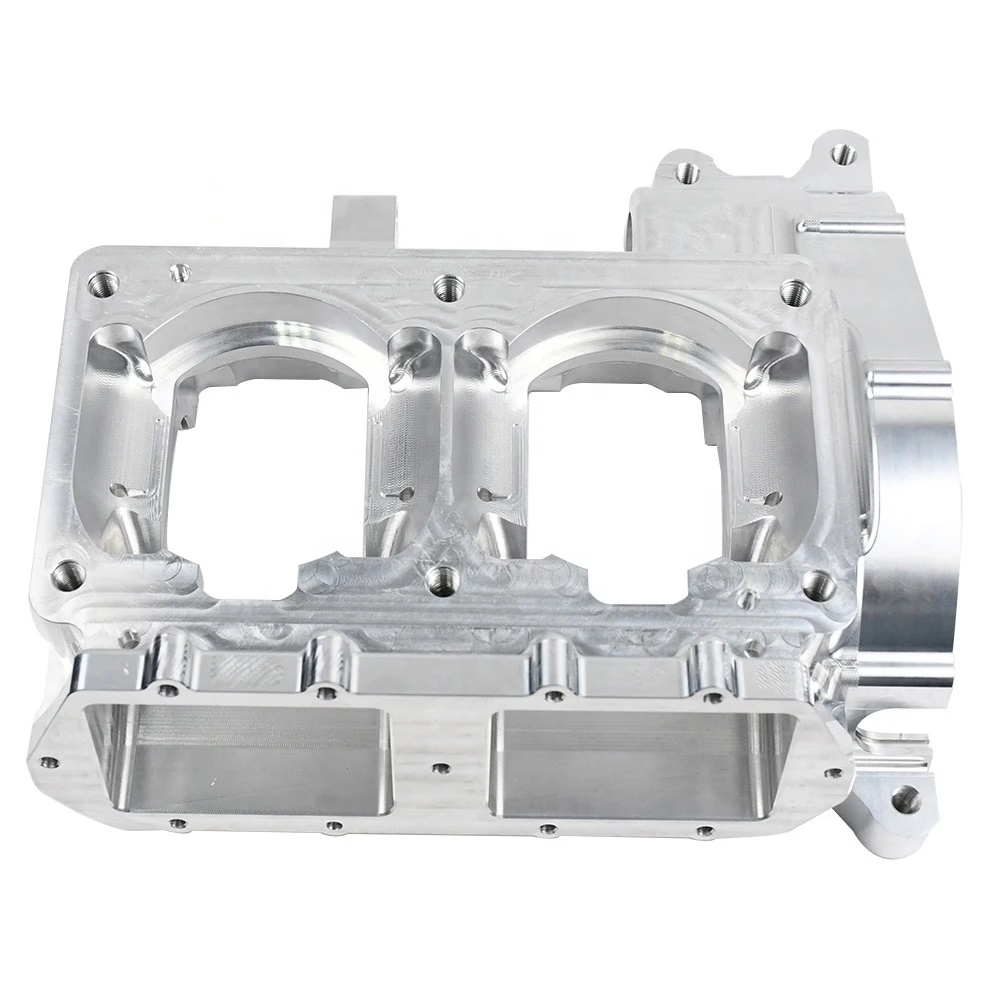
What CNC tour treatment technology actually changes
Every cutting tool and every guideway is a system of three layers: the substrate, the geometry, and the surface. CNC tour treatment technology works on the last two. The substrate decides how much heat and load the part can carry. The treatment decides how long the surface keeps its shape once chips start flowing.
Two mechanisms matter. The first is hardness at the interface, which slows abrasive and adhesive wear. The second is chemical inertness, which stops workpiece material from welding to the rake face or the rail. A treatment that improves one and hurts the other is a bad trade, and that happens more often than people expect.
There is also a geometric side. A coating adds 2–8 μm to every surface, so a sharp edge becomes slightly rounder. On a finishing cutter that matters; on a roughing cutter it usually does not. The treatment choice and the edge prep have to be decided together, not one after the other.
The practical question is never which treatment is best in the abstract. It is which treatment keeps the part inside tolerance for the whole run at the lowest cost per part. That answer changes with material, hardness, coolant, and how rigid the machine is.
- 1HardnessResists abrasive wear from hard inclusions and scale
- 2InertnessReduces built-up edge and adhesive wear
- 3Thickness2–8 μm of coating changes effective edge radius
- 4Heat resistanceDecides the safe cutting speed ceiling
PVD, CVD, and nitriding compared
PVD covers the coating family deposited at 400–500 °C in a vacuum. Because the temperature stays below the tempering range of most tool steels, the substrate keeps its bulk hardness. TiN, TiAlN, AlTiN, CrN and DLC are all PVD. The layers are thin, usually 2–5 μm, and the process leaves the edge sharp. That is why PVD dominates solid carbide end mills and drills.
CVD runs hotter, roughly 900–1,000 °C, and produces thicker layers of 5–20 μm. The higher temperature allows very hard grades such as TiCN and alpha-alumina, which hold up in continuous turning of cast iron and steel. The cost is thermal load: substrates must be selected for it, and sharp edges suffer. CVD is a turning-insert process more than an end-mill process.
Nitriding is not a coating. It diffuses nitrogen into the surface of a steel part and forms a hard case, typically 0.1–0.6 mm deep, with a surface hardness around 700–1,100 HV. There is no sharp interface to flake off, which makes it useful on guideways, ballscrews and mold components where a bonded layer would spall under point loads.
Cryogenic treatment is a different lever again. Soaking a tool or a steel part at −185 °C or below, then tempering, converts retained austenite toward martensite and promotes fine carbide precipitation. The gain is usually modest dimensional stability and wear resistance, not a step change in hardness.
- 1PVD400–500 °C, 2–5 μm, keeps edge sharp
- 2CVD900–1,000 °C, 5–20 μm, very hard, dulls edges
- 3NitridingDiffused case 0.1–0.6 mm, no delamination
- 4Cryogenic−185 °C soak, stability more than hardness
Matching the treatment to the workpiece
Aluminium is a soft, sticky material. It does not need high hot hardness; it needs a surface that aluminium will not weld to. CrN and DLC work well here, and polished flutes matter as much as the coating. A hard AlTiN layer on a polished aluminium cutter is money spent on the wrong property, and it can even promote adhesion.
Steels and stainless steels run hotter at the edge. AlTiN and TiAlN keep hardness up to roughly 800–900 °C, which is why they are the default on 4140, 4340 and 17-4PH. Titanium and Inconel are worse: heat stays in the cut, and edge temperatures climb fast. Uncoated carbide with a strong edge or AlTiN with a heavy edge prep both work, but light-coated sharp tools fail quickly.
Cast iron and hardened steel above 45 HRC push toward CVD grades and ceramic or CBN inserts. The abrasive carbide particles in cast iron chew through thin PVD layers. For hardened steel, the depth of cut is small and the load is concentrated, so the coating needs thickness and thermal stability more than sharpness.
Composites, graphite and plastics are a separate case. The wear mechanism is abrasion by hard fibres, not heat. DLC and diamond-like coatings help on carbon fibre; on unfilled plastics an uncoated polished tool often outlasts a coated one because the coating adds friction.
- 1AluminiumCrN or DLC, polished flutes, avoid thick hard layers
- 2Steel and stainlessAlTiN or TiAlN, hot hardness to 800–900 °C
- 3Titanium and InconelStrong edge, heavy prep, expect lower speeds
- 4Cast iron and hardened steelCVD or CBN, abrasion resistance first
Where treatments go wrong on the shop floor
Most treatment failures are not coating failures. They are preparation failures. A tool that goes into the chamber with residual grinding oil, a damaged micro-geometry, or a poorly polished rake face will show poor adhesion no matter which layer is deposited. Cleaning and edge prep are the expensive part of the process, and they are the part people try to skip.
Thickness control is the second trap. A 6 μm layer on a Ø3 mm end mill changes the effective edge radius enough to raise cutting forces and push the tool off size. On small-diameter tools, keep the layer at the low end of the range and check the first-off part against the drawing.
Nitriding has its own failure mode: distortion. The treatment runs at 500–560 °C, and thin or asymmetric parts can move. For long guideways and ballscrews, the part is usually stress-relieved before nitriding and ground after, so the case is removed from the functional surface and only the flanks keep it.
Cryogenic treatment is often oversold. It can improve dimensional stability in tool steels and reduce retained austenite, which helps gage blocks and some molds. It will not turn a 60 HRC steel into a 65 HRC steel, and it will not rescue a bad heat treat cycle.
- 1Clean firstResidual oil and oxides kill adhesion
- 2Control thicknessSmall cutters need the low end of the range
- 3Grind after nitridingRemoves distortion from the functional surface
- 4Do not oversell cryoStability gain, not a hardness jump
How to verify a treatment actually worked
Tool life tests are the only honest measure, and they need a fixed baseline. Run the same material, the same parameters, and the same machine. Record flank wear every few minutes until the wear land reaches the rejection limit, usually 0.2–0.3 mm for a turning insert or 0.1 mm for a finishing end mill.
Coating thickness can be checked non-destructively by X-ray fluorescence on most PVD layers, and destructively by calotte grinding. Case depth on a nitrided part is measured on a cross-section with a microhardness traverse, typically reporting the depth to 550 HV. Ask for the traverse chart, not just a number.
Adhesion is worth a check on any new supplier. A Rockwell indentation test or a scratch test shows whether the layer flakes at the interface. On a production tool, a simple visual check of the wear pattern after the first hour tells you a lot: uniform flank wear is good, chipping and built-up edge are not.
Finally, tie the result back to cost. A tool that costs twice as much but runs three times as long is a good deal only if the machine time saved is worth more than the tooling spend. On a 5-axis cell running unattended, tool changes cost more than the insert, so longer life wins even at a higher price.
- 1Flank wear limit0.2–0.3 mm insert, 0.1 mm finish end mill
- 2Layer thicknessXRF non-destructive, calotte grinding destructive
- 3Case depthMicrohardness traverse to 550 HV
- 4Cost per partCompare tooling spend against machine time saved
CNC tour treatment technology: treatment vs. job
Pick the row that matches your workpiece family, then confirm the edge prep with the tool supplier.
| Workpiece | Treatment | Typical layer or case | Watch out for |
|---|---|---|---|
| Aluminium 6061, 7075 | CrN or DLC (PVD) | 2–4 μm | Thick hard layers promote sticking |
| Mild and alloy steel | AlTiN or TiAlN (PVD) | 3–5 μm | Edge rounding on small cutters |
| Stainless 304, 17-4PH | AlTiN with heavy prep | 3–5 μm | Work hardening, built-up edge |
| Titanium and Inconel | AlTiN, strong edge | 3–5 μm | Heat stays in the cut, low speeds |
| Cast iron | CVD TiCN + alumina | 5–20 μm | Thin PVD layers wear through fast |
| Hardened steel >45 HRC | CVD or CBN insert | 5–20 μm | Chipping if the setup is not rigid |
| Guideways and ballscrews | Nitriding | 0.1–0.6 mm case | Distortion if the part is thin |
| Carbon fibre composite | DLC, polished | 2–4 μm | Abrasion by hard fibres, dust control |
The trade-off in one line
If the edge must stay sharp on a small cutter, choose PVD; if the insert faces abrasive cast iron or hardened steel and sharpness is secondary, choose CVD. For guideways and large steel components where a bonded layer could spall, choose nitriding instead of a coating.
Common questions about CNC tour treatment technology
Can I coat a tool that was already coated once?
Yes, but the old layer must be stripped first, usually by chemical etching or abrasive blasting. Re-coating over a worn layer traps contamination at the interface and adhesion drops. Many shops strip and recoat indexable inserts two or three times before scrapping them.
Stripping removes a small amount of substrate each cycle, so measure the critical dimensions before deciding to recoat rather than replace.
Does a thicker coating always last longer?
No. Thicker layers carry more internal stress and are more likely to chip at the edge, especially on interrupted cuts. On small-diameter tools the added thickness also rounds the edge and raises cutting forces.
For most PVD end mills, 3–5 μm is the useful range. Going beyond that usually trades edge integrity for wear resistance you did not need.
Is nitriding a replacement for coating?
No, they solve different problems. Nitriding hardens the bulk surface of a steel part to a depth of 0.1–0.6 mm, which suits guideways, ballscrews and mold plates. It does not give the low-friction, chemically inert top layer that a coating gives a cutting edge.
Some parts use both: nitriding for the case, then a PVD layer on top. That combination is common on forming tools and some extrusion dies.
Why did my coated tool fail after ten minutes?
Check the preparation first, not the coating. Contamination, a damaged edge, or the wrong edge prep account for most early failures. Then check the cutting data: too high a surface speed for the coating grade, no coolant where coolant is needed, or a setup that vibrates.
A single trial cut with a known-good tool on the same machine separates a tooling problem from a process problem in about half an hour.
Does treatment change the tolerance I can hold?
It can, through edge geometry. A coated tool cuts a slightly different effective radius than an uncoated one, which shows up on tight-tolerance bores and slots. On a Ø6 mm cutter with a 5 μm layer, the change is measurable.
Run a first-off part and check it against the drawing before committing the program to a full run. For parts held to ±0.005 mm, that check is not optional.
What does cryogenic treatment actually do?
It soaks the part below −185 °C and then tempers it, which drives retained austenite toward martensite and precipitates fine carbides. The measurable gain is dimensional stability and a modest wear improvement in tool steels.
It does not raise bulk hardness much and it will not fix a part that was austenitized or tempered incorrectly. Treat it as a finishing step, not a repair step.
Send us the drawing and the workpiece material
We will review the tool path, the material, and the tolerance before quoting, and tell you where a treatment change would actually save you money. Quotation and free DFM analysis within 12 hours.
12-hour quote100% inspectionNo minimum order quantity
More machining notes from the shop floor
We publish setup notes, tooling trials and inspection data from the factory floor.











