
CNC Vertical Processing Service Guide
This guide is written for engineers and buyers who need to select a vertical machining supplier, not read a brochure. It covers spindle travel, tolerance, material, lead time, MOQ and paperwork so you can tell whether a shop fits your part before you send a drawing.
In this article
- 1
- 2
- 3
- 4
- 5
- 6
- 7
- 8
What matters most when you buy
Vertical machining center or horizontal: which fits your part
Read the row that matches your part shape, then check the travel and loading column.
| Part situation | Vertical (VMC) | Horizontal (HMC) |
|---|---|---|
| Part size in plan view | Up to 4,000 mm on long-travel machines | Better for heavy cubic parts |
| Part weight | Easier to load from above | Needs pallet or tombstone |
| Chip evacuation | Chips sit in pockets | Gravity clears chips well |
| Setup for 5 faces | Needs 4-axis or 5-axis table | Often done in one setup |
| Fixture cost | Lower for small batches | Higher, but amortized over volume |
| Best batch size | 1 to a few hundred | Hundreds to thousands |
| Typical parts | Plates, housings, brackets | Gearboxes, manifolds, valve bodies |
The short version
Pick a vertical machining supplier by envelope, tolerance method and paperwork first, and by unit price last. If the travel fits, the inspection plan is specific and the certificates match your industry, the quote is worth reviewing. If any of those three is vague, keep looking.
What a CNC vertical processing service actually includes
A vertical machining center holds the spindle vertically, so the tool comes down onto a workpiece clamped on a horizontal table. The table moves in X and Y; the spindle or the head moves in Z. That geometry decides almost everything else about what the process can do well: open access from the top, simple clamping, and short tools that stay stiff at depth.
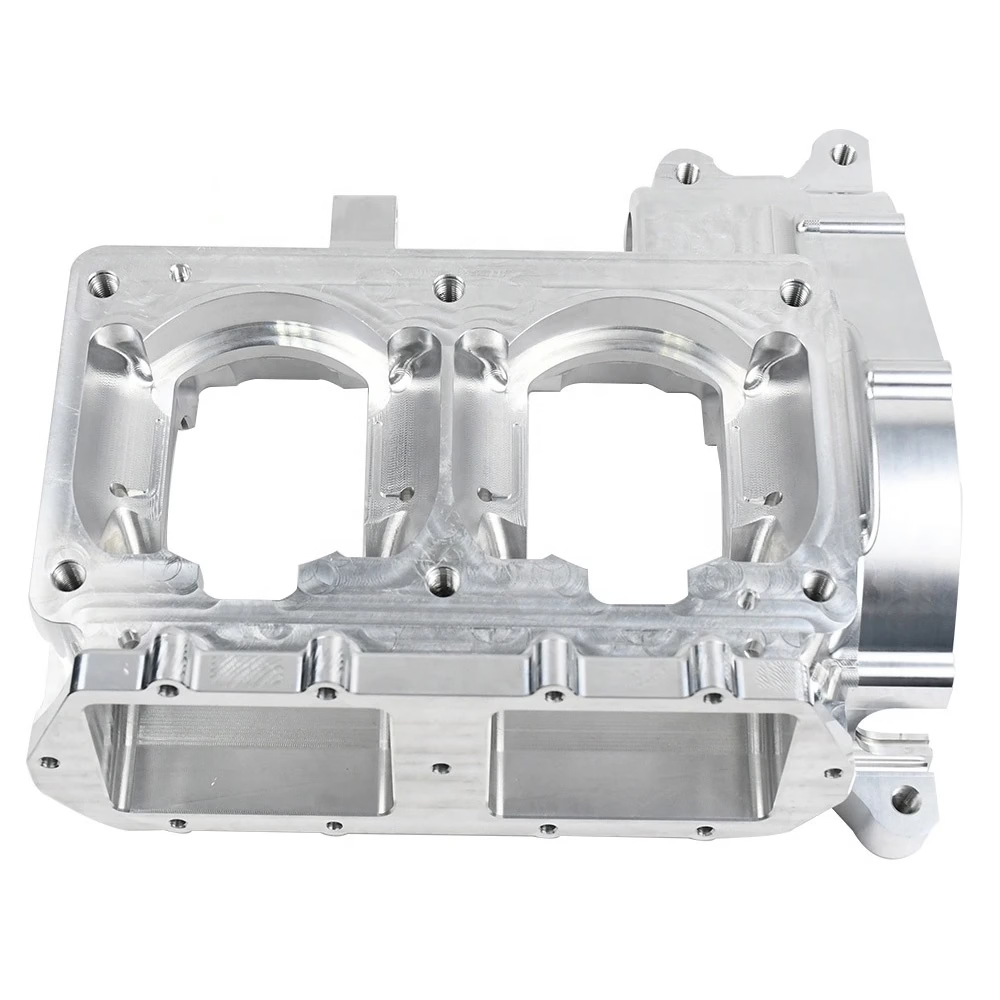
For buyers, a CNC vertical processing service is not just spindle time. It is fixturing, tool selection, in-process measurement, deburring and the paperwork that proves the parts match the drawing. A shop that quotes only machine hours is usually quoting a different scope than the one you asked for.
Vertical work covers milling, drilling, tapping, boring, reaming, face milling and slotting. With a fourth axis or a trunnion table, the same machine can reach four or five faces of a part without a second setup. That is why vertical centers are used for prismatic parts, plates, housings and brackets rather than long shafts, which belong on a lathe.
The limit is not the spindle direction. It is the ratio of part size to machine travel, and how much of the part is reachable without re-clamping. Every re-clamp adds a datum shift, and datum shifts are where tolerance disappears.
- 1Reachable facesThree axes cover one face; a fourth axis adds a rotating face, a fifth adds tilt.
- 2Best part familyFlat, boxy or plate-like parts with features on multiple faces.
- 3Weak fitVery long, slender parts that need support along the axis.
Travel, spindle and tooling: the specs you should ask for
Ask for the working envelope, not the machine model. At GreatLight, the largest travel is 4,000 × 400 × 150 mm, with medium machines at 750 × 1,150 × 550 mm and 600 × 600 × 600 mm, and compact machines at 500 × 500 × 450 mm and 500 × 310 × 200 mm. If your part plus fixture does not fit inside one of those boxes, the machine cannot make it in one setup.
Spindle speed and taper decide the finish and the tool life on hard materials. A 40-taper spindle with a CAT or HSK holder handles most steel and stainless work. Small cutters below 3 mm need higher RPM and low runout, or they break and leave witness marks.
Tooling also sets the smallest internal corner. A Ø6 mm end mill cannot leave a sharper corner than its radius. If the drawing calls for a 2 mm internal radius in a deep pocket, the shop needs a long, thin tool, and that means lower feed and more chatter risk.
Fixtures matter as much as the machine. Soft jaws, vacuum plates, magnetic chucks and custom vises all change how much of the part is exposed to the cutter. Ask how the shop plans to hold your part before you accept the quote.
- 1Envelope firstPart plus fixture must fit the travel in all three axes.
- 2Corner radiusThe tool diameter limits the smallest internal corner you can get.
- 3Holding methodClamping choice decides vibration, access and cycle time.
Materials and finishes you can request
Vertical machining covers most metals and engineering plastics. On the metal side, the common grades are aluminium 6061, 6061-T6, 2024, 5052, 5083, 6063, 6082, 7075 and ADC12; stainless 303, 304, 316, 316L, 420, 430, 431, 440C and 17-4PH (SUS630); steel 1018, 1045, 4130, 4140, 4340, A36 and tool steel; and copper alloys such as C101, C103, C110, beryllium copper, C27400, C28000 and C36000.
Titanium and nickel alloys are also machinable: TA1, TA2, TC4 (Ti-6Al-4V), Inconel, and magnesium AZ31B or AZ91D. These grades cut slowly, generate heat and wear tools, so expect longer cycle times and a different surface finish than aluminium. Plastics such as ABS, PC, PMMA, POM, PA, PEEK, PP, HDPE and carbon fibre need sharp tooling and controlled feeds to avoid melting or fraying.
Finishing is usually a separate step. Anodizing comes in clear, colour, hardcoat and conductive types. Electroless nickel, zinc, silver and gold plating are available, along with powder coating and black oxide. Bead blasting, tumbling, brushing and polishing change the surface texture, and laser marking or engraving can add part numbers or logos down to a minimum character height of 1.5 mm.
One practical note: the finish you choose can change the dimensions. Hardcoat anodizing builds a layer that shifts tight fits, and plating adds thickness on threads unless the shop masks them. Tell the shop which surfaces are critical before finishing is quoted.
- 1AluminiumFast to cut, good for prototypes and housings.
- 2Stainless and steelSlower feeds, but strong and wear resistant.
- 3Titanium and InconelHigh heat and tool wear; plan longer lead time.
- 4Plating and anodizingCan shift dimensions on tight fits.
How to judge a vertical machining supplier
Start with the tolerance claim and the inspection method behind it. A shop quoting ±0.005 mm should be able to say what it measures with, how often it checks, and what happens when a feature drifts. At GreatLight, inspection runs on raw material check, in-process monitoring and final inspection, with 100% inspection before shipment and reports on request.
Next, look at capacity in the right unit. Machine count alone means little. What matters is how many machines can hold your part size and how many shifts run them. GreatLight operates 127 high-precision CNC machines across 3 wholly-owned plants covering 7,600 m², with 150 technicians, 16 simultaneous 5-axis centers, 12 four-axis mills, 27 three-axis machines and 16 mill-turn centers.
Then check the commercial terms. A shop with no minimum order quantity has to be organized for mixed small and large runs, from one prototype to 10,000+ parts. That usually shows up in how fast it returns a quote and whether it offers DFM feedback before cutting metal.
Finally, look at the certificates that match your industry: ISO 9001:2015 for general quality, IATF 16949:2016 for automotive, ISO 13485:2016 for medical devices and ISO 27001:2022 for information security. A certificate does not make parts accurate, but a missing one can stop your purchase order before it starts.
- 1Tolerance plus methodAsk how the dimension is measured, not only what value is promised.
- 2Capacity in your size classA 4,000 mm machine is useless if your part is 20 mm.
- 3Quote speedQuotation and free DFM analysis within 12 hours is a workable benchmark.
Lead time, MOQ and the hidden costs in a quote
Lead time has three parts: quoting, production start and shipping. At GreatLight, quotation and free DFM analysis come back within 12 hours, production can start within 24 hours, and parts ship in 3–5 days. Historical late-delivery probability is below 2%. Treat those as planning numbers, not promises, and confirm them against your own schedule.
MOQ is where small buyers get squeezed. Tooling, fixtures and first-article inspection cost the same whether you order one part or one thousand. A supplier with no minimum order quantity has already absorbed that in its workflow. If a shop demands a high MOQ for a prototype, it is telling you it is set up for volume, not for development.
Watch for costs that appear after the quote: custom fixtures, first-article inspection reports, material certifications, surface finishing, masking for plating and freight. Ask whether each item is included or billed separately. The lowest unit price is often not the lowest landed cost.
Material choice moves lead time more than machine speed. A 7075 or 17-4PH part may need a material order; a 6061 part is often on the shelf. If your schedule is tight, ask which grades are stocked before you finalize the design.
- 1Three-part lead timeQuote, production start, shipping. Ask for all three.
- 2MOQ signalNo MOQ means the shop is built for mixed runs.
- 3Post-quote extrasFixtures, reports, masking and freight are common add-ons.
Step by step: how to qualify a vertical machining supplier
Run these steps in order. Skipping the first two is the most common reason a project fails after the PO is placed.
- 11. Check the envelope against your partAdd the fixture footprint to the part size, then compare with the quoted travel. A 4,000 × 400 × 150 mm machine will not hold a 500 mm tall housing.
- 22. Ask for the tolerance methodRequest the measurement instrument, the sampling plan and the report format. A claim of ±0.005 mm without a CMM or gauge plan is a marketing line.
- 33. Confirm the material grade and stockMatch the drawing to a stocked grade where possible. 6061-T6 and 304 are usually faster than 7075 or Inconel.
- 44. Review the fixture planAsk how the part will be held, how many setups are needed, and which faces are machined per setup. Fewer setups means fewer datum shifts.
- 55. Agree on inspection and reportsDecide which dimensions get first-article inspection and whether material certificates are needed. Ask for reports on request.
- 66. Settle finishing and maskingConfirm anodizing type, plating thickness and which threads or bores must stay bare.
- 77. Confirm commercial termsWrite down MOQ, quote validity, shipping terms and the NDA status before the first cut.
- 88. Run a small first orderStart with one or a few parts, measure them yourself, then scale. This exposes setup and communication problems early.
Questions buyers ask before placing an order
What is the difference between vertical and horizontal machining?
The spindle direction. A vertical machine points the tool down onto a table that moves in X and Y, so parts load from above and clamping is simple. A horizontal machine points the tool sideways, which clears chips faster and suits heavy cubic parts that need several faces in one setup.
For flat plates, brackets and small housings, vertical is usually cheaper and faster. For large gearbox or manifold parts in high volume, horizontal often wins on chip control and setup count.
How tight a tolerance can vertical machining hold?
GreatLight works to ±0.005 mm (±0.0002 in) on qualifying features. That value depends on the feature, the material and the fixture, so it is not automatic on every dimension.
Ask which features are critical and how they will be measured. Surface finish ranges from Ra 0.2–0.8 μm for fine work to Ra 1.6–3.2 μm as machined.
What is the minimum order quantity?
There is no minimum order quantity. Runs can start at one prototype and extend to 10,000+ parts.
Tooling and inspection cost the same at either end, so unit price drops as volume rises. The trade-off is that prototype work usually needs more engineering attention per part.
Which materials are available?
Aluminium, stainless steel, carbon and alloy steel, copper alloys, titanium, Inconel, magnesium and engineering plastics are all machined. Common grades include 6061-T6, 304, 316L, 4140, 17-4PH, TC4 (Ti-6Al-4V), POM and PEEK.
If your drawing calls for an unusual grade, say so at the quote stage. It affects both price and lead time.
How fast can parts ship?
Quotation and free DFM analysis come back within 12 hours, production can start within 24 hours, and parts ship in 3–5 days. Historical late-delivery probability is below 2%.
These are planning figures. Confirm them against your own schedule when you request the quote.
How is confidentiality handled?
Uploads are secure and confidential, and an NDA is available on request. GreatLight holds ISO 27001:2022 for information security alongside ISO 9001:2015, IATF 16949:2016 and ISO 13485:2016.
If your drawings are export-controlled or under customer NDA, tell the shop before sending files.
Send your drawing, get a quote and DFM feedback in 12 hours
Upload the 3D model or 2D drawing and tell us which features are critical. We review the envelope, the fixtures and the tolerance plan, then come back with a quote, a lead time and any manufacturability notes.
Quote in 12 hours100% inspectionNo MOQNDA on request
More machining notes from the shop floor
We publish setup notes, tooling trials and inspection data from the factory floor.











