
CNC vs Manual Machining: Which One Fits Your Part
This page compares cnc vs manual machining on the factors that actually decide the job: tolerance, lot size, setup time, geometry and cost per part. Read it if you are choosing a process for a drawing, a repair or a short run, and you want the reasoning rather than a slogan.
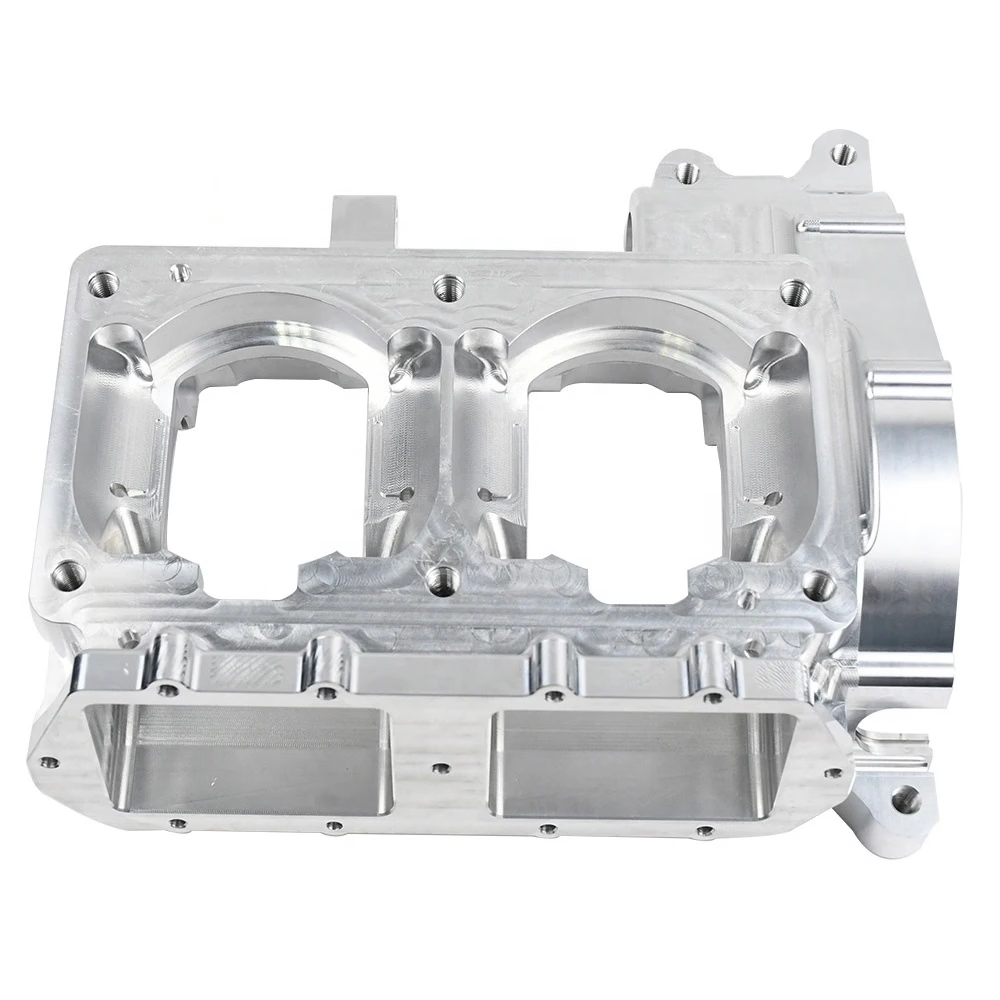
CNC vs Manual Machining at a Glance
Figures below are typical shop ranges, not a quote.
| Factor | Manual | CNC |
|---|---|---|
| Achievable tolerance | ±0.05 mm with skill | ±0.005 mm repeatable |
| Best lot size | 1–20 parts | 5 to 10,000+ parts |
| Setup time | Minutes, hand-set | Minutes to hours, programmed |
| Cost per part | High on repeats | Drops sharply with volume |
| Complex 3D geometry | Very limited | Standard on 5-axis |
| Change after first part | Fast, no code change | Fast once program is live |
| Operator attention | Continuous | One operator, several machines |
| Surface finish | Ra 1.6–3.2 μm typical | Ra 0.2–1.6 μm achievable |
| Best fit | Repair, jig, one-off | Production, complex, tight tolerance |
Where Manual Machining Still Wins
Manual machining means the operator turns the handwheels and feeds the tool by feel. That feel is the whole point. A machinist can hear a chatter start, back off the feed and save a part that a programmed cycle would have scrapped. For one-off work, that judgment is worth more than any code.
The economics are simple. If you need one fixture plate, one repair part or a prototype that will change three times before lunch, manual is often faster. There is no CAM session, no toolpath verification and no fixture design. The machinist dials in the position, cuts, measures and adjusts.
Manual also handles shapes that are awkward to clamp for a VMC. A welded frame, a long shaft with an interrupted cut, a part that needs to be indicated in on the machine. Setup on a knee mill or a manual lathe can be improvised with shims and clamps in minutes.
The ceiling is repeatability. Two operators will not hit the same dimension twice. Fatigue over a shift shows up in the tolerance band, and any feature needing three interpolated axes at once is out of reach.
- 1Repair and reworkMatch an existing worn surface, often with no drawing.
- 2Tooling and jigsShop-made fixtures, soft jaws, drill bushings.
- 3One-off bracketsSingle plates where CAM time exceeds cutting time.
What CNC Changes Once You Commit to Code
Once a part is programmed, the machine repeats the same motion every cycle. That is where the tolerance holds. On our 5-axis centers we hold ±0.005 mm (±0.0002 in) on production runs, and the 100th part matches the first.
Setup is front-loaded. You pay for programming, fixture design and first-article inspection before the first good part. After that the cost per part falls fast. For a 5-part run the setup may dominate; for a 500-part run it almost disappears.
Complexity becomes cheap. A pocket with a blended fillet, a port with a compound angle, a part with 40 drilled holes on four faces. On a 5-axis machine those are one setup. Manually they would be four setups, four fixtures and four chances to lose position.
Consistency also matters for assembly. If ten parts go into one weldment, parts that vary by 0.1 mm will fight each other. CNC removes that argument from the build.
- 1RepeatabilitySame program, same result, shift after shift.
- 2Complex geometryUndercuts, compound angles, blended surfaces.
- 3Documented inspectionIn-process checks and first-article reports.
How to Decide: Five Questions on the Drawing
Start with the tolerance callout. If the tightest dimension is looser than ±0.05 mm and the feature is a simple bore or face, manual can do it. If the drawing calls ±0.01 mm or tighter, or if a tolerance is tied to a datum across several features, run it on CNC.
Then count the parts. Under about five pieces, setup dominates and manual is competitive. From roughly twenty pieces upward, CNC wins on cost per part almost every time. Between five and twenty it depends on how complex the part is.
Look at the geometry. Any feature needing simultaneous motion on more than two axes, a deep cavity with a small radius, or a surface that has to blend smoothly, points to CNC. Manual machines do straight lines and single-radius forms well.
Finally, ask what happens when the part changes. In a design loop, manual lets you cut, measure, tweak the drawing and cut again the same day. On a frozen design headed for production, CNC plus a saved program is the cheaper path.
- 1ToleranceTighter than ±0.01 mm across features: CNC.
- 2Lot sizeOne to five parts: check manual first.
- 3GeometryThree-axis interpolation or blending: CNC.
Setup Cost, Lead Time and What You Actually Pay For
The line item people miss is setup. Manual setup is minutes of hand work. CNC setup is programming, workholding and a first article, which is why a CNC shop quotes more for part number one and much less for part number five hundred.
Fixture cost follows the same curve. A simple vise job needs almost nothing. A part with a curved datum face may need a soft jaw or a custom nest, and that cost is spread over the run. On low volume, that spread hurts. On high volume, it is trivial.
Lead time behaves differently. Our quotation and DFM analysis come back within 12 hours, production can start within 24 hours, and parts ship in 3–5 days. A manual job can start the same hour if a machinist is free, but it cannot scale past one pair of hands.
Material matters too. Titanium, Inconel and 17-4PH cut slowly and work-harden, so tool load and coolant have to be controlled. That is easier to hold on a CNC with a fixed feed and speed than by hand.
- 1Low volumeSetup dominates; manual is often cheaper.
- 2Mid volumeCompare fixture cost against cycle time.
- 3High volumeCNC cost per part keeps falling.
Where the Two Processes Meet in One Shop
Most real jobs are not pure. A CNC shop still keeps manual lathes and mills for prepping stock, cutting soft jaws, deburring and making the fixtures that the CNC machines run on. Manual work feeds the automated side.
The reverse also happens. A repair job may be roughed by hand to match a worn surface, then finished on a CNC to hit the drawing dimension. The machinist decides which half of the job goes where.
For a buyer, that means the question is rarely which process is better in general. It is which process holds the tolerance and the cost on this drawing, at this quantity, with this deadline. A shop that runs both can answer that honestly.
At GreatLight we run 127 high-precision CNC machines across 3 plants, including 16 simultaneous 5-axis centers, plus manual support for fixture and prep work. From one prototype to 10,000+ parts, with no minimum order quantity.
So the answer is not a winner. It is a handoff. Manual proves the idea and builds the fixture. CNC repeats it at tolerance. Choose by the tolerance and the quantity on your drawing, and let the shop tell you where the handoff sits.
- 1Pre-machiningSaw, face and square stock by hand or on a manual mill.
- 2Soft jaws and nestsManual workholding made to fit the CNC.
- 3Final finishingDeburr, polish and mark after the CNC cycle.
The Verdict
Choose manual for one to five simple parts, repairs and shop-made fixtures where setup time dominates. Choose CNC when the tolerance is ±0.01 mm or tighter, the lot is twenty pieces or more, or the geometry needs simultaneous multi-axis motion.
CNC vs Manual Machining: Common Questions
Can manual machining hold ±0.005 mm?
Not in production. A skilled machinist can hit a tight dimension once, with the part indicated in and the cut measured before the finish pass. Holding that across a run of parts is a different problem, because thermal growth, tool wear and operator fatigue all move the number.
For a single feature on a single part, it is worth trying. For a tolerance that has to hold on every piece, move the job to a CNC with a fixed cycle and in-process checks.
Is manual machining cheaper for prototypes?
Sometimes, and only for simple geometry. If the part is a plate with a few holes and a pocket, a manual mill can finish it before a CAM session would be done.
If the part has curved surfaces, tight tolerances or features on several faces, CNC is usually faster overall. The setup cost is real, but it is paid once, and the first article sets the baseline for every copy that follows.
What lot size makes CNC worth the setup?
As a rough line, twenty pieces. Below that, compare your quoted setup charge against the manual hourly rate for the same features. Above it, CNC cost per part drops quickly and usually wins.
The crossover moves with complexity. A simple turned bushing may cross over at fifty pieces. A five-axis bracket with compound angles crosses over much earlier, because manual cannot make it at all without multiple fixtures.
Can CNC machines do repair work?
Yes, if you can model the worn feature and locate the part on the machine. In practice many repairs mix both: rough out by hand to remove damage, then set up on a CNC to restore the dimension and surface finish.
The limit is fixturing. A repair part rarely has clean datum faces, so indicate-in time can exceed cutting time. That is a setup problem, not a process problem.
Which process gives a better surface finish?
CNC reaches Ra 0.2–0.8 μm with the right tool and stepover. Manual work typically lands around Ra 1.6–3.2 μm because the feed is controlled by hand.
If the drawing calls Ra 0.8 μm or finer, plan for CNC and possibly a finishing pass or a secondary operation such as tumbling or polishing.
Do I need a drawing to quote a manual job?
For a repair or a one-off, a photo with dimensions and a description of the worn area is often enough to start. The shop will confirm the critical features before cutting.
For anything repetitive, a 2D or 3D file is better. It removes the guesswork and lets the shop quote setup, material and cycle time separately so you can see where the cost sits.
Send the Drawing, Get a Process Recommendation
Upload your file and we will confirm tolerance, process and lead time. Quotation and free DFM analysis within 12 hours, NDA on request.
12-hour quote100% inspectionNo minimum order
More from the shop floor
We publish setup notes, tooling trials and inspection data from the factory floor.











