
Cost of CNC Machining Services for Custom Sculpture 2025
This guide is for artists, studio fabricators and brand teams comparing quotes for machined sculpture in 2025. It breaks the cost of CNC machining services into material, machine time, tolerance, finishing and inspection, then gives the checks that separate a fair quote from a cheap one that comes back as a rework.
In this article
- 1
- 2
- 3
- 4
- 5
- 6
- 7
- 8
What drives the number before you call a shop
How three supplier types price a sculptural part
Ranges are typical patterns, not fixed rates. Ask each shop to quote the same STEP file.
| Supplier type | What they charge for | Best fit | Watch out for |
|---|---|---|---|
| Art foundry with CNC | Pattern, mold, casting, chasing | Bronze editions over 5 pieces | CNC only cuts the pattern, not the surface |
| General machine shop | Machine hours plus material | Simple geometric forms, brackets, bases | No 5-axis reach on deep undercuts |
| 5-axis job shop | Setup, CAM time, machine hours | One-off organic forms, large panels | CAM time billed before a chip is cut |
| In-house studio | Machine lease, tooling, labor | Repeat work with known geometry | Fixturing skill is the real bottleneck |
| Prototype house | Speed premium on 3–5 day turns | Maquettes and approval models | Size limit near 500 mm on fast lines |
Buy the geometry, not the hourly rate
The cheapest quote is the one that names the machine, the setup count and the inspection method. If a shop cannot describe those three, the number is a guess.
Where the cost of CNC machining services actually sits
Every sculpture quote is five numbers added together: material, CAM programming, setup and fixturing, machine time, and finishing plus inspection. On a one-off piece, programming and fixturing often reach 30–40% of the total. On a run of twenty identical pieces, the same two lines drop below 10% because they are amortized across the batch.
Machine time is where buyers get surprised. A 5-axis toolpath on a curved surface runs the tool at a controlled stepover, so a 600 mm tall form can hold the machine for many hours. A flat relief of the same footprint may run in a fraction of that. Compare quotes on the same geometry and the same stock size, or the comparison means nothing.
The hourly rate on the invoice is not the whole story. A shop at a lower rate that programs conservatively and runs extra semi-finish passes can cost more than a shop that charges more per hour and finishes in fewer operations. Ask how many setups and how many tool changes the job needs.
- 1MaterialGrade, stock size and whether the block is cut from plate or near-net cast.
- 2CAM and setupOne-time cost. Spreads across the batch on repeat orders.
- 3Machine timeDriven by volume removed, surface area and tool reach.
- 4FinishingPolishing and coating priced by visible surface area.
Material choice changes the quote more than any other single decision
Aluminium 6061 and 7075 cut fast, hold detail and take anodizing well, so they are the cheapest path for a large outdoor or indoor form. Stainless 304 and 316 cut three to four times slower, and 316L work-hardens if the toolpath dwells, so a stainless sculpture can easily double or triple the machining line of the same shape in aluminium. Titanium, Inconel and beryllium copper sit further up again and are usually reserved for small, high-value features.
Plastics behave differently. POM and PMMA machine cleanly at high spindle speed but deflect under cutting force, so thin sections need support or a slower feed. PEEK holds dimension at temperature but costs many times more per kilogram. Carbon fibre cuts as a laminate and needs dust control, which some shops will not quote at all.
Stock form matters as much as grade. A near-net casting or a forged blank removes less material and cuts machine hours, but you pay for the blank and for a first-article check. For a single sculpture the plate is usually cheaper. For an edition of ten, a cast blank often wins.
- 1Watch hardness7075 and 17-4PH need different tooling and feeds than 6061.
- 2Watch grainCut from the wrong face and a long thin form will move after machining.
- 3Watch wall thicknessBelow about 1.5 mm in metal, chatter and distortion risk rises.
Geometry and size set the floor on machine hours
Deep cavities, undercuts and features on five faces push a part from a 3-axis job to a 5-axis job. That changes both the machine rate and the CAM time. A 5-axis tool can reach an undercut in one setup where a 3-axis machine needs three, so the trade is real: higher rate, fewer setups. Ask the shop which it plans and why.
Size interacts with reach. A 4,000 mm long form can be machined, but the tool hangs far from the spindle and deflects, so feeds drop and hours climb. On long thin forms, a mill-turn or a traveling-column machine is often the better route, and the quote should say so rather than assume a standard vertical.
Fine detail has a hidden cost. A feature narrower than the tool cannot be cut at all. A 1.5 mm wide groove needs a 1 mm or smaller cutter, which must run at reduced feed and depth of cut, so a small area of fine detail can consume more time than a large open surface.
Tolerance and surface finish are priced per feature, not per part
Tolerance is the most over-bought line on a sculpture quote. A public artwork that reads from ten meters does not need ±0.005 mm. That tolerance belongs on interfaces: a mounting plate, an interlocking joint, a bearing seat, a light fitting recess. Mark those features and let the rest of the surface run at a general tolerance.
Surface finish follows the same logic. As-machined at Ra 1.6–3.2 μm is fine under a painted or textured finish. Ra 0.8–1.6 μm is a good painted or anodized base. Ra 0.2–0.8 μm is a polished, visually reflective surface and is priced by area, because it often needs hand work after the machine stops.
One practical rule: every extra decimal place and every step finer in finish adds inspection time. If the shop inspects 100% of features to a tight callout, the inspection line grows. Specify tight only where a mating part or a visual seam demands it.
- 1General toleranceUse for sculptural mass and non-mating surfaces.
- 2Tight toleranceLimit to joints, mounts and any interlocking interface.
- 3Finish by areaPolish only the faces the viewer can see and touch.
How to check a shop quoting the cost of CNC machining services for custom sculpture 2025
Ask for the DFM report before the price. A shop that reviews the STEP file and flags thin walls, unreachable faces and tool-size conflicts is doing the work that prevents a rework. GreatLight returns a quotation and a free DFM analysis within 12 hours, and production can start within 24 hours after approval.
Ask which machine and how many setups. The answer tells you whether the quote is real. A 5-axis shop with 16 simultaneous 5-axis centers and a Ø400 mm rotary table can hold an organic form in fewer setups than a 3-axis shop. Reach also matters: 4,000 × 400 × 150 mm travel covers long panels, while 750 × 1,150 × 550 mm and 600 × 600 × 600 mm cover most studio-scale figures.
Ask what is included in inspection. Raw material check, in-process monitoring and final inspection before shipment are the baseline. Reports should be available on request. A shop that quotes a tight tolerance but cannot describe its inspection method is quoting a number it cannot hold.
Ask about minimum order and confidentiality. A shop with no minimum order quantity can take one prototype or a 10,000+ part run. If the design is unreleased, an NDA should be available on request, and uploads should be handled as secure and confidential.
- 1CertificationsISO 9001:2015, IATF 16949:2016, ISO 13485:2016, ISO 27001:2022 cover quality, automotive, medical and information security.
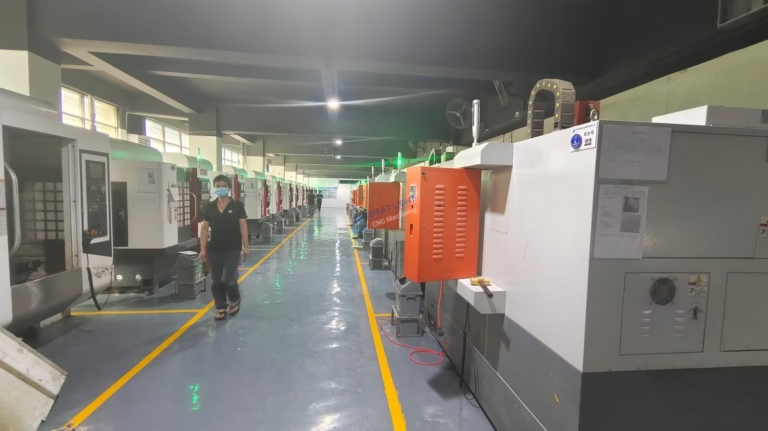
- 2Capacity127 high-precision CNC machines, including 16 five-axis, 12 four-axis, 27 three-axis and 16 mill-turn centers.
- 3Track record15 years, 3 wholly-owned plants, 7,600 m² and 150 technicians.
Seven steps to a quote you can compare
Run these in order. Skipping step 1 is the most common reason two quotes differ by 3×.
- 1Fix the deliverableDecide whether you are buying a machined master, a machined final piece or a pattern for casting. Each is a different quote.
- 2Send a clean STEP fileExport AP214, units in mm, no surfaces left unstitched. Add a PDF drawing for any tight interface.
- 3Mark tolerance zonesHighlight joints and mounts at ±0.005 mm and leave the sculptural surface at general tolerance. Do not tolerance the whole model.
- 4State the finish by faceList which faces are polished, which are bead blasted and which stay as-machined. Note any color anodizing or powder coat.
- 5Give the stock preferenceSay whether the shop may choose plate, bar or a cast blank. Letting the shop pick often lowers the price.
- 6Ask for setup countRequest the planned number of setups and the machine class. Compare that, not just the total.
- 7Confirm the batchOne-off, five or twenty. Ask how the price changes per piece so you can judge whether to edition the work.
Questions buyers ask before placing a sculpture order
Why do two shops quote very different totals for the same sculpture?
Most often they are quoting different scope. One includes CAM programming, fixturing and finishing; the other quotes machine time only and adds the rest later.
The second difference is machine class and setup count. A 5-axis job with two setups and a 3-axis job with five setups are not the same product, even from the same STEP file.
Do I need ±0.005 mm on a sculpture?
Usually no. Tight tolerance buys you fit and repeatability, not visual quality.
Specify it only on mounting plates, interlocking joints, bearing seats and light recesses. Those are the features where a mismatch shows up as a gap or a wobble.
What is the largest sculpture that can be machined in one setup?
Travel limits the answer. GreatLight runs up to 4,000 mm maximum processing size, with large travel at 4,000 × 400 × 150 mm and medium travel at 750 × 1,150 × 550 mm or 600 × 600 × 600 mm.
Beyond that, the form is split into sections and joined. Plan the seams into the design rather than letting the shop choose them.
How does the finish affect the total?
Finishing is priced by visible area and by how much hand work is needed. Bead blasting and brushing are quick. Polishing to a reflective surface on a curved, detailed form is slow.
Anodizing, plating, powder coating and black oxide add a separate process step and a handling risk, so they belong in the quote from the start, not added after machining.
Is there a minimum order quantity?
No. GreatLight takes work from one prototype to 10,000+ part runs. That matters for sculpture because many projects start as a single maquette before an edition is approved.
The per-piece price drops as setup and CAM are spread across the batch, so ask for a one-off, five-off and twenty-off price at the same time.
What lead time should I plan for?
Quotation and free DFM analysis come back within 12 hours, and production can start within 24 hours of approval. Parts typically ship in 3–5 days.
Add time for finishing and for any first-article approval on a large or complex form. Historical late-delivery probability is below 2%.
Send the STEP file and get a real number
Quotation and free DFM analysis within 12 hours. No minimum order quantity, uploads secure and confidential.
12-hour quote100% inspectionNo MOQNDA on request
More from the shop floor
We publish setup notes, tooling trials and inspection data from the factory floor.











