
How to Vet a CNC Processing Supplier in China
A working guide for engineers and sourcing teams comparing contract machinists in China. We show the seven checks that separate a shop that can hold ±0.005 mm from one that only quotes it, and the points where a low price quietly moves risk onto your project.
In this article
- 1
- 2
- 3
- 4
- 5
- 6
- 7
Key takeaways
Seven checks and what each answer tells you
Use this as a scoring sheet when you compare two or three shops.
| Check | What to ask | Good answer | Red flag |
|---|---|---|---|
| Tolerance | Which features hold ±0.005 mm? | Feature list plus inspection method | "All dimensions ±0.005 mm" |
| Machine mix | 5-axis, mill-turn, 3-axis counts | 16 / 16 / 27 machines | One machine type only |
| Size range | Largest part you machine | 4,000 mm maximum processing size | No stated envelope |
| MOQ | Minimum order quantity | No minimum order quantity | Large MOQ on prototypes |
| Certifications | Which standards are audited? | ISO 9001, IATF 16949, ISO 13485, ISO 27001 | "ISO certified" with no number |
| Quote package | What comes with the price? | Quote plus free DFM analysis | Price only, no notes |
| Delivery history | Late-delivery probability | Below 2% historically | No data offered |
Tolerance claims and machine mix
Every supplier page says the same thing about accuracy. The useful question is narrower: which features on your part need ±0.005 mm, and how will the shop verify them? A bore position, a flatness callout and a shaft diameter are three different problems. A shop that answers with a feature list and an inspection method has thought about your part. A shop that answers "all dimensions" has not.
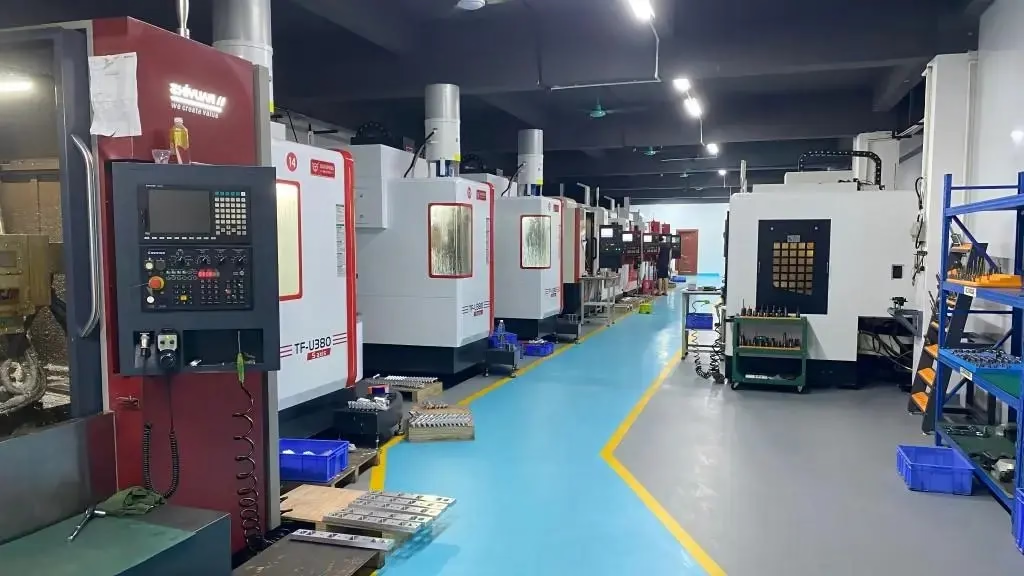
Tolerance also depends on the machine doing the work. A three-axis machine reaches tight geometry by repositioning the part across setups, and each setup adds stack-up. A simultaneous five-axis center holds the tool at an angle and finishes the feature in one setup, which removes that error source. GreatLight runs 16 simultaneous 5-axis machining centers, 12 four-axis mills, 16 mill-turn centers and 27 three-axis machines across 127 high-precision CNC machines.
The mix matters more than the total. A shop with 50 three-axis machines and no mill-turn center cannot turn and mill a shaft in one setup, so it will either move the part between machines or send it out. Ask which machine family your part will run on, and ask who owns the program.
Size is the other half of the machine question. Our largest travel is 4,000 × 400 × 150 mm, with medium envelopes at 750 × 1,150 × 550 mm and 600 × 600 × 600 mm, and compact envelopes at 500 × 500 × 450 mm and 500 × 310 × 200 mm. If your part sits near the edge of an envelope, ask how the shop will hold it.
- 1Feature, not blanketMatch each tolerance callout to a process and an inspection method.
- 2One setup winsFive-axis or mill-turn removes repositioning error on complex parts.
- 3Envelope checkConfirm travel before you release a drawing with a long part.
Order size, materials and finishing under one roof
Minimum order quantity is where prototype projects die. Some shops quote a good unit price and then add an MOQ of 500 pieces, which turns a design check into a purchase order. We run no minimum order quantity, from one prototype to 10,000+ part runs. That is a statement about setup, not generosity: a single-part job is priced around the setup and programming hours, and you should expect to see that in the quote breakdown.
Material availability is the next constraint. Common grades are rarely a problem. The list we keep in stock or source quickly covers aluminium 6061, 6061-T6, 2024, 5052, 5083, 6063, 6082, 7075 and ADC12; stainless 303, 304, 316, 316L, 420, 430, 431, 440C and 17-4PH (SUS630); steel 1018, 1045, 4130, 4140, 4340, A36 and tool steel; copper and brass C101, C103, C110, beryllium copper, C27400, C28000 and C36000; titanium TA1, TA2 and TC4 (Ti-6Al-4V); Inconel; magnesium AZ31B and AZ91D; plus plastics including ABS, PC, PMMA, POM, PA, PEEK, PP, HDPE and carbon fibre.
Exotic grades are where lead time moves. Inconel and Ti-6Al-4V cut slowly, wear tools faster and often need a stress-relief step between roughing and finishing. If a supplier quotes the same lead time for 7075 aluminium and Inconel, the quote was probably built from the aluminium job.
Finishing is the last item on this check. Anodizing in clear, colour, hardcoat and conductive variants, electroless nickel, zinc, silver and gold plating, powder coating, black oxide, bead blasting, tumbling, brushing and polishing are all standard. Laser marking holds a minimum character height of 1.5 mm. Keeping finishing in-house or in a controlled partner network protects the surface you paid for.
- 1No MOQOne prototype through 10,000+ part runs, priced on setup plus cycle time.
- 2Exotic grades cost timeTitanium and Inconel need slower speeds and often a stress-relief step.
- 3Finish spec earlyAnodize type and masking notes change the price more than the colour does.
Certifications, inspection and what the quote includes
Certification is a filter, not a score. ISO 9001:2015 tells you the shop runs a documented quality system. IATF 16949:2016 adds automotive process discipline, and ISO 13485:2016 adds medical device traceability. ISO 27001:2022 covers information security, which matters when you send CAD files and drawings to an overseas supplier. GreatLight holds all four. Ask for the certificate number and the scope, because a certificate for a trading office does not cover a machine shop.
Inspection is the part of the system that touches your parts. We inspect 100% of parts before shipment, with raw material checks, in-process monitoring and a final inspection, and we provide reports on request. For a first article, ask what the report contains: dimensions only, or dimensions plus material certificate and finish thickness. That difference decides whether you can close your own quality file without a second round of measurements.
The quote itself is a document you can read. A usable quote names the material grade, the machine family, the finish, the inspection level and the assumptions behind the price. If a feature is quoted as machined but your drawing calls Ra 0.8–1.6 μm, the gap shows up at first article. Our quotation and free DFM analysis come back within 12 hours, and production can start within 24 hours of approval.
Confidentiality belongs in this check too. Uploads are secure and confidential, and we sign an NDA on request. If your drawings are controlled, settle that before you send files, not after.
- 1Four certificates, one scope checkISO 9001, IATF 16949, ISO 13485, ISO 27001.
- 2Ask what the report holdsDimensions, material cert and finish thickness are three different documents.
- 3Read the assumptionsFinish, inspection level and setup count are where quotes diverge.
Lead time, delivery risk and the cost of a low price
Lead time is quoted in stages, and each stage can slip. Our numbers are: quotation and free DFM analysis within 12 hours, production start within 24 hours, and parts shipping in 3–5 days. Historical late-delivery probability is below 2%. Those figures describe our shop, not the industry, so treat them as a benchmark and ask every supplier for the same three numbers.
The reason to ask is that a low unit price usually hides a step. The shop may skip a stress-relief pass, machine a tight bore with a worn tool, or outsource the anodizing to the cheapest line in the area. None of that appears on the invoice until the parts fail incoming inspection or a customer finds a coating defect six months later.
A better comparison is total cost per accepted part. Add the setup, the inspection reports, the finishing, the freight and the probability of a rework loop. On a 50-piece run of a complex aluminium housing, a shop that machines it in two setups instead of five often wins even at a higher hourly rate, because the second setup is where the scrap lives.
One more point on scale. A supplier that handles one prototype is not automatically a supplier that handles a 10,000-piece production run, and the reverse is also true. Ask how the shop plans the transition from first article to repeat orders, and who signs the first article report.
- 1Three numbersQuote time, production start, ship time. Ask all three.
- 2Total cost per accepted partInclude setup, reports, finishing, freight and rework risk.
- 3Plan the rampFirst article approval and repeat-order control should be one process.
Step by step: vetting a supplier in one week
- 1Step 1 — Send one representative partPick the part with the tightest tolerance and the most setups, not the easiest one. Send the 3D model plus a 2D drawing with GD&T, material grade and finish callout.
- 2Step 2 — Time the responseNote when the quotation and DFM notes arrive. Under 12 hours is a good sign. A week with no technical questions usually means the price was guessed.
- 3Step 3 — Read the DFM notesLook for setup reduction, suggested tolerance loosening, tool access warnings and thin-wall risks. Free DFM analysis should change something in your design or your price.
- 4Step 4 — Ask for the process planWhich machine, how many setups, which features hold ±0.005 mm, what inspection method. Compare plans across suppliers, not just prices.
- 5Step 5 — Check certificates and scopeRequest ISO 9001:2015, IATF 16949:2016, ISO 13485:2016 or ISO 27001:2022 certificates as your industry requires, and confirm the scope covers the plant.
- 6Step 6 — Place a small paid order firstNo minimum order quantity means you can buy one or two parts. Measure them yourself before you commit to a production run.
- 7Step 7 — Compare total cost per accepted partAdd setup, finishing, inspection reports and freight. A cheaper unit price with a rework loop is not cheaper.
Questions buyers ask before the first order
Can a supplier in China really hold ±0.005 mm?
Yes, on the right feature with the right machine and setup. A ground or bored diameter on a rigid part is different from a thin-wall pocket in a long aluminium housing. Ask which features the shop will hold that tolerance on and how it will measure them.
Temperature, fixturing and tool wear all move the result. A shop that says yes to everything is telling you it did not read the drawing.
What does no minimum order quantity actually mean?
It means you can order one part. The price will be dominated by programming, setup and inspection, so the unit cost looks high next to a 1,000-piece quote. That is normal and it is the cheapest way to verify a supplier before a production run.
Production runs of 10,000+ parts are priced on cycle time and material, and the setup is spread across the batch.
Which certifications should I ask for?
Start with ISO 9001:2015 for a documented quality system. Add IATF 16949:2016 for automotive and EV parts, ISO 13485:2016 for medical devices, and ISO 27001:2022 if your drawings are controlled or your customer audits your supply chain.
Ask for the certificate number and the scope. A certificate held by a sales office does not cover the machine shop.
How do I compare quotes from different suppliers?
Normalize first. Require the same material grade, finish, inspection level and quantity from each shop. Then compare total cost per accepted part, including setup, reports, finishing and freight.
A quote that lists assumptions is easier to compare than one that only lists a price, because you can see what changes if the quantity or finish moves.
What finishes are available, and does the choice affect tolerance?
Anodizing in clear, colour, hardcoat and conductive variants, electroless nickel, zinc, silver and gold plating, powder coating, black oxide, bead blasting, tumbling, brushing and polishing are all standard. Laser marking has a minimum character height of 1.5 mm.
Coating adds thickness. If a plated shaft has a tight diameter callout, state whether the tolerance applies before or after plating, otherwise the parts may measure oversize.
How do I protect our design files?
Uploads are secure and confidential, and we sign an NDA on request. Settle confidentiality before you send files, and keep the NDA on file with the project number.
If your customer requires supplier audits, tell us at the quoting stage so the documentation is prepared with the first article instead of afterwards.
Send one part and see how the answer reads
Upload a model and drawing, get a quotation and free DFM analysis within 12 hours, and compare the process plan against your current supplier.
12-hour quoteNo MOQ100% inspection before shipmentNDA on request
Follow our shop floor
We publish setup notes, tooling trials and inspection data from the factory floor.











