
Bulk 5 Axis CNC Services ODM: What to Check Before You Commit
This guide is for engineers and sourcing leads who are about to move a part from prototype into volume. It explains how bulk 5 axis cnc services odm actually differs from contract machining, and which questions separate a real engineering partner from a shop that only quotes a price per part.
In this article
- 1
- 2
- 3
- 4
- 5
- 6
- 7
- 8
Key takeaways
What separates a design-driven ODM partner from a contract shop
Use this table as a screening checklist when you compare suppliers for a bulk run.
| Check | Contract shop | Design-driven ODM partner | Why it matters |
|---|---|---|---|
| DFM feedback | Quotes the drawing as-is | Returns marked-up CAD in 12 hours | Catches tool-access problems before tooling |
| Setup strategy | Three-axis, many setups | Five-axis, one or two setups | Fewer setups means tighter positional accuracy |
| Fixture ownership | Charges for every fixture | Designs reusable modular fixtures | Amortized fixture cost across the run |
| Inspection | AQL sampling | 100% inspection before shipment | One bad cavity is a full batch recall |
| Certifications | ISO 9001 only | ISO 9001, IATF 16949, ISO 13485, ISO 27001 | Each certificate opens a different market |
| Order size | Minimum lot charges | From one prototype to 10,000+ parts | Lets you validate before volume spend |
| Quote scope | Per-part price only | Price plus tooling, finish and inspection | Hidden costs appear after award |
| Confidentiality | Verbal promise | NDA on request, secure uploads | Protects your design before it ships |
Pick the partner who reads your CAD before quoting
If the DFM notes are specific and the quote is broken into four lines, the supplier is worth a first article. If the reply is a single price per part, keep looking.
When bulk 5 axis cnc services odm makes sense, and when it does not
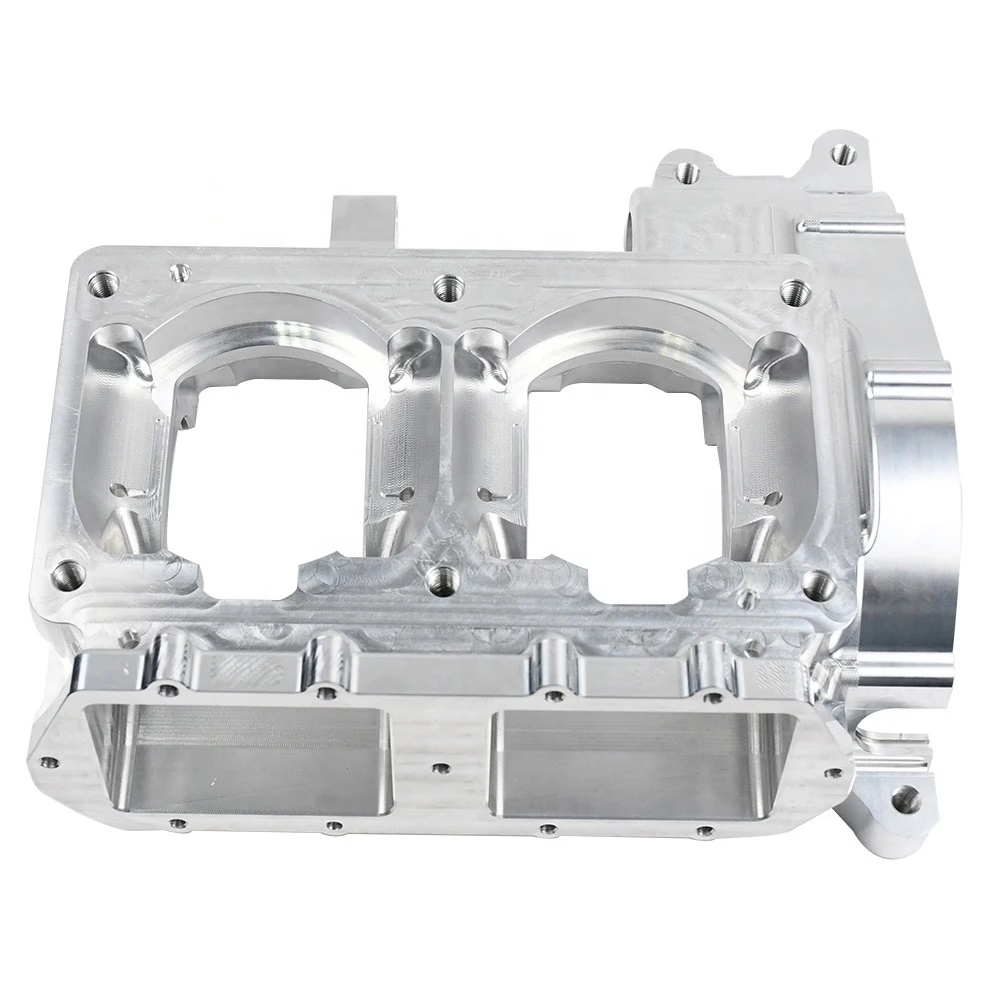
Five-axis machining pays off when a part has features on more than two faces, when positional tolerance between features is tight, or when the part is large enough that re-fixturing introduces error. A housing with angled ports, a bracket with compound angles, an impeller with twisted blades. Those are the shapes where one five-axis setup beats three three-axis operations.
It does not pay off for simple prismatic parts. A flat plate with a few holes, a bushing, a spacer. On those parts, a three-axis mill with a good fixture is faster and cheaper. If a supplier quotes five-axis time for a part that only needs three-axis work, they are either short on three-axis capacity or padding the quote.
The ODM part matters more than the axis count. ODM means the supplier can co-develop the part, not just cut it. They review your CAD, flag wall thickness that will chatter, suggest a draft angle that helps the fixture, and confirm the material will hold tolerance after heat treat. That feedback loop is what keeps a bulk run from stalling at part 200.
Ask one question early: who owns the process plan? If the answer is your engineering team, you are buying capacity. If the answer is shared, you are buying a partner. Both are valid. Just know which one you are paying for.
- 1Good fitComplex geometry, tight feature-to-feature tolerance, large parts, low-to-mid volume with design still moving.
- 2Poor fitSimple 2.5D parts, very high volume where die casting or forging wins on unit cost.
- 3Watch forQuotes that price five-axis time on parts that need three-axis work.
Tolerance, surface finish and material: the numbers to agree on
Tolerance is where most bulk runs go wrong, because a drawing note like ±0.05 mm on a 300 mm part is not the same as ±0.05 mm on a 30 mm part. Agree on the tightest callout and the datum scheme before the first chip. The achievable floor for five-axis work here is ±0.005 mm, but that is a floor, not a default. Specify it only where function demands it.
Surface finish follows the same logic. As-machined at Ra 1.6–3.2 μm suits most structural parts. Sealing faces and bearing bores usually need Ra 0.8–1.6 μm. Optical and fluid-handling surfaces can reach Ra 0.2–0.8 μm, but that adds cycle time and often a finishing operation. Put the finish callout on the specific face, not the whole drawing.
Material choice limits both. Aluminum 6061-T6 and 7075 machine cleanly and hold tolerance well. Stainless 316L and 17-4PH work but move more under cutting heat, so rough and finish passes need to be separated. Titanium Ti-6Al-4V and Inconel cut slowly and wear tools, which shows up in lead time and price. Plastics like PEEK and POM are dimensionally stable but need sharp tooling and light depths of cut.
Before volume, ask for a first-article report on the tightest two or three features. That single document tells you whether the process is capable before you pay for 5,000 parts.
- 1Tolerance±0.005 mm achievable; apply only to functional features.
- 2FinishRa 1.6–3.2 μm as-machined, Ra 0.8–1.6 μm for sealing faces.
- 3MaterialsAluminum, stainless, steel, copper alloys, titanium, Inconel, engineering plastics.
Capacity, size limits and lead time you should verify
Capacity numbers only matter if they match your part. A shop with 127 CNC machines is not useful if none of them can reach your envelope. Ask for the travel of the machine that will actually run your job. On the large end, 4,000 × 400 × 150 mm is the ceiling here. Medium work sits in the 750 × 1,150 × 550 mm and 600 × 600 × 600 mm ranges. Compact parts run on 500 × 500 × 450 mm or 500 × 310 × 200 mm machines.
Axis count matters for scheduling as much as for geometry. A shop with only a few five-axis spindles will queue your job behind larger customers. Here there are 16 simultaneous five-axis machining centers, 12 four-axis mills, 27 three-axis machines and 16 mill-turn centers. That mix lets a supplier route simple work to three-axis and keep five-axis capacity for parts that need it.
Lead time is a claim, so test it. The useful commitments are: quotation and free DFM analysis within 12 hours, production start within 24 hours, parts shipping in 3–5 days. Those are starting points, not guarantees for every part. A part that needs a new fixture, anodizing and a first-article report will take longer. Ask which step drives the date.
One more number worth asking about: historical late-delivery probability. Below 2% is a reasonable bar for a supplier that runs bulk ODM work. If they cannot answer the question, they are not tracking it.
- 1Large partsUp to 4,000 mm processing size; 4,000 × 400 × 150 mm travel.
- 2Machine mix16 five-axis, 12 four-axis, 27 three-axis, 16 mill-turn centers.
- 3ScheduleQuote and DFM in 12 hours, production start within 24 hours.
Certifications, NDA and quality paperwork for ODM programs
Certifications are not decoration. Each one answers a specific question a customer will ask. ISO 9001:2015 covers the basic quality management system. IATF 16949:2016 is what automotive and EV customers need before they will release a production part. ISO 13485:2016 applies to medical devices and their components. ISO 27001:2022 covers information security, which matters when your CAD files sit on a supplier's server.
For ODM work, the paperwork trail is part of the deliverable. Ask for raw material certificates, in-process monitoring records and a final inspection report. Reports on request is a reasonable standard. What you do not want is a supplier who can only produce a packing slip.
Confidentiality deserves a direct question. Bulk ODM means the supplier sees your full design intent, including revisions you have not released. Secure uploads and an NDA available on request are the baseline. If the supplier hesitates on an NDA, that is a signal about how they treat design data in general.
One practical note on inspection. 100% inspection before shipment sounds expensive, but on a 2,000-part run it costs far less than a recall. For safety-critical parts in automotive, medical or aerospace programs, treat it as non-negotiable.
- 1Automotive / EVRequire IATF 16949 plus 100% inspection.
- 2MedicalRequire ISO 13485 and a traceable inspection record.
- 3Any programNDA on request, secure uploads, reports on request.
How to read a bulk 5 axis cnc services odm quote
A per-part price alone tells you almost nothing. Ask for the quote broken into four lines: machining time, material, finishing and inspection. When those are separated, you can see where the cost sits and where a design change would help. If machining time dominates, look at tool access. If finishing dominates, look at which surfaces actually need the callout.
Tooling and fixtures are the most common hidden line. Some shops quote a low per-part price and recover it with fixture charges on the first invoice. Ask up front whether fixture cost is one-time, amortized across the run, or billed per setup. A design-driven partner will design reusable modular fixtures so the cost spreads out.
Finishing options affect both price and lead time. Anodizing, electroless nickel, zinc, silver and gold plating, powder coating, black oxide, bead blasting, tumbling, brushing and polishing are all available. Laser marking is worth noting: minimum character height is 1.5 mm, so a 0.8 mm logo will not reproduce cleanly.
Finally, check the order-size policy. No minimum order quantity means you can run one prototype and then 10,000+ parts on the same process plan. That continuity is the quiet advantage of ODM: the fixture, the program and the inspection plan carry over, so the volume run does not restart the learning curve.
- 1Four-line quoteMachining, material, finishing, inspection separated.
- 2Fixture costAsk if it is one-time, amortized or per setup.
- 3Laser markingMinimum character height 1.5 mm.
Seven steps to qualify a bulk 5 axis cnc services odm supplier
Run these in order. Each step filters out a different kind of risk.
- 1Send the CAD and the volume forecastInclude the STEP file, the 2D drawing with datum callouts, the material spec and the annual volume. A supplier who quotes from a PDF alone cannot check tool access.
- 2Read the DFM response, not just the priceA real partner returns marked-up CAD with notes on wall thickness, tool reach and tolerance stacking. Expect this within 12 hours. If the feedback is generic, move on.
- 3Ask how many setups the part needsFor five-axis work, one or two setups is normal. If the answer is five or six, the shop is planning to run it on three-axis machines and pass the handling cost to you.
- 4Confirm the machine envelopeMatch your part size to the actual travel: 4,000 × 400 × 150 mm for large work, 750 × 1,150 × 550 mm for medium, 500 × 500 × 450 mm for compact. Do not accept a general capacity claim.
- 5Agree on the inspection plan in writingName the features to be measured, the gauge used and the report format. 100% inspection before shipment is the baseline for ODM runs; reports on request.
- 6Verify the certificates against your marketISO 9001:2015 as the base. Add IATF 16949:2016 for automotive, ISO 13485:2016 for medical, ISO 27001:2022 if design data security is in scope.
- 7Run a first article before releasing volumeOrder one to five pieces on the production process plan, measure the tightest features, then release the bulk PO. Keep the fixture and program unchanged between the two.
Questions engineers ask before releasing a bulk order
What is the difference between ODM and contract machining in a CNC context?
Contract machining means the shop builds to your drawing and process plan. ODM means the shop co-develops the part with you, reviews the CAD for manufacturability, proposes design changes and owns part of the process plan.
In practice, the difference shows up in the DFM response. An ODM partner returns marked-up CAD with specific notes. A contract shop returns a price.
How tight a tolerance can a bulk five-axis run actually hold?
±0.005 mm is achievable on five-axis work, but it should be applied only to functional features. A 300 mm part with a blanket ±0.005 mm callout will cost far more than the same part with tight tolerance on two bores and standard tolerance elsewhere.
Material matters. Aluminum 6061-T6 and 7075 hold tight tolerance more predictably than titanium or Inconel, which move under cutting heat and need separated rough and finish passes.
Is there a minimum order quantity for ODM runs?
Not necessarily. Runs can start at one prototype and scale to 10,000+ parts on the same process plan.
The value is continuity. The fixture, CNC program and inspection plan carry from prototype to volume, so the learning curve is paid once.
Which certifications should I require for automotive or medical parts?
For automotive and EV programs, IATF 16949:2016 is the one customers ask for, on top of ISO 9001:2015. For medical devices and components, ISO 13485:2016 applies.
ISO 27001:2022 covers information security and is worth requiring when your CAD data sits on the supplier's systems.
How should finishing and laser marking be specified?
Put the finish callout on the specific face, not the whole drawing. As-machined at Ra 1.6–3.2 μm covers most structural surfaces; sealing faces usually need Ra 0.8–1.6 μm.
For laser marking, note that the minimum character height is 1.5 mm. Anything smaller will not reproduce cleanly.
What protects my design during an ODM program?
Secure uploads and an NDA available on request are the baseline. Ask for it before sending the CAD, not after.
If a supplier pushes back on signing an NDA, treat that as information about how they handle design data across all their customers.
Send your CAD and get a DFM review with the quote
Quotation and free DFM analysis within 12 hours. No minimum order quantity, from one prototype to 10,000+ parts, with 100% inspection before shipment.
12-hour quote100% inspectionNDA on requestNo MOQ
More from the shop floor
We publish setup notes, tooling trials and inspection data from the factory floor.











