
Different CNC Alloy Machining Services: How to Choose
This guide is for engineers and buyers comparing different CNC alloy machining services before releasing a PO. It covers which alloy suits which process, what tolerance and finish to expect, and which supplier checks actually predict a clean first article. Read it before you send drawings out for quote.
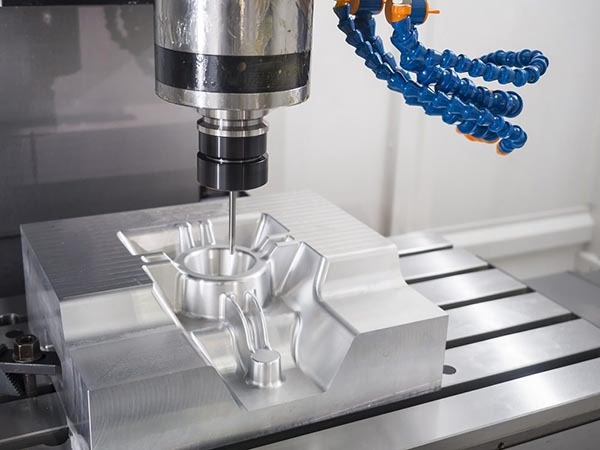
Key takeaways
Alloy families and their machining behavior
Use this as a first filter when you compare different CNC alloy machining services.
| Alloy family | Typical grades | Machining behavior | Best fit |
|---|---|---|---|
| Aluminum | 6061-T6, 7075, 2024, 6082 | Fast cutting, low force, good finish | Housings, brackets, heat sinks |
| Stainless steel | 303, 304, 316L, 17-4PH | Work-hardens; 303 free-cutting, 316L gummy | Shafts, valves, medical parts |
| Alloy steel | 4130, 4140, 4340, 1045 | Needs rigid setup; heat treat after roughing | Structural and powertrain parts |
| Titanium | TA2, TC4 (Ti-6Al-4V) | Low thermal conductivity, high tool wear | Aerospace and implant parts |
| Nickel alloys | Inconel 718, 625 | Slow speeds, heavy tool wear, high heat | Hot sections, high-temp fixtures |
| Copper and brass | C110, C36000, beryllium copper | Free-cutting; beryllium copper needs dust control | Busbars, RF cavities, connectors |
| Magnesium | AZ31B, AZ91D | Very light cuts; chip fire risk without control | Lightweight frames, drone parts |
Pick the alloy first, then the shop
Get the alloy and critical dimensions right, and the supplier comparison becomes simple. If the quote has no DFM note or setup plan, keep looking.
Matching alloy to part function
Start with the load case, not the alloy name. A bracket that carries a static load in a dry enclosure rarely needs 7075. A part that sees vibration and salt spray usually does. Write down the three conditions the part lives in: temperature range, chemical exposure, and load type. That short list eliminates half the alloy table before you talk to any shop.
Aluminum covers most enclosures and brackets. 6061-T6 machines cleanly and takes anodizing well. 7075 gives higher strength but is more abrasive and costs more per kilogram, so reserve it for thin walls and high-stress fittings. 2024 machines well but has weaker corrosion resistance and often needs a protective finish.
Stainless steel is where process choice matters most. Grade 303 is free-cutting and good for high-volume turned parts. Grade 316L resists chlorides but galls easily and needs sharp tools, steady feed, and plenty of coolant. If a part needs both corrosion resistance and hardness, 17-4PH in the H900 condition is a common answer, but plan the heat treat after roughing to control distortion.
Titanium and nickel alloys sit at the other end. Ti-6Al-4V has poor thermal conductivity, so heat stays in the cutting edge. That means lower surface speed, higher feed per tooth, constant coolant, and a rigid machine. Inconel pushes this further: tool life is short, cycle times are long, and the quote should reflect that. If your design can use a different alloy without losing function, it usually should.
- 1Write the environment firstTemperature, chemicals, and load type narrow the alloy list fast.
- 2Reserve high-strength gradesUse 7075 or Ti-6Al-4V where strength per kilogram actually matters.
- 3Plan heat treat into the routingRough, treat, then finish machine to hold tight tolerances.
What tolerance and finish to ask for
Tolerance should follow function. A mounting hole pattern usually needs ±0.05 mm or looser, while a bearing bore or a mating spigot may need ±0.005 mm. Putting a blanket tight tolerance on every dimension raises cost and inspection time without improving the part. Mark only the features that matter and let the rest run to general tolerance.
Surface finish works the same way. As-machined finishes land around Ra 1.6–3.2 μm and suit most structural parts. Sealing faces, sliding surfaces, and optical mounts often need Ra 0.8–1.6 μm. Below that, you are usually looking at Ra 0.2–0.8 μm, which may require finer tooling, slower passes, or a secondary operation such as lapping or polishing.
For titanium and stainless steel, finish is harder to hold because the material tends to smear rather than cut cleanly. Expect a narrower process window and more frequent tool changes. When a drawing calls for both a tight tolerance and a fine finish on a deep pocket, ask the shop to confirm reach and tool length before quoting.
A useful habit: list critical dimensions on a separate sheet with their function. Shops quote faster and inspect the right features. It also gives you a clean basis for a first article inspection report.
- 1General tolerance is fine for most featuresTighten only what touches another part or carries load.
- 2Ra 0.8–1.6 μm covers most sealing facesFiner finishes add cost and inspection steps.
- 3Flag deep features earlyTool reach limits finish and tolerance in deep pockets.
Machine capacity and part size limits
Part size decides which machine class you need. Small fittings and connectors run well on compact 3-axis or 4-axis machines. Housings with features on five faces need simultaneous 5-axis work to avoid multiple setups. Long structural parts up to 4,000 mm need a machine with that travel, and not every shop has one.
Setup count is the quiet cost driver. Every extra setup adds fixture time, a new datum, and stack-up error. A part that looks cheap on a 3-axis quote can cost more after three operations and a re-fixture. If a part has angled faces, undercuts, or deep side pockets, ask how many setups the shop plans and whether a 5-axis or mill-turn machine removes some of them.
Mill-turn centers help when a part is mostly cylindrical with milled features, such as a shaft with flats and cross holes. Turning and milling in one cycle keeps concentricity and removes a second operation. For round parts with tight coaxial tolerance, that is often the deciding factor.
Ask for the machine class and the setup count in writing. It is a fair question, and the answer tells you whether the quote was built from your drawing or from a guess.
- 1Count the setupsEach setup adds error and labor; fewer is usually better.
- 25-axis suits multi-face partsAngled faces and undercuts often need it.
- 3Mill-turn for coaxial featuresOne cycle holds concentricity better than two.
How to judge a capable supplier
The quote is the first test. A response that includes a DFM note, a setup plan, and a tolerance comment shows the shop read the drawing. A bare price with no questions usually means the part will come back with issues or a change order.
Certifications tell you which quality systems are already running. ISO 9001:2015 covers general quality management. IATF 16949:2016 matters for automotive and EV work. ISO 13485:2016 applies to medical devices. ISO 27001:2022 covers information security, which matters when your drawings and CAD data leave your network.
Inspection practice matters more than the certificate on the wall. Ask what is checked, on which equipment, and whether reports come with the shipment. A shop that inspects every part before shipment and can share raw material certificates is easier to audit later.
Finally, check the confidentiality path. Uploads should be secure, and an NDA should be available on request. If your part is a new design, that is not optional.
- 1DFM note in the quoteShows the drawing was actually reviewed.
- 2Certificates match your industryIATF for automotive, ISO 13485 for medical.
- 3NDA on requestStandard step for new designs and CAD data.
Cost, MOQ, and lead time signals
Price per part is only half the picture. Add setup, fixturing, finishing, and inspection to get a landed cost. A low unit price with a large setup charge is fine for 10,000 parts and bad for five.
MOQ is a quick filter. Shops that accept one prototype and also run 10,000+ parts remove the awkward handoff between a prototype vendor and a production vendor. That continuity matters because the process, fixtures, and inspection plan carry over.
Lead time has two parts: quote turnaround and production. A 12-hour quote with free DFM analysis lets you plan the build. Production that can start within 24 hours and ship in 3–5 days fits most prototype and bridge-production schedules.
Be wary of quotes that promise the tightest tolerance, the fastest delivery, and the lowest price at once. Those three pull against each other. A shop that explains the trade-off is easier to work with than one that ignores it.
- 1Use landed costSetup, finishing, and inspection belong in the comparison.
- 2No MOQ helps the prototype stageThe same process can scale to production.
- 3Split quote time from build timeBoth affect when you get parts in hand.
A 6-step check before you release a PO
Run these in order; each step can eliminate a supplier or a process.
- 1Define the alloy requirementWrite temperature, chemical exposure, and load type. Pick the least expensive alloy that meets all three.
- 2Mark critical dimensionsList them on a separate sheet with function. Leave the rest at general tolerance to control cost.
- 3Set the finish by surface functionRa 1.6–3.2 μm for structural faces; Ra 0.8–1.6 μm for sealing and sliding faces.
- 4Confirm machine class and setup countAsk which machine and how many setups. Fewer setups means less stack-up error.
- 5Check certificates against your industryISO 9001 for general work, IATF 16949 for automotive, ISO 13485 for medical, ISO 27001 for data.
- 6Compare landed cost and lead timeAdd setup, finishing, and inspection. Treat quote time and build time as separate numbers.
Questions buyers ask
Which alloy is easiest to machine?
Aluminum 6061-T6 is the easiest common alloy. It cuts fast, holds a good finish, and needs no special tooling.
Brass C36000 and free-cutting stainless 303 are also easy, but they are chosen for function, not for machining ease alone.
Can I get a tight tolerance on titanium?
Yes, but plan for it. Ti-6Al-4V holds ±0.005 mm on stable features when the setup is rigid and coolant is constant.
Thin walls and deep pockets are harder because the material moves after cutting. Tell the shop which features matter.
Do I need a different service for prototype and production?
Not necessarily. A shop that accepts one prototype and also runs 10,000+ parts keeps the process and fixtures consistent.
That avoids a re-qualification step when you move from prototype to production.
What should a quote include?
A useful quote lists material, machine class, setup count, finishing, and inspection.
A DFM note is the strongest signal that the drawing was reviewed before pricing.
How do I protect my design during quoting?
Use a supplier with secure uploads and ask for an NDA before sending CAD data.
ISO 27001:2022 certification covers the information security side of that requirement.
When is 5-axis not worth it?
If the part is prismatic with features on one or two faces, a 3-axis or 4-axis machine does the job for less.
5-axis pays off when it removes two or more setups or reaches features a 3-axis machine cannot.
Send your alloy part for review
Upload a drawing and get a quote with free DFM analysis within 12 hours, plus 100% inspection before shipment.
12-hour quote100% inspectionNo minimum order quantityNDA on request
More from GreatLight
We publish setup notes, tooling trials and inspection data from the factory floor.











