
Center Feed Lathe and Feed Lathe: How They Actually Differ
On a center feed lathe the bar stock moves through a stationary spindle while the tool slides in Z. On a feed lathe the bar stays put and the tool moves in X and Z. That single difference decides which parts you can run, how long the bar can be, and where the tolerance lands. This page is for engineers choosing between the two layouts before a quote or a production run.
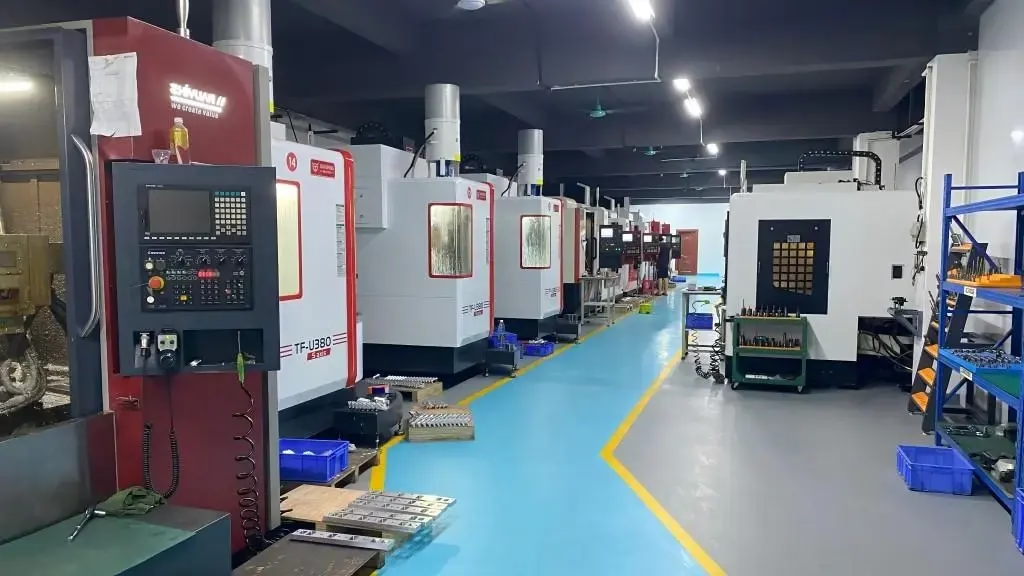
Center feed lathe vs feed lathe at a glance
Read each row as a decision point, not a spec sheet.
| Factor | Center feed lathe | Feed lathe (bar feed) |
|---|---|---|
| Bar stock motion | Feeds through the spindle bore | Held static in the chuck or collet |
| Tool motion | Z slide on the turret | X and Z on the turret |
| Typical bar length | Up to 3–4 m from a bar feeder | Short billets, 300–600 mm |
| Best part profile | Long shafts, constant diameter | Short, stepped, or flanged parts |
| Chuck grip | Collet, light grip, low runout | Chuck or collet, heavier grip |
| Setup change | New bar pusher and guide bush | New jaws and tool offsets |
| Tolerance reach | ±0.005 mm on diameters | ±0.005 mm on diameters |
| Cycle time on long parts | Short, one continuous feed | Long, needs repositioning |
Why the bar path changes everything
On a center feed lathe, the bar stock is pushed forward by a bar feeder into a guide bush, then through the spindle bore. The spindle holds the bar and rotates it, but the bar itself keeps moving in Z as material is consumed. The tool only needs to travel in Z to cut. On a feed lathe, the bar is gripped once by a chuck or collet and stays there. The tool moves in X and Z to reach the work.
That difference sounds small until you look at bar length. A center feed lathe can run a 3 m or 4 m bar in one continuous cycle. A feed lathe is limited by how far the bar can extend past the chuck without whipping. Past roughly 3 times the diameter, unsupported bar starts to bend and chatter.
The guide bush on a center feed lathe acts as a moving support. It sits within 1–2 mm of the cut, so the bar is always supported right where the tool bites. That is why these machines hold tight diameters on long, slender parts. A feed lathe has no such support, so long parts need a tailstock or a steady rest.
- 1Guide bush is the keyIt follows the tool and supports the bar within 1–2 mm of the cut.
- 2Chuck grip is the keyIt holds the bar once, so rigidity depends on the chuck and the overhang.
Which parts belong on which machine
Pick a center feed lathe when the part is long and mostly constant in diameter. Think shafts, pins, guide rods, and hydraulic spools. If the length-to-diameter ratio is above 5:1 and the profile has few steps, center feed wins on cycle time and straightness. The bar feeds continuously, so the machine does not stop to reposition.
Pick a feed lathe when the part is short, stepped, or has a flange. Think bushings, adapters, fittings, and small housings. These parts need a chuck with real grip and a tool that can move in X to face, turn, and bore. A center feed lathe can do them, but you lose the advantage of continuous feed.
There is a middle ground. A mill-turn center with a bar feeder can run long parts and still move the tool in X and Z. We have 16 mill-turn centers that handle this. The trade-off is setup time and tool clearance.
- 1Long and plainCenter feed lathe, especially above 5:1 L/D.
- 2Short and steppedFeed lathe with a chuck and a multi-tool turret.
- 3Mixed workMill-turn center with a bar feeder, at the cost of setup time.
Where tolerance and finish land
Both layouts can hit ±0.005 mm on turned diameters if the machine is in good shape and the tool is rigid. The difference shows up on long parts. A center feed lathe holds diameter consistency over 3 m because the guide bush supports the bar. A feed lathe will drift as the tool moves further from the chuck, especially past 4 times the diameter.
Surface finish follows the same logic. On a supported bar, Ra 0.8–1.6 μm is routine. On an unsupported bar, chatter can push you to Ra 1.6–3.2 μm or worse. If the print calls for Ra 0.2–0.8 μm, you need a rigid setup, a sharp insert, and a support close to the cut.
Material matters too. Free-machining brass and aluminum run well on both. Stainless 316 and 17-4PH work-harden, so they prefer the constant feed of a center feed lathe. Titanium TC4 (Ti-6Al-4V) needs low cutting speed and high rigidity, which favors a feed lathe with a heavy chuck for short parts.
- 1Long partsCenter feed lathe holds tolerance over 3 m.
- 2Short partsFeed lathe with a chuck matches it within 4× diameter of the chuck.
- 3Fine finishRa 0.2–0.8 μm needs support close to the cut.
Setup, tooling, and run cost
A center feed lathe needs a bar feeder, a guide bush sized to the bar, and a pusher. Changing bar diameter means changing the guide bush, which can take 30–60 minutes. The payoff is unattended running. Once set, the machine runs bar after bar with no operator.
A feed lathe needs jaws or a collet and tool offsets. Swapping a collet takes minutes. That makes it the better choice for high-mix, low-volume work. If you run 20 different parts a week, a feed lathe keeps the spindle turning.
Tool cost is similar. Both use indexable inserts. The center feed lathe may use a smaller insert because the guide bush limits clearance. That is a small cost difference, not a deciding factor.
- 1High volume, one diameterCenter feed lathe with a bar feeder.
- 2High mix, low volumeFeed lathe with quick-change collets.
When neither layout fits
Neither layout handles a part that is both long and has a large flange. The flange needs chuck grip, and the length needs support. That is a job for a mill-turn center with a tailstock, or a lathe with a steady rest.
Parts above 4,000 mm go to a different class of machine. We machine up to 4,000 mm on our largest centers, but not every lathe in that size is a center feed or a feed lathe.
If the part is a one-off prototype, the setup cost of a center feed lathe rarely pays back. Run it on a feed lathe or a mill-turn center. Save the bar feeder for the production run.
- 1Long plus flangedMill-turn with a tailstock, not either lathe.
- 2Over 4,000 mmOutside the range of both layouts.
- 3One-off prototypeFeed lathe or mill-turn, not a bar feeder.
The verdict
For long, plain shafts above 5:1 length-to-diameter, choose a center feed lathe. For short, stepped, or flanged parts, choose a feed lathe. If the part mixes both traits, a mill-turn center is the safer pick.
Questions engineers ask
Can a feed lathe run bar stock from a bar feeder?
Yes, if the spindle bore is large enough and the bar is short. The feeder pushes the bar into the chuck, then stops. The chuck grips it and the tool cuts.
The limit is bar length. Past roughly 3 times the diameter, the unsupported bar whips. A center feed lathe avoids that with a guide bush.
Does a center feed lathe need a guide bush for every bar diameter?
Yes. The guide bush is sized to the bar, usually within 0.01–0.02 mm. A 12 mm bar needs a 12 mm bush.
Changing bar size means changing the bush and the pusher. Budget 30–60 minutes for the swap.
Which layout gives better concentricity?
A center feed lathe usually wins on long parts. The guide bush supports the bar within 1–2 mm of the cut, so runout stays low.
On short parts, a feed lathe with a good collet matches it. Concentricity depends more on the collet and the chuck than on the layout.
Can both layouts hit ±0.005 mm?
Yes, on diameters and under good conditions. The machine, the tool, and the setup matter more than the layout.
On long parts, only the center feed lathe holds that tolerance over the full length. The feed lathe drifts as the tool moves away from the chuck.
What about parts with a cross hole or a milled flat?
Neither a plain center feed lathe nor a plain feed lathe can mill. You need a mill-turn center or a second op on a mill.
We run 16 mill-turn centers that turn and mill in one setup. That removes the second op and the re-clamping error.
How do I know which one to quote?
Send the drawing and the annual volume. If the part is long and plain, we quote a center feed lathe. If it is short and stepped, we quote a feed lathe.
We return a quotation and a free DFM analysis within 12 hours. Production can start within 24 hours.
Send the drawing, get a straight answer
Tell us the part length, the diameter, and the volume. We will tell you which layout fits and why.
12-hour quote100% inspectionNo minimum order quantity
More CNC knowledge
We publish setup notes, tooling trials and inspection data from the factory floor.











