
Double Column Vertical Machining Center: How the Bridge Structure Works
A double column vertical machining center carries the spindle on a bridge instead of a single column, so the cutting load closes through a symmetric frame. This page explains the mechanics, the travel limits, and the part shapes that actually benefit. Read it if you are deciding between a bridge-type machine and a C-frame VMC.
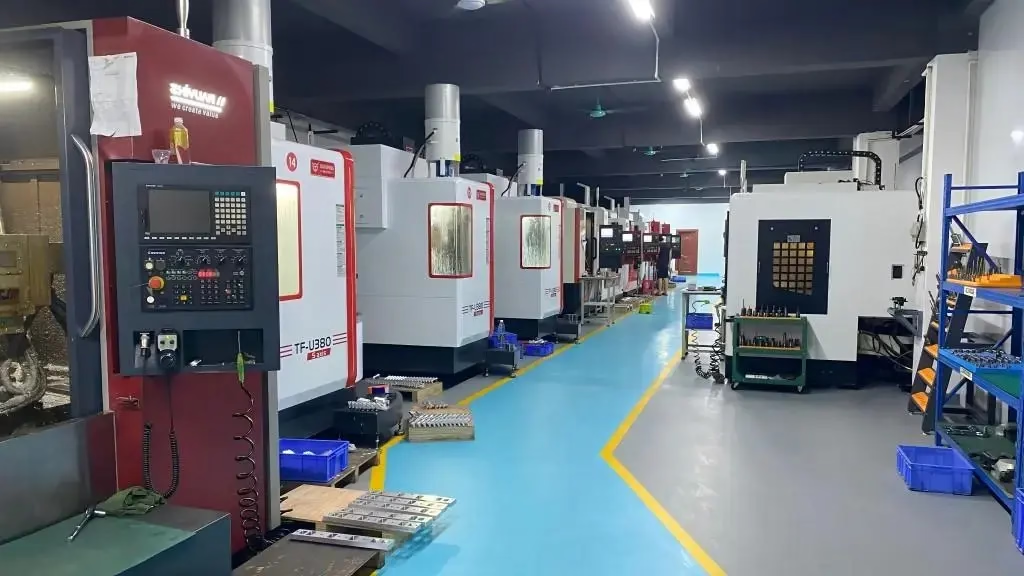
Why the double column vertical machining center bends less
On a C-frame vertical mill, the column is a cantilever. Cutting force pushes the spindle sideways and the column bends, so deflection grows with Z height. On a double column vertical machining center, the spindle sits on a cross rail that spans between two columns. Force travels down both columns at once. The frame is closed, so bending is shared instead of concentrated.
That symmetry is the whole point. A symmetric bridge deflects in a predictable, mostly vertical direction, and the two sides cancel each other's tilt. A ram that extends 600 mm out of the rail on a C-frame machine is a long lever. The same extension on a bridge machine sits inside a box, so the error at the tool tip stays small.
Thermal behavior follows the same logic. A single column heats unevenly, and the hot side grows longer than the cold side. Two columns of matched section, in the same shop air, drift together. That is why bridge machines hold ±0.005 mm on long passes and why they hold it after six hours of cutting, not just on the first part.
- 1Closed frameCutting force returns through both columns, not one cantilever.
- 2Short leverThe ram stays inside the bridge, so tool-tip error stays small.
- 3Matched driftTwo equal columns expand together as the shop warms.
Which parts fit a bridge-type machine
Bridge machines earn their cost on parts that are long, tall, or heavy. Think base plates, gantry beams, mold bases, machine frames, and weldments that arrive already stress-relieved. If a part is 1,200 mm long and 700 mm tall, a 40-taper C-frame machine will chatter at the top of the cut before it runs out of travel.
The trade-off is reach. A bridge machine cannot drop its spindle into a deep pocket the way a C-frame machine can, because the rail sits above the work. Deep cavities, undercuts, and features far below the top surface are awkward. You also pay for the extra iron in acceleration: a heavy bridge does not reverse direction as quickly as a small mill.
Part weight matters too. A cast iron fixture plus a 900 kg steel weldment is normal on a bridge table. On a C-frame machine of similar envelope, that load is already a problem for the linear guides. So the question is not which machine is better. It is which machine matches the part's length-to-height ratio and its mass.
- 1Good fitLong, tall, heavy parts with features near the top surface.
- 2Poor fitDeep pockets, undercuts, and small parts with tight cycle times.
- 3Watch the ratioLength over height above about 1.5 favors a bridge.
How the axes are arranged and what it means at the tool
Most bridge machines move the table in X and Y and the ram in Z, or move the cross rail in Y and the ram in Z while the table handles X. The second layout keeps the table short and stiff, which helps on very long parts. Either way, the mass that moves is different from a C-frame machine, so acceleration and chip-to-chip time change.
A rotary table changes the picture again. With a Ø400 mm table on the bridge, a part can be indexed to four or five faces without a second setup. That removes one re-clamp error and one queue. For a part with features on all six sides, the setup count drops from three to one.
Five-axis bridge machines add two rotary axes, usually a trunnion or a swivel head. The frame is still closed, so the rigidity advantage carries into the tilted cut. This is where a double column vertical machining center stops being a big drill and starts being a finishing machine for complex geometry.
- 1Moving massBridge layouts move the rail or the table, not a single column.
- 2Rotary tableØ400 mm indexing removes one setup on multi-face parts.
- 3Five-axis bridgeTrunnion or swivel head keeps the closed frame in the tilted cut.
What accuracy a bridge machine can hold in production
Published positioning accuracy is a lab number. What matters is the tolerance the machine holds on part 200, after the spindle is warm and the chips are flying. On a well-set bridge machine, ±0.005 mm is realistic on features cut in one continuous pass with a sharp tool and a stable fixture.
Surface finish depends more on the tool path and the tool than on the frame. Ra 0.8–1.6 μm is a normal target for aluminum and mild steel. Push to Ra 0.2–0.8 μm and you need a finishing pass with a small stepover, a balanced holder, and a machine that does not ring. The bridge helps here because the frame damps better than a cantilever.
Long parts amplify every error. A 0.01 mm tilt at the fixture becomes 0.05 mm over 500 mm of cut. That is why we check the raw material, monitor in process, and inspect 100% before shipment. Reports come on request. The machine is only one link in that chain.
- 1Warm-up mattersRun the spindle before the first tight-tolerance cut.
- 2Fixture firstA soft fixture moves more than the frame ever will.
- 3Inspect the seriesCheck the trend across parts, not only the first one.
Bridge machine vs C-frame VMC: which part goes where
Use this as a first filter before you ask for a quote.
| Part or job | Bridge machine | C-frame VMC |
|---|---|---|
| Part length over 1,200 mm | Preferred | Travel limited |
| Height over 600 mm | Preferred | Chatter risk |
| Deep pocket or undercut | Awkward | Preferred |
| Part weight over 500 kg | Preferred | Guide load high |
| Small parts, fast cycle | Slow to accelerate | Preferred |
| Features on 5 or 6 faces | One setup with rotary | Two or three setups |
| Thin wall, light finishing | Good damping | Adequate |
| Tight tolerance, long pass | ±0.005 mm realistic | Drifts with Z height |
The short answer
If your part is long, tall, or heavy, choose a double column vertical machining center. If it is small with deep cavities and a fast cycle, a C-frame VMC will cut it cheaper and quicker.
Questions engineers ask before they commit
Does a bridge machine remove the need for a fixture?
No. Rigidity in the frame does not make a soft fixture stiff. A bridge machine holds tolerance because the load path is closed, but a part that lifts or rings in the vise will still lift and ring.
Keep the fixture short and clamped near the cut. Support tall walls from both sides where the geometry allows.
Can a double column vertical machining center cut hardened steel?
It can, but the limit is the spindle and the tool, not the frame. A 40-taper spindle with a coated carbide cutter handles 4140 and 4340 at moderate hardness. Above that, you need a different spindle and a different strategy.
Tell us the material and hardness when you ask for a quote. Tool steel and 17-4PH behave very differently from 6061.
How long does setup take on a bridge machine?
Setup is mostly fixture and probe time, not machine time. With a preset fixture and a touch probe, a repeat job can be running inside an hour. A brand-new part with a new fixture takes longer.
We quote from one prototype to 10,000+ part runs, and there is no minimum order quantity.
What materials do you run on these machines?
Aluminum 6061, 7075, and 6082; stainless 303, 304, 316L, and 17-4PH; steel 1018, 1045, 4140, and 4340; titanium TC4; Inconel; and plastics such as POM, PEEK, and PC.
Finishing options include anodizing, electroless nickel, black oxide, bead blasting, and laser marking.
How do you keep my drawings confidential?
Uploads are secure and confidential, and we sign an NDA on request. We hold ISO 27001:2022 for information security, alongside ISO 9001:2015, IATF 16949:2016, and ISO 13485:2016.
You get a quotation and a free DFM analysis within 12 hours, and production can start within 24 hours of approval.
Do you inspect every part?
Yes. We check raw material on arrival, monitor in process, and inspect 100% before shipment. Inspection reports are available on request.
Our historical late-delivery probability is below 2%, and parts normally ship in 3–5 days.
Send the part, not the guesswork
Upload a STEP file and tell us the material and tolerance. You get a quotation and a free DFM analysis within 12 hours, plus an engineer who will tell you if a bridge machine is the wrong tool for the job.
12-hour quote100% inspectionNo minimum order
More machining notes
We publish setup notes, tooling trials and inspection data from the factory floor.











