
Mobile Phone Production CNC: How the Metal Parts Are Actually Cut
A phone shell, a mid-frame and a camera bezel each ask for a different cutting strategy. This page explains where mobile phone production CNC fits, what it can hold, and where it stops making sense. Read it if you specify parts, quote them, or sign off first article inspection.
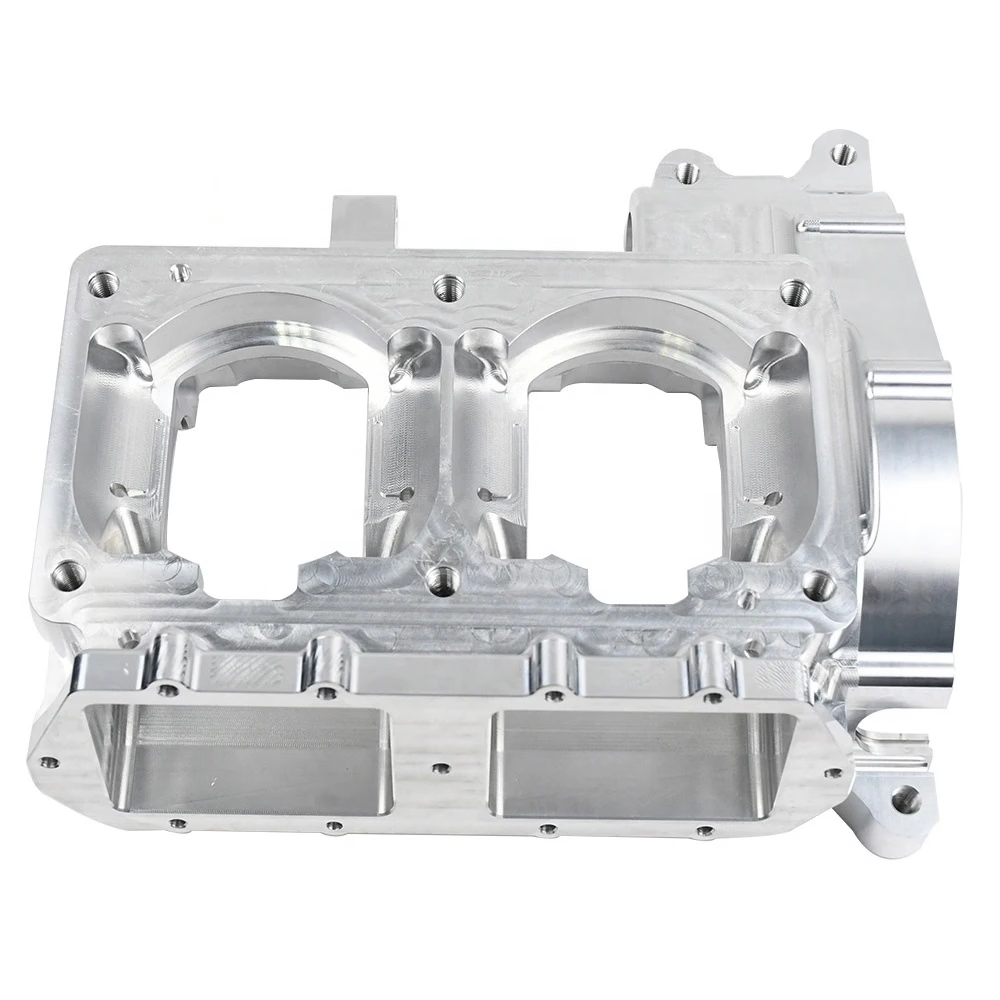
What mobile phone production CNC actually removes
Start with the part, not the machine. A phone has three metal jobs that behave differently on a spindle. The mid-frame is a long, thin structure with a pocket for the battery and ribs that carry stiffness. The outer band or unibody shell is mostly a wall. The camera bezel and button bosses are small features with tight position tolerances.
Each one fails in its own way. Thin walls bend under clamping pressure. Long pockets chatter when the tool overhangs too far. Small bosses drift when the fixture does not repeat. Mobile phone production CNC is mostly the work of holding a part still while you remove 60 to 80 percent of its mass from a billet, without letting heat or clamping force move it.
That is why the process is judged on wall thickness, not on the outside look. A 0.8 mm wall that stays 0.8 mm over a 150 mm length is a real result. A polished surface on a wall that bows 0.15 mm in the middle is scrap.
We machine housings, mid-frames, brackets, shields and antenna carriers from aluminium 6061, 6063, 7075, ADC12, stainless 304 and 316L, and plastics such as POM, PC and PEEK. The alloy choice usually follows the finish, not the other way around.
- 1Mid-framePockets, ribs and screw bosses; wall thickness drives the whole setup.
- 2Unibody shellPerimeter cutting plus a curved floor; heat is the main enemy.
- 3Camera bezelSmall, tight position tolerance, often finished on a 4-axis or 5-axis.
Why 5-axis suits thin housings
A three-axis machine can cut a phone housing. It just needs more setups, and every extra setup adds a datum error. On a 0.9 mm wall, a 0.03 mm datum shift is visible in the fit between the frame and the glass.
A simultaneous 5-axis center keeps the tool normal to a curved floor and shortens the overhang. Short overhang means less chatter, so you can run a smaller step-over and reach Ra 0.8–1.6 μm without a separate polishing step. It also lets you cut undercut speaker grilles and side-button reliefs in one pass instead of two.
The trade-off is programming time. Five-axis toolpaths need verified post-processing and a simulated stock model, so a first article takes longer to release. For a simple flat bracket, that time is wasted. For a curved unibody shell, it pays back on the first batch.
GreatLight runs 16 simultaneous 5-axis machining centers, 12 four-axis mills, 27 three-axis machines and 16 mill-turn centers. Parts arrive on whichever platform matches the geometry, not on whichever is free.
- 1Use 5-axis whenCurved floors, undercuts, or a wall under 1.2 mm.
- 2Use 3-axis whenFlat plates, shields, simple brackets, loose position tolerance.
- 3Use mill-turn whenRound camera rings and bushings that need turning plus cross holes.
What tolerance and finish mobile phone production CNC can hold
General machined features hold ±0.005 mm on critical dimensions. That number is for a feature the machine can reach with a rigid setup and a controlled temperature. It is not a blanket callout for every dimension on the drawing, and it should not be.
Position tolerance is the real constraint on a phone part. A hole pattern that must line up with a flex connector is usually specified at ±0.02 mm to ±0.05 mm across the part, because the stack-up between frame, shield and board eats the rest. Call out the datum scheme on the drawing. If the datum is the glass face, say so.
Surface finish follows the alloy and the toolpath. As-machined aluminium lands at Ra 1.6–3.2 μm. A finer step-over with a ball nose reaches Ra 0.8–1.6 μm, and Ra 0.2–0.8 μm is available for sealing faces and optical seats. Anodizing adds 5 to 15 μm of oxide, so a hardcoat will blur a 1.5 mm laser mark if the mark is cut before coating.
We inspect 100 percent of parts before shipment, with raw material check, in-process monitoring and final inspection. Reports are available on request.
- 1±0.005 mmCritical machined features with a rigid, reachable setup.
- 2±0.02–0.05 mmTypical position tolerance for connector and screw patterns.
- 3Ra 1.6–3.2 μmStandard as-machined finish on aluminium.
- 4Ra 0.2–0.8 μmSealing faces and optical seats, slower cycle.
When mobile phone production CNC is the wrong process
CNC is a subtraction process, so cycle time scales with the volume of material you remove. A housing that starts as a 200 g billet and ends at 35 g takes a long time to cut. At 100,000 pieces a year, die casting or stamping plus a light finishing cut will beat it on cost per part.
The honest split is this. Use CNC for prototypes, low and mid volume, tight-tolerance features, and the final trim on a cast or forged blank. Use casting or stamping for the bulk shape when the volume is high and the wall is uniform.
There are also features CNC simply cannot reach. A closed internal channel, a hollow rib with no tool access, or a sharp internal corner with a radius smaller than the cutter allows. Each of those needs a different process or a design change, and it is cheaper to find out at the drawing stage.
Send the model before tooling is cut. We return a DFM analysis with the quote, usually within 12 hours, and flag the features that will cost you cycle time.
- 1Good fitPrototypes, 1 to 10,000+ parts, tight position tolerance, cosmetic bands.
- 2Poor fitVery high volume with uniform walls, closed internal channels.
- 3HybridCast or forged blank, then CNC for mating faces and holes.
Mobile phone production CNC against other processes
Volume, tolerance and geometry decide the process. Cost per part decides the volume.
| Process | Best volume | Typical tolerance | Watch out for |
|---|---|---|---|
| CNC milling | 1 to 10,000+ parts | ±0.005 mm | Cycle time on deep pockets |
| Die casting | High volume | ±0.05 mm plus machining | Porosity, draft angles |
| Stamping | High volume, thin sheet | ±0.1 mm | Burrs, no thick bosses |
| CNC trim on casting | Mid to high volume | ±0.01 mm on cut faces | Fixture repeat on a rough blank |
| Vacuum casting | 25 to 100 parts | ±0.2 mm | Soft tool wear, limited alloys |
The short version
If the wall is under 1.2 mm, the position tolerance is tighter than ±0.05 mm, or you need fewer than 10,000 parts, cut it on a 5-axis CNC. If the wall is uniform and the volume is above 100,000, cast the shape and CNC only the mating faces.
Questions engineers ask before releasing a phone part
How thin a wall can mobile phone production CNC hold?
It depends on the alloy and the unsupported length. On aluminium 6061 we work to 0.8 mm walls on parts up to 150 mm long, and 0.5 mm on shorter features with light finishing passes.
Below that, the part deflects under cutting force and the wall thickness varies along the length. A rib or a temporary tab helps. Add one at the drawing stage rather than after the first article.
Should the drawing call out ±0.005 mm everywhere?
No. A blanket tolerance raises cycle time on every feature because each one needs a finishing pass and a slower feed. Most dimensions on a phone housing sit comfortably at ±0.05 mm.
Reserve ±0.005 mm for the features that actually locate the part: glass datum faces, connector holes, camera seat. Mark the rest as general tolerance.
Which aluminium alloy is best for an anodized housing?
6061 and 6063 anodize cleanly and take clear, color and hardcoat finishes. 7075 gives higher strength but the oxide can look darker and less uniform, which matters on a visible band.
If the housing is also a heat path, 6061 balances thermal conductivity and machinability. ADC12 is a casting alloy, so use it only if you are trimming a cast blank.
Do you machine the glass or the display cover?
No. We cut metal and plastic components: mid-frames, housings, bezels, brackets, shields, antenna carriers and button parts.
Glass and ceramic covers come from a different supply chain. We do machine the seat that the cover sits in, so the flatness and the corner radius of that seat are worth specifying.
How is confidentiality handled on a new phone design?
Uploads are secure and confidential, and we sign an NDA on request before any file is reviewed. The ISO 27001:2022 certification covers our information security process.
Unreleased industrial designs are common here. Files are not shared outside the project team, and tooling is not photographed for marketing.
What lead time should I plan for a first article?
A quotation with free DFM analysis comes back within 12 hours. Production can start within 24 hours of the order, and parts ship in 3 to 5 days.
A brand new 5-axis housing with a complex fixture takes longer for programming and first article inspection. Tell us the deadline up front and we will say whether it is realistic.
Send the model, get a DFM answer back
Upload your STEP file and we return a quotation with a free DFM analysis within 12 hours. No minimum order quantity, from one prototype to a 10,000+ part run.
12-hour quote100% inspectionNDA on request1 pc to 10,000+
Follow the shop floor
We publish setup notes, tooling trials and inspection data from the factory floor.











