
Explore the advantages of 5-axis CNC machining centers
A 5-axis CNC machining center adds two rotary axes to the three linear ones. That sounds simple. It changes fixture count, tolerance stack-up, tool reach and cycle time all at once. This page explains the mechanism behind each advantage, where it stops paying off, and how to judge whether your part belongs on a 5-axis CNC machining center or a 3-axis machine.
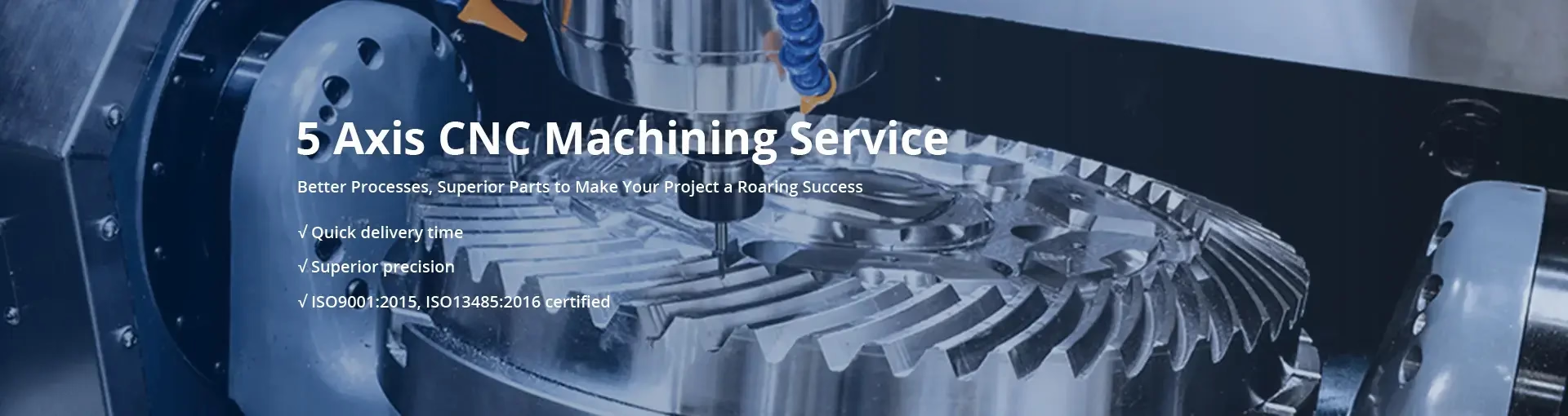
How 5-axis CNC machining centers move the tool
A 3-axis mill moves the tool in X, Y and Z. The work stays where the fixture put it. A 5-axis CNC machining center adds two rotary axes, usually named A and B or B and C, depending on the builder. One rotary axis tilts the spindle or the table; the second rotates the part or swings the head around it.
That second rotation is the part people underestimate. With only one rotary axis you can tilt into a face, but you still approach it from a fixed direction. With two, the tool axis can point almost anywhere in the upper hemisphere, so the same cutter reaches five sides of a block without the operator touching the vise.
The control has to keep all five axes synchronized while it interpolates. On a 5-axis CNC machining center the post-processor converts CAM toolpaths into axis commands, and the machine compensates for the pivot distance between the rotary centerline and the tool tip. Get that offset wrong and a flat face comes out tapered.
Two common layouts exist. Table-table machines rotate the part under a fixed spindle, which suits heavier parts and a Ø400 mm rotary table. Spindle-tilt machines swing the head around the work, which suits long parts where the table cannot carry the swing. Each layout changes how much of the part you can reach in one setup.
- 1Rotary axesA and B, or B and C, added to X, Y, Z
- 2Pivot offsetRotary centerline to tool tip must be measured, not assumed
- 3LayoutTable-table for heavy parts, spindle-tilt for long ones
Fewer setups means a shorter tolerance stack
Every time a part comes off the table and goes back on, you add a locating error. On a 3-axis machine a five-sided part may need three or four setups, each one re-clamped against a fresh datum. Each setup contributes its own error to the stack, and the stack sets your real tolerance.
On a 5-axis CNC machining center the part is clamped once and the rotary axes bring the remaining faces to the tool. One datum survives the whole cycle. That is why a shop can quote ±0.005 mm on a housing with angled ports instead of ±0.02 mm on the same part spread across three fixtures.
Setup time drops too, but that is the smaller win. The larger win is that a feature machined in setup one and a feature machined in setup three now share the same origin. Hole-to-hole position no longer depends on how well the operator re-indicated the block at 7 a.m.
The limit is part size and rigidity. A part that must be re-clamped because it cannot be reached by any rotary combination still needs a second setup. Rotary axes do not remove the need for a good fixture. They remove the need for three of them.
- 1One datumAll faces reference the same origin
- 2Stack-upFewer setups, fewer accumulated errors
- 3Not a cure-allUnreachable geometry still needs a second setup
Short tools, better surface finish
Reach is a stiffness problem. A Ø6 mm end mill hanging 60 mm out of the holder deflects under cutting load, and that deflection shows up as chatter and as a surface that misses the finish spec. On a 3-axis machine the only way to reach a deep pocket wall is a long tool.
A 5-axis CNC machining center tilts the part so the tool approaches the wall at an angle, and the same feature can be cut with a shorter, stiffer tool. Less overhang means less vibration, which means the cutter can run at a higher feed and still hold Ra 0.8–1.6 μm on a wall that would chatter on a 3-axis setup.
The angle also matters at the bottom of a pocket. A ball nose cutter leaves a scallop whose height depends on the stepover and the tilt. Tilt the tool 15° to 30° off the surface normal and the effective cutting radius at the tip grows, so the scallop gets shallower for the same stepover.
This is where 5-axis work pays for itself on molds and impellers. It is also where it can cost you. A tilted tool has a different contact point, so feeds and speeds from a 3-axis library will not transfer directly. The CAM programmer has to re-check the chip load.
- 1Shorter overhangStiffer tool, less chatter on deep walls
- 2Tilt for finish15°–30° off normal reduces scallop height
- 3Re-check feeds3-axis chip loads do not transfer to tilted cuts
What a 5-axis machine can and cannot hold
Accuracy on a 5-axis CNC machining center comes from the linear axes plus the rotary positioning. Our machines hold ±0.005 mm (±0.0002 in) on parts up to 4,000 mm, and we inspect 100% of parts before shipment. Those numbers come from the machine and the metrology, not from the axis count.
Rotary axes add their own error sources. Backlash in the rotary drive, thermal growth in the trunnion, and the accuracy of the pivot offset all feed into the final position. A machine that is geometrically perfect when cold will drift as the spindle and rotary motors warm up.
That is why thermal compensation and warm-up cycles matter more on a 5-axis CNC machining center than on a 3-axis one. It is also why we check the rotary centerline against a known artifact rather than trusting the last calibration sticker.
What 5-axis does not fix is material behavior. Thin walls still deflect under clamping and cutting force. Titanium still work-hardens. A 5-axis machine gives you better access to the cut, not a different alloy.
- 1Linear plus rotaryTolerance is the sum of both systems
- 2Thermal driftRotary and spindle growth need warm-up
- 3Material limitsThin walls and work-hardening stay the same
When a 5-axis CNC machining center is the right call
Match the part to the machine before you request a quote.
| Part condition | 5-axis | 3-axis |
|---|---|---|
| Faces reachable from one direction | Overkill | Best fit |
| Angled holes and ports on 4+ faces | One setup, tight position | Three setups, looser stack |
| Deep pocket with thin walls | Short tool, tilted approach | Long tool, chatter risk |
| Contoured surface, mold or impeller | Continuous tilt, shallow scallop | Steep walls, visible steps |
| Large flat plate, 4,000 mm long | Possible on large travel | Simpler and cheaper |
| Prototype, one or two pieces | No MOQ, still viable | Usually lower cost |
The trade-off in one line
If your part has features on four or more faces, angled holes, or a contoured surface that must hold ±0.005 mm, put it on a 5-axis CNC machining center. If every feature is reachable from one direction, a 3-axis machine will hold the same tolerance for less money and less programming time.
Questions engineers ask before switching
Does 5-axis machining always hold a tighter tolerance than 3-axis?
No. The tolerance a shop can hold depends on the machine's geometry, thermal stability and metrology, not on the number of axes. A well-maintained 3-axis machine can hold ±0.005 mm on a simple part.
The gain from 5-axis comes from doing more features in one setup, which removes the re-clamping errors that would otherwise enter the stack.
Can a 5-axis CNC machining center cut a part with undercuts?
Yes, if the undercut is reachable by tilting the tool axis. A T-slot with a straight shank cutter needs a specific approach angle, and the rotary axes can provide it without a special form tool.
Truly enclosed cavities with no line of sight still need another process, such as EDM or a split design.
How long does programming take compared to 3-axis?
Expect more CAM time. The programmer has to define the tool axis for every operation, check for collisions between the holder and the part, and verify the pivot offset.
The payoff is fewer setups on the floor. On a complex housing, the extra hour at the desk often saves several hours at the machine.
What part size fits your 5-axis capacity?
We run 16 simultaneous 5-axis machining centers with travels of 4,000 × 400 × 150 mm, 750 × 1,150 × 550 mm, 600 × 600 × 600 mm, 500 × 500 × 450 mm and 500 × 310 × 200 mm.
The largest envelope suits long extrusions and rails. Smaller envelopes suit compact housings, and the Ø400 mm rotary table handles round and near-round parts.
Which materials are common on 5-axis work?
Aluminium 6061, 7075 and 6082, stainless 304, 316L and 17-4PH, titanium TC4 (Ti-6Al-4V), Inconel, and engineering plastics such as PEEK and POM.
Harder alloys cut slower, so the cycle-time advantage of one setup matters more on titanium and Inconel than on aluminium.
Do you need an NDA before I send drawings?
Uploads are secure and confidential, and we can sign an NDA on request before you release files. We hold ISO 9001:2015, IATF 16949:2016, ISO 13485:2016 and ISO 27001:2022.
Quotation and a free DFM analysis come back within 12 hours.
Send the drawing, get a real answer
Upload your model and we will tell you whether it belongs on a 5-axis CNC machining center or a 3-axis machine, with a quote and free DFM analysis within 12 hours.
12-hour quote100% inspectionNo minimum order quantity
More machining notes
We publish setup notes, tooling trials and inspection data from the factory floor.











