
Fast Custom CNC Machining Services: 7 Checks Before You Order
A practical way to compare suppliers of fast custom CNC machining services. You will see which claims can be verified, which numbers matter for your part, and where a quote usually hides its real lead time. Written for engineers and procurement teams sourcing prototypes and small production runs.
In this article
- 1
- 2
- 3
- 4
- 5
- 6
- 7
- 8
Key takeaways
Fast custom CNC machining services: criteria that separate suppliers
Use this grid when two quotes look similar on price.
| Criterion | What to ask for | Red flag |
|---|---|---|
| Quote turnaround | Timestamped quote and DFM notes | Quote arrives without process notes |
| Tolerance capability | Stated tolerance per critical feature | One blanket ±0.1 mm on all drawings |
| Lead time basis | Days from PO to shipment, not from machining start | Lead time starts after material arrives |
| Minimum order quantity | Prototype and 10,000+ part runs accepted | MOQ quoted per part number |
| Certifications | ISO 9001, IATF 16949, ISO 13485, ISO 27001 | Certificate expired or scope mismatched |
| Finishing | Anodizing, plating, passivation in-house | Finishing outsourced with no tracking |
| Inspection | 100% inspection before shipment, reports on request | Sample inspection only |
| Confidentiality | NDA available on request; secure uploads | Files sent over plain email only |
When speed is the right priority and when it is not
Fast custom CNC machining services fit some jobs better than others.
| Situation | Prioritize speed | Reason |
|---|---|---|
| Functional prototype for a design review | Yes | Geometry feedback is worth more than unit cost |
| Bridge parts while a mold is being cut | Yes | Stops the line without tooling spend |
| Motor housings and gearbox plates | Yes | 5-axis work removes extra setups and fixtures |
| High-volume part with a stable design | No | Die casting or molding wins on unit cost |
| Decorative trim with loose tolerance | No | Sheet metal or extrusion is faster and cheaper |
| Part with one feature needing Ra 0.2 μm | Partly | Add a finishing step before you promise a ship date |
The verdict: pick the supplier who removes queue time, not just one who runs machines at night
If your part is a prototype, a bridge order or a 5-axis housing, choose a shop that quotes in 12 hours, starts within 24 hours and keeps machining, finishing and inspection under one roof. If your design is stable and volumes are high, slow down and compare casting or molding instead.
What fast custom CNC machining services actually mean
Most suppliers use the phrase to mean lights-out spindles. That is only part of it. Real speed comes from the quote, the DFM review, the CAM program, the material cut list and the inspection plan all moving on the same day. If any of those steps waits for an email reply, the spindle time does not help you.
Ask one question early: who touches the drawing first? A supplier with an in-house manufacturing engineer will send back a DFM note with the quote, listing thin walls, tight corners and any feature that will need a second setup. A supplier without one sends a price and finds the problems after the PO.
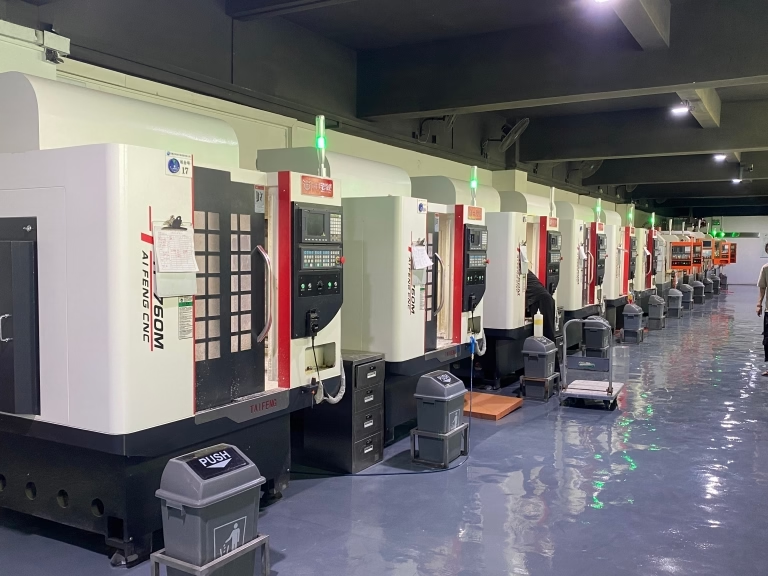
The second check is the process chain. Machining, heat treatment, finishing and inspection may sit in four different buildings. Every handoff adds a transport queue. Vertically integrated shops move the part from a 5-axis center to an anodizing line to a CMM without a truck ride, which is where days disappear.
- 1Quote plus DFM in 12 hoursA concrete benchmark for the administrative half of speed.
- 2Production start in 24 hoursOnly meaningful if material is already in stock or on the cut list.
- 3Parts ship in 3–5 daysApplies to typical prototype and small-batch work, not to every geometry.
Tolerance, surface finish and the numbers behind them
A shop that lists ±0.005 mm is telling you about its best case, not about your part. Tolerance applies per feature. A 200 mm aluminum bracket with a bored bearing seat can hold tight on the bore and stay loose everywhere else. That is normal and it is cheaper.
Surface finish follows the same logic. As-machined surfaces land around Ra 1.6–3.2 μm. A fine finish in the Ra 0.2–0.8 μm range usually needs a separate pass, a different tool, or a finishing operation after machining. Tell the shop which surfaces actually mate or seal.
Materials change what is realistic. Aluminum 6061 and 7075 cut fast and hold tight tolerance well. Stainless 316L and 17-4PH work-harden, so aggressive feed rates cause tool wear and chatter. Titanium TC4 (Ti-6Al-4V) and Inconel need slower passes and more tool changes, which lengthens the schedule.
If your drawing calls for a wall thinner than about 0.8 mm in aluminum or 1.0 mm in stainless, expect the shop to ask about support and workholding before quoting a firm date.
- 1Call out critical features onlyBlanket tolerances on non-mating surfaces add cost without adding function.
- 2Separate sealing surfacesMark them so the shop can plan a finishing pass.
- 3Match material to scheduleAluminum is the fast default; titanium and Inconel add days.
Lead time, MOQ and what a fast quote should contain
Lead time has three parts: quoting, material, and machining plus finishing. A supplier can control the first and third. Material is the variable nobody likes to discuss. Ask whether the quoted date assumes stock on hand or a purchase order to a mill. The answer changes the date by a week or more.
A useful quote states the ship date, not the machining start date. It also names the inspection step. A historical late-delivery probability below 2% is a reasonable benchmark to ask about, because it forces the supplier to describe how they track jobs, not just how fast their machines run.
MOQ is the quiet cost driver. A shop with no minimum order quantity lets you run one prototype and then 10,000+ parts on the same process. A shop with a per-part MOQ pushes you into tooling or into batching parts you do not need yet. For prototype work, MOQ is often a bigger schedule risk than price.
- 1Ship date, not start dateAsk for the date the part leaves the building.
- 2Material statusStock vs. mill order is a one-week difference.
- 3No MOQOne prototype to 10,000+ part runs on the same setup.
Certifications and confidentiality for regulated programs
Certifications are not decoration. They tell you which quality system the shop already runs. ISO 9001:2015 covers general quality management. IATF 16949:2016 is the automotive and EV requirement. ISO 13485:2016 applies to medical devices. ISO 27001:2022 covers information security, which matters when your drawings are the valuable part.
Check the scope on the certificate, not just the logo. A certificate that covers trading rather than machining does not carry the same weight. Ask for the certificate number and the issuing body. A supplier who can answer in one email is organized; one who forwards a PDF with no explanation is not.
Confidentiality usually runs alongside this. Secure uploads and an NDA available on request are baseline for aerospace, medical and robotics work. For humanoid robotics and EV programs, motor housings, gearbox plates and sensor brackets often carry geometry that should not sit in an open inbox.
- 1ISO 9001:2015General quality baseline.
- 2IATF 16949:2016Automotive and EV programs.
- 3ISO 13485:2016Medical device components.
- 4ISO 27001:2022Drawing and data security.
Step by step: how to run a fast CNC order without surprises
The sequence that keeps a 3–5 day schedule intact.
- 1Send a STEP file with a 2D drawingThe STEP defines geometry; the 2D drawing carries tolerances, datums and finish calls. Include material grade and quantity.
- 2Read the DFM note before the priceLook for thin-wall warnings, minimum tool radius and any feature the shop says needs a second setup.
- 3Confirm the tolerance per featureMark the two or three features that mate, seal or locate. Leave the rest at general tolerance to keep the schedule short.
- 4Agree on the material sourceAsk whether the quoted date assumes stock. If the mill order is needed, add the realistic days to your plan.
- 5Lock the finish and inspection planState anodizing type, plating or passivation, and whether you want dimensional reports with the shipment.
- 6Get the ship date in writingThe date should be from PO release to shipment, and it should include finishing and 100% inspection.
- 7Review the first article before the run continuesOn 10,000+ part runs, approve the first article so a small setup error does not repeat across the batch.
Questions buyers ask before ordering
How fast can a custom CNC part realistically ship?
Quotation and DFM analysis within 12 hours, production start within 24 hours, and parts ship in 3–5 days for typical prototype and small-batch work.
Complex geometry, titanium or Inconel, and multi-step finishing add time. Ask for the ship date from PO release, not from machining start.
What is the smallest order you can run?
There is no minimum order quantity. The same process covers one prototype and 10,000+ part runs.
That matters for bridge production: you can validate a design before committing to tooling.
Which tolerances should I put on the drawing?
Put ±0.005 mm only on features that mate, seal or locate. Use general tolerance elsewhere.
A drawing with tight tolerance on every surface raises cost and can push the ship date, because it forces extra setups and more inspection time.
Can you machine large parts?
Maximum processing size is 4,000 mm, with travel of 4,000 × 400 × 150 mm on the large machines. Medium travel includes 750 × 1,150 × 550 mm and 600 × 600 × 600 mm.
A Ø400 mm rotary table supports round and cylindrical features that would otherwise need a second setup.
How do you handle my drawings and IP?
Uploads are secure and confidential, and an NDA is available on request. Information security is covered by ISO 27001:2022.
For aerospace, medical and robotics programs, ask for the NDA before you send the first STEP file.
What do I get with the shipment?
Every order goes through raw material check, in-process monitoring and 100% inspection before shipment, with a 99.99% qualification rate.
Inspection reports are available on request. Ask for them when the part is going into a regulated assembly.
Send your drawing and get a quote with DFM notes
Share a STEP file and a 2D drawing. We return a quotation and free DFM analysis within 12 hours, with the ship date stated from PO release.
12-hour quoteNo minimum order quantity100% inspection before shipmentNDA on request
More machining notes and shop updates
We publish setup notes, tooling trials and inspection data from the factory floor.











