
CNC Towers: Five Essential Characteristics That Decide Your Part
A CNC tower is the column and spindle structure that carries the cutting tool. Its stiffness, thermal behavior and tool-change layout set what a machine can hold. This page explains the five characteristics that matter when you read a machine spec or quote a part.
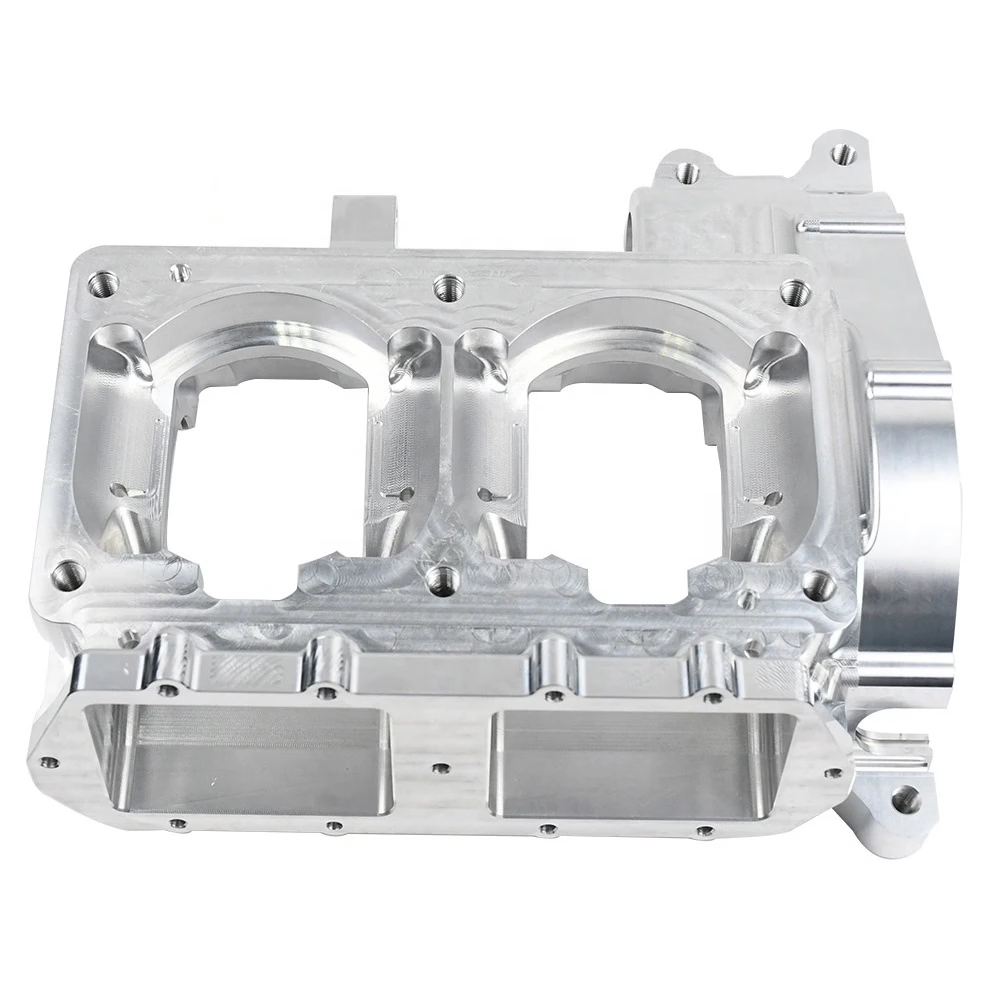
What a CNC Tower Actually Is
In most machine catalogs the tower is the vertical column that carries the spindle head, plus the guideways and the drive train behind it. On a gantry mill the same job is done by a bridge. Either way, the tower is the load path between the cutting edge and the floor.
That path matters more than the control brand. A tower that flexes 20 μm under a 2 kN cut will leave a taper on a deep bore no matter how good the servo tuning is. Stiffness is set by casting mass, rib layout and guideway type, not by spindle rpm.
The tower also carries the tool changer, the coolant lines and often the rotary table on a trunnion machine. So it decides two things at once: how accurately the tool meets the part, and how fast the machine can move between two different tools without losing that accuracy.
When an engineer says a machine is rigid, they usually mean the tower does not twist under load. That is measurable. Push a dial indicator against the spindle nose, load the table with a known force and watch the reading. A well-built CNC tower returns to zero within a few microns.
This is why two machines with the same 12,000 rpm spindle and the same controller can behave very differently on the same part. The tower geometry, not the electronics, sets the ceiling on what the cut can hold.
Static and Dynamic Stiffness
Stiffness is the first characteristic because everything else depends on it. Static stiffness is how far the tool deflects under a steady load. Dynamic stiffness is how the structure behaves when that load changes thousands of times per second during a milling cut.
Cast iron absorbs vibration well because of its internal damping. Welded steel towers are lighter and cheaper to build, but they ring. A fabricator can fill a steel column with polymer concrete or sand to recover some damping, though the result rarely matches a good casting for chatter resistance.
The practical number to ask for is the deflection at the spindle nose under a specified force. If a supplier cannot give that figure, ask for a cutting test instead. A 50 mm deep slot in 4140 at a fixed feed and speed will show chatter marks if the tower is soft.
Dynamic stiffness also sets the limit on tool overhang. A long slender end mill in a soft tower will chatter at a depth of cut that a short tool handles without complaint. The tower is not the only variable, but it is the one you cannot change after the machine is installed.
For our own work, the 16 simultaneous five-axis centers hold ±0.005 mm on features that a lighter three-axis frame would lose to vibration. That is not a controller feature. It is mass and rib design doing their job.
Thermal Stability and Growth
A spindle running at 12,000 rpm for two hours will grow. The tower grows with it. Ballscrew shafts stretch as they warm, and the column leans toward the heat source. On a 500 mm part, a 10 °C shift in the frame can move the tool by 15 to 25 μm.
Machine builders fight this in three ways. They pre-load the ballscrew and cool it with oil. They mount the spindle in a cooled housing. And they put temperature sensors on the casting so the control can compensate in software. All three cost money, and all three show up in the price of the machine.
For job shops, the practical answer is warm-up. Run the spindle at 60 percent of maximum for 20 to 30 minutes before the first finish pass. On a cold Monday morning this is the difference between a bore that holds ±0.005 mm and one that drifts out of tolerance by noon.
In a temperature-controlled room held at 20 ± 1 °C, thermal drift is small and predictable. In a workshop that swings from 12 °C to 30 °C across the year, the same machine will need more frequent compensation and more frequent proving.
If your part has a tight true-position callout across a long dimension, ask how the shop handles thermal growth. A shop that measures parts at the machine without letting them cool is measuring a moving target.
Guideway Type and Axis Travel
The tower slides on either linear roller guides or box ways. Linear guides are fast, need little lubrication and suit high-speed finishing. Box ways are slower but carry heavier loads and damp vibration better, which is why heavy roughing machines still use them.
Travel figures tell you what the tower can reach, not what it can cut accurately. A machine rated 4,000 × 400 × 150 mm will not hold ±0.005 mm at the far end of that 4,000 mm stroke unless the tower is built for it. Reach and accuracy are different specifications.
Look at the ratio of travel to column size. A long X stroke on a short column means the saddle hangs far out and the tower sees a large bending moment. That is fine for sheet-metal drilling and poor for mold work.
On a trunnion machine, the rotary table sits inside the tower structure, so the table diameter and the tower height have to be chosen together. A Ø400 mm rotary table under a tower with limited Z travel will not clear tall parts.
For most parts between 500 mm and 750 mm, a compact tower with 500 × 500 × 450 mm travel and a 12,000 rpm spindle covers the work. Buying a large-travel machine for small parts adds thermal mass you have to manage for no gain in accuracy.
Tool Change Layout and Chip Control
The tool changer is mounted on or beside the tower, so its design is part of the tower's characteristics. A side-mount drum with 24 pockets changes tools in about 1.5 seconds. A chain magazine with 60 pockets takes longer but lets you leave tools set up across a full job.
Chip evacuation is the quiet problem. On a vertical tower, chips fall toward the operator and pile up against the column. On a horizontal or trunnion layout, gravity pulls chips away from the cut. That single difference often decides whether an unattended night shift runs clean.
Through-spindle coolant at 70 bar removes chips from deep holes that flood coolant cannot reach. It also needs a rotary union in the spindle, which adds a maintenance item. For holes deeper than five times the diameter, it is usually worth it.
If your part has many small holes and tight cycle times, count the tool changes. Shaving 0.8 seconds off each change across 400 changes per day recovers more than five minutes of spindle time. That is a tower and changer decision, not a cutting-tool decision.
Chip control also affects surface finish. Recut chips leave marks on a finished wall. A tower layout that clears chips from the cutting zone reduces the need for a second finishing pass.
Integration Into Flexible Manufacturing Systems
A single CNC tower is a machine. Several towers linked by a pallet pool, a robot and a central tool store become a flexible manufacturing system. The tower has to be designed for that from the start, because retrofitting a pallet interface onto a standalone machine is expensive.
The key requirement is repeatability, not peak accuracy. An FMS runs unattended, so the machine must return to the same position after 200 pallet changes, not just after one. That means absolute encoders, a clean pallet clamping interface and a tower that does not shift with temperature.
Pallet pools work best when the parts share a fixture family. If every job needs a new fixture, the setup time eats the unattended hours. Standardize the pallet size and the locating method before adding a second tower.
A robot load cell or a pallet changer also needs a machine that reports its status over the network. Older towers with proprietary interfaces are hard to integrate. Ask about the protocol before you buy, not after.
For runs between 50 and 10,000 parts, a small FMS with two or three towers usually beats a single large machine. The reason is simple. When one tower is down, the others keep cutting. That redundancy is worth more than the extra spindle speed of a single flagship machine.
Choosing a CNC Tower Layout by Part and Volume
Use this table to match the tower type to the job, then confirm the numbers with the shop.
| Part / job | Tower layout | What it gives you |
|---|---|---|
| Prototype, 1–50 parts | 3-axis vertical, 500 × 500 × 450 mm | Low setup cost, fast quote |
| Complex 5-face part | Trunnion with Ø400 mm rotary table | One setup, ±0.005 mm |
| Long extrusion, 4,000 mm | Long-bed with 4,000 × 400 × 150 mm | Reach, not tight tolerance |
| Heavy roughing, steel | Box-way column, 4-axis | Damping and load capacity |
| Unattended 200+ pallets | Linked towers with pallet pool | Repeatability over accuracy |
| Deep holes over 5× Ø | Any tower with 70 bar through-spindle | Chip clearing and finish |
Which Tower Fits Your Part
If your part fits in a 500 mm cube and needs tight tolerance, choose a compact trunnion tower and spend the budget on thermal control. If your part is long, light and drilled rather than milled, choose long travel and accept looser tolerance. If you run the same family every week, choose linked towers with a pallet pool.
Common Questions About CNC Towers
Does a heavier CNC tower always cut more accurately?
Not always. Mass helps damping and thermal inertia, but a heavy tower with worn guideways will still lose position.
The useful measure is deflection at the spindle nose under a known force, plus repeatability after a warm-up cycle. Ask for both figures.
How long should a machine warm up before a finish pass?
For a 12,000 rpm spindle, run at about 60 percent of maximum speed for 20 to 30 minutes. That covers most of the thermal growth.
If the shop is not temperature controlled, add a proving cut on scrap before the first good part.
Can a CNC tower be added to an existing FMS?
Sometimes, but it is rarely cheap. The pallet interface, the clamping repeatability and the network protocol all have to match.
It is usually better to buy towers that were designed for pallet integration from the beginning.
What tolerance can a five-axis tower hold in production?
On our machines, ±0.005 mm on features that fit inside the work envelope. Surface finish runs from Ra 0.2–0.8 μm on fine work to Ra 1.6–3.2 μm as machined.
Tolerance depends on the feature, the material and the fixturing, so we confirm it during DFM review.
Which materials are hard on a CNC tower?
Titanium and Inconel put high cutting forces through the structure at low speed. They expose a soft tower quickly.
Aluminium and brass cut easily and rarely show tower limits. The tower becomes the constraint mainly on steel and superalloys.
Do I need a large-travel tower for a 600 mm part?
No. A 750 × 1,150 × 550 mm or 600 × 600 × 600 mm envelope usually covers a 600 mm part with room for the fixture.
Buying extra travel adds thermal mass and cost without improving accuracy on that part.
Send Your Part, Get a Tower Recommendation
Upload a STEP file and we will return a quotation with a free DFM analysis within 12 hours.
12-hour quote100% inspectionNo minimum order
More CNC Machining Notes
We publish setup notes, tooling trials and inspection data from the factory floor.











