
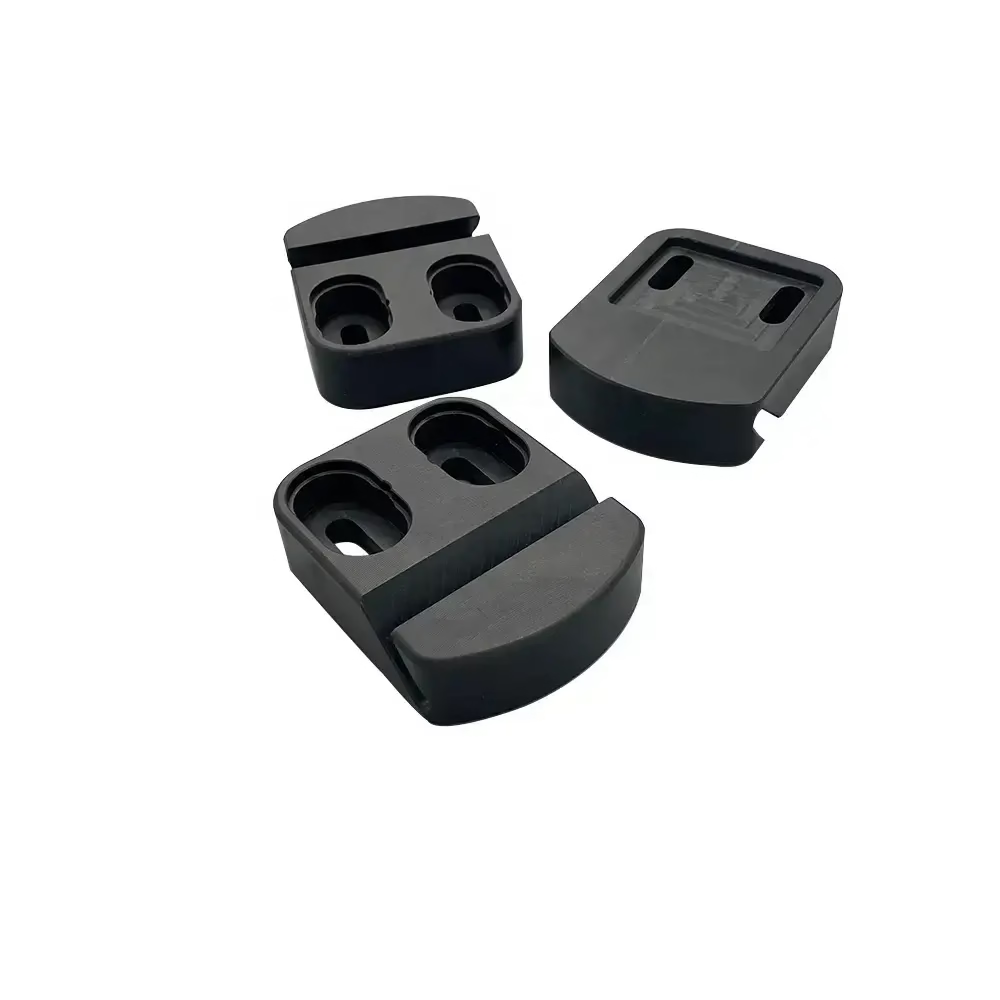
HDPE CNC processing service
This page is for engineers and buyers selecting an HDPE CNC processing service for machined parts. It covers what HDPE does well, where machining goes wrong, and the checks that separate a capable shop from a cheap quote. Read it before you send the drawing out.
In this article
- 1
- 2
- 3
- 4
- 5
- 6
- 7
- 8
Key takeaways
What to compare across HDPE CNC suppliers
Use this as a checklist when you read quotes side by side.
| Criterion | What good looks like | Warning sign |
|---|---|---|
| Tolerance | ±0.005 mm stated with heat control | "As close as possible" with no number |
| Finish | Ra 0.8–1.6 μm on sealing faces | One finish value for every surface |
| Tooling | Sharp polished carbide, air blast | Coolant-only setup on HDPE |
| Workholding | Soft jaws, vacuum, low clamp force | Hard jaws on thin-wall parts |
| MOQ | No minimum, 1 part to 10,000+ | High MOQ before a prototype |
| Lead time | Quote in 12 h, ship in 3–5 days | Vague "2–4 weeks" wording |
| Inspection | 100% before shipment, reports on request | No mention of measurement |
| Certification | ISO 9001 plus scope-matched certs | Logos with no certificate scope |
The verdict on choosing an HDPE CNC processing service
Pick the shop that can explain its tooling, clamping and inspection plan for your specific part. Price follows capability, not the other way around.
When HDPE is the right choice for CNC machining
HDPE is a high-density polyethylene. It is soft compared to aluminium, machines fast, and resists most acids, bases and salt water. Parts stay light and do not corrode. For fluid handling, food-contact fixtures, marine hardware and insulating spacers, that combination is hard to beat on cost.
It is not a structural plastic. It creeps under sustained load, expands roughly ten times more than steel for the same temperature rise, and softens well below the melting point of metals. If your part carries a constant load in a warm enclosure, HDPE will move over months.
Machining suits HDPE better than moulding when volumes are low, geometry is complex, or the design is still changing. A router or mill can cut a channel, groove or bore in one setup. Tooling cost stays at zero, so a redesign costs a new program, not a new mould.
- 1Pick HDPE forChemical resistance, impact toughness, low weight, electrical insulation.
- 2Do not pick HDPE forHigh stiffness, tight thermal stability, load-bearing threads.
- 3Compare againstPOM for stiffness, PP for chemical resistance at lower cost, PEEK for heat.
Why HDPE machining goes wrong, and how a good shop prevents it
HDPE has a low friction coefficient. That sounds helpful, but it means the chip tends to rub instead of shear. Heat builds at the cutting edge, the material softens, and the tool starts pushing the surface instead of cutting it. The result is a torn, fuzzy finish and a dimension that springs back after the part cools.
The fix is a sharp, polished, high-rake cutter with a generous flute space. Air blast clears chips and carries heat away. Flood coolant can work, but it can also stain or stress-relieve the surface if the shop does not dry and handle the part carefully.
Clamping is the second failure point. HDPE deflects under load and springs back, so hard jaws squeeze a thin wall out of tolerance before the cutter touches it. Soft jaws machined to the part profile, or vacuum workholding, hold the part without marking it.
Elastic recovery is the third issue. The material pushes back against the tool after it passes, so a finishing pass should be light. Roughing leaves 0.3–0.5 mm of stock, and the finishing pass removes it in one or two passes at moderate feed.
- 1Cutter geometrySharp, polished, high rake, two or three flutes for chip clearance.
- 2Heat controlAir blast first; keep the chip from recutting and the part below softening.
- 3ClampingSoft jaws or vacuum. Never clamp a thin wall with hard jaws.
- 4Finishing passLight depth, moderate feed, single pass over the surface.
What to verify in an HDPE CNC processing service
Machine count is a weak signal on its own. Ask instead which machines run plastic. A shop with 127 high-precision CNC machines, including 16 simultaneous 5-axis machining centers and 27 three-axis machines, can dedicate a spindle to plastics so chips from metal never contaminate the cut.
Travel matters if your part is long. GreatLight handles up to 4,000 mm maximum processing size, with work envelopes of 4,000 × 400 × 150 mm on the large machines and 750 × 1,150 × 550 mm or 600 × 600 × 600 mm on the mid-size ones. A Ø400 mm rotary table covers round parts that need indexing.
Quality control is where HDPE quotes diverge most. Ask whether inspection is 100% before shipment, whether in-process checks happen after each operation, and whether dimensional reports come with the parts. A shop that measures only the first article is not controlling a plastic part that moves with temperature.
Certification should match your industry. ISO 9001:2015 is the baseline. IATF 16949:2016 matters for automotive and EV parts, ISO 13485:2016 for medical devices. ISO 27001:2022 covers information security, which matters when your drawings are confidential.
- 1Dedicated capacityAsk for a plastic-only spindle or a documented cleaning routine.
- 2Size rangeConfirm the work envelope before you assume the part fits.
- 3Inspection100% before shipment, raw material check, in-process monitoring, final inspection.
- 4Scope of certsA certificate only counts if the process and the site are in scope.
Lead time, MOQ and quoting signals
A clear quote includes the material grade, the finish, the tolerance, the inspection method and the ship date. If any of those are missing, the price is not comparable to another quote. You are comparing two different scopes.
MOQ is a useful filter. A service with no minimum order quantity can run one prototype and then a 10,000+ part production run without re-quoting. That removes the awkward gap between prototype and production, which is where many plastic projects stall.
Lead time should be specific. A quotation and free DFM analysis within 12 hours, production start within 24 hours, and parts shipping in 3–5 days is a defined workflow. Compare that with a supplier that will not commit to a date until after you place the order.
Confidentiality belongs in the comparison too. Secure uploads and an NDA on request are low-cost protections that tell you how the shop treats customer drawings. If you are prototyping a product that is not public, ask before you send files.
- 1Quote completenessMaterial, finish, tolerance, inspection, date. All five, or ask again.
- 2MOQNo minimum means one prototype is a valid order.
- 3TimingLook for a quote window and a production start, not just a ship estimate.
- 4NDARequest it before uploading sensitive geometry.
Design details that change the price of an HDPE part
Wall thickness drives both cost and stability. HDPE moves with temperature, so a uniform 3–6 mm wall behaves better than a part that jumps from 2 mm to 12 mm. Thick sections cool slower and can pull the part out of flat.
Deep pockets and small internal corners are the second cost driver. A cutter needs a radius to enter, so a square internal corner forces either a smaller tool or an EDM-style process that HDPE does not need. Add a corner radius at least one third of the pocket depth.
Threads in HDPE are weak. A metal insert, a through-bolt with a washer, or a larger coarse thread lasts longer. If the design needs repeated assembly, plan for an insert rather than cutting threads directly into the plastic.
Surface finish is a choice, not a default. Ra 1.6–3.2 μm is a normal as-machined finish. Ra 0.8–1.6 μm suits sealing faces and sliding contact. Ra 0.2–0.8 μm is possible but costs more and rarely changes how an HDPE part performs.
- 1Uniform walls3–6 mm nominal. Avoid thick-to-thin transitions.
- 2Pocket cornersRadius at least one third of the depth.
- 3ThreadsUse inserts or coarse threads; avoid fine threads in plastic.
- 4FinishSpecify Ra per surface, not one value for the whole part.
Step by step: how to qualify an HDPE CNC processing service
Run these checks in order. Each one can disqualify a supplier before you spend money.
- 1Send the drawing with a tolerance calloutInclude material grade, critical dimensions and finish. A shop that quotes without asking which dimensions matter is guessing.
- 2Ask which machine runs the partGet the work envelope and whether the spindle is dedicated to plastics. Confirm your part fits before the quote is final.
- 3Ask for the inspection plan100% before shipment, in-process checks after each operation, and reports on request. If the answer is "we check the first one", move on.
- 4Confirm tooling and workholdingSharp polished cutters with air blast, soft jaws or vacuum for thin walls. Hard jaws on a 2 mm wall is a red flag.
- 5Check the certificate scopeISO 9001:2015 baseline. Add IATF 16949 for automotive, ISO 13485 for medical. Ask which site holds the certificate.
- 6Order one prototype firstNo minimum order quantity means you can validate fit, finish and flatness before committing to a production run.
- 7Review the first article against the reportCompare measured values to the drawing, not to the sample. If the report is missing, request it before you release the next batch.
Questions buyers ask about HDPE CNC processing
Can HDPE be machined to ±0.005 mm?
Yes, on a controlled process. The tolerance is achievable when the shop manages cutting heat, uses sharp tooling with air blast, and clamps the part without distorting it.
The practical limit depends on the feature. A short bore or a flat face holds ±0.005 mm better than a long thin wall, which will still move with temperature after machining. Tell the shop which dimensions are critical.
Why does my HDPE part have a fuzzy surface?
Fuzzy edges usually come from a dull cutter, too low a surface speed, or chips recutting the surface. HDPE shears cleanly only when the tool is sharp and the chip clears.
Ask for a polished, high-rake cutter and air blast. If the shop is running the same parameters it uses on aluminium, the finish will not improve.
Is coolant needed when machining HDPE?
Not always. Air blast handles most HDPE cuts and avoids staining. Coolant can help on deep pockets where chips are hard to clear.
Either way, the shop should dry the part and handle it cleanly if the part is for food or medical use. Residual coolant on a porous plastic surface is hard to remove.
What is the minimum order quantity for HDPE parts?
At GreatLight there is no minimum order quantity. You can order one prototype and later run 10,000+ parts without changing suppliers or re-qualifying the process.
That matters for HDPE because design changes are common after the first fit check. A low-volume first order is cheaper than committing to a large run early.
How long does an HDPE machining order take?
Quotation and free DFM analysis come back within 12 hours. Production can start within 24 hours, and parts ship in 3–5 days.
These are the standard windows, not a guarantee for every geometry. Complex 5-axis parts or large panels may need a longer slot, and the quote will say so.
Which certifications should an HDPE supplier hold?
ISO 9001:2015 is the baseline quality certificate. For automotive and EV work, look for IATF 16949:2016. For medical devices, ISO 13485:2016. ISO 27001:2022 covers information security.
Check that the certificate names the site that will make your part. A group certificate does not automatically cover every factory.
Send your HDPE drawing for a DFM review
Upload the file and get a quotation plus free DFM analysis within 12 hours. Uploads stay secure and confidential, with an NDA available on request.
12-hour quoteNo minimum order100% inspection
More from the shop floor
We publish setup notes, tooling trials and inspection data from the factory floor.











