
How Machine Tools Generate High Yields on a Production Floor
This guide is for engineers and buyers who have to judge a shop before the first PO. It covers the numbers that decide whether machine tools generate high yields: spindle hours, uptime, tolerance spread, and tooling life. By the end you can read a quote sheet and a capability list and know which claims to test.
In this article
- 1
- 2
- 3
- 4
- 5
- 6
- 7
Key takeaways
Which machine configuration suits which part
Use the part geometry and volume to pick the cell, not the machine brand.
| Part type | Best cell | Why | Skip it when |
|---|---|---|---|
| Prismatic, 4–6 faces | 5-axis mill | One setup, no re-fixturing error | Only two faces are machined |
| Round with cross holes | Mill-turn center | Turning and milling in one cycle | No cross features or slots |
| Simple turned shaft | 3-axis lathe | Lower hourly rate, faster cycle | Run needs tight true position |
| Large frame, long travel | 4,000 mm gantry | Fits in one setup | Part is under 500 mm |
| Tight-tolerance pocket | 5-axis with probing | On-machine check between cuts | Tolerance is looser than ±0.05 mm |
| Prototype, one piece | 3-axis or 5-axis | No tooling cost | Volume run needs a die |
| High-count bracket | Mill-turn or die casting | Cycle time drives unit cost | Only a few pieces are needed |
The verdict: match the cell, then measure
Machine tools generate high yields when the cell fits the part, the spindle hours are real, and the inspection plan is written down. Ask for spindle hours, first-pass yield, and the capability number before you approve the first article.
Why machine tools generate high yields only when the cell matches the part
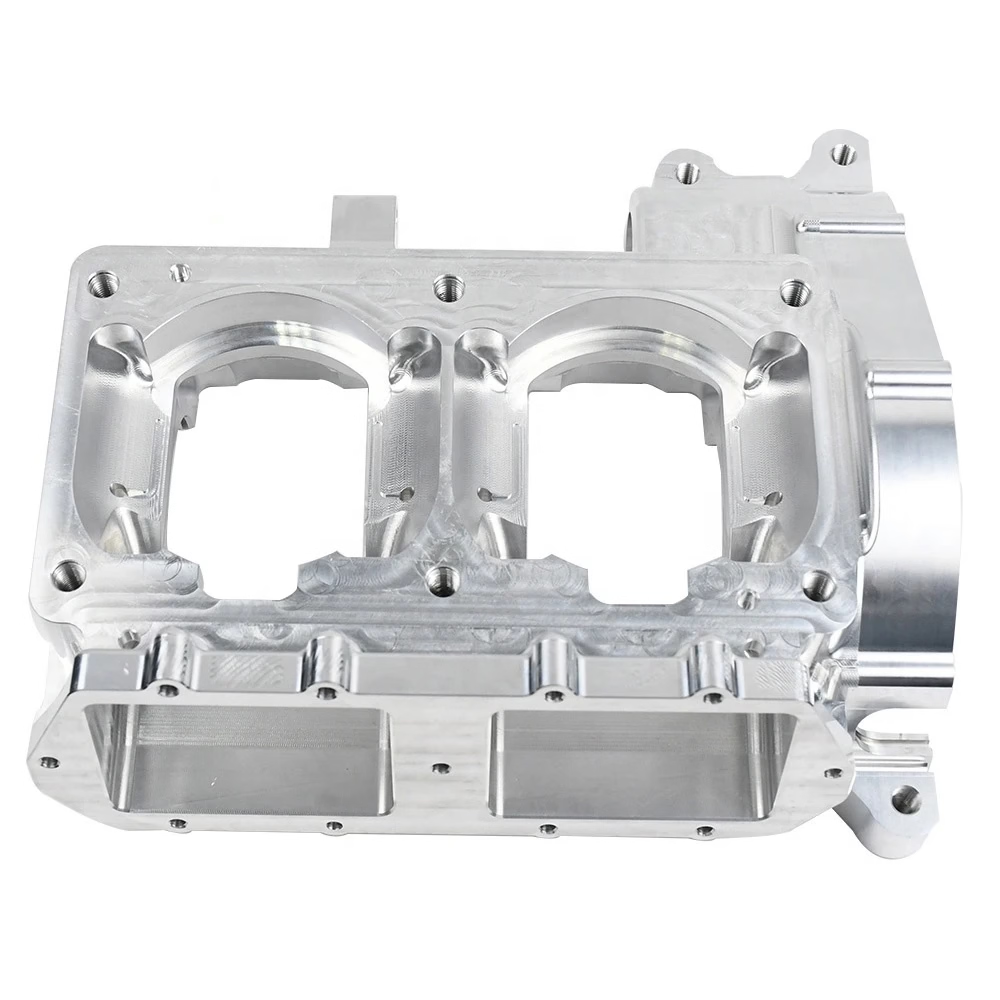
A machine that is wrong for the part will still cut metal. It will just cut it slowly, with more setups and more scrapped parts. That is the quiet reason yields drop. The machine is not broken. The cell is wrong. A 5-axis center on a simple turned shaft is slower than a lathe because program, setup, and inspection all take longer for no gain.
The first question is feature count. Count how many faces and angles need machining. If the answer is two, a 3-axis machine is the right call and it will run cheaper. If the answer is five or six faces with tight position between them, a 5-axis center removes the re-fixturing steps that cause stack-up error. Each re-fixture adds a chance to lose 0.02 mm or more.
The second question is volume. On a 10,000-piece run, cycle time decides unit cost more than machine rate. On a five-piece aerospace bracket, setup time decides it. The same shop should run both cells, and a good supplier will tell you which one your part belongs in before quoting.
The third question is tolerance. If the print calls for ±0.005 mm, the machine, the thermal control, and the probe all matter. If the print calls for ±0.05 mm, paying for a 5-axis cell adds cost with no quality gain. Match the cell to the print, not to the machine catalog.
How to read a machine tools generate high yields claim
Every shop says it has high-precision machines. That phrase means nothing on its own. Ask for the spindle hours per week, the number of shifts, and the uptime figure for the past quarter. A shop running three shifts on 127 machines has very different capacity from a shop running one shift on the same list.
Spindle hours are the honest measure. A machine sitting idle still costs money and still appears on the equipment list. If the list says 16 simultaneous 5-axis centers but the shop runs one shift, effective 5-axis capacity is closer to five machines. That gap shows up as longer lead times and rushed setups.
Tool life is the second number. A cutter that lasts 40 minutes per edge forces a stop every cycle or two. A cutter that lasts 120 minutes per edge runs through a shift without an operator walking over. The difference is not the tool alone. It is the tool, the coolant, the feed and speed, and the rigidity of the setup.
Ask how the shop measures yield. A real answer names the metric: first-pass yield, scrap rate per run, or rework hours per week. A vague answer about quality being a priority is a sign the shop does not track the number that matters.
- 1Ask for spindle hoursWeekly hours across the fleet, not the machine count.
- 2Ask for first-pass yieldPer run or per month, with a definition of what counts as a pass.
- 3Ask about tool lifeAverage minutes per edge on the material in your part.
- 4Ask who runs the night shiftLights-out capacity changes lead time more than spindle speed.
Tolerance, finish, and inspection: the numbers behind yield
Tolerance and finish drive yield because they drive scrapped parts. A process that holds ±0.005 mm on a stable part may drift on a thin wall or a long bore. The print tolerance is a target. The process capability is what the shop actually delivers across a run.
Surface finish follows the same logic. A Ra 0.8–1.6 μm finish is a normal machined result with the right insert and feed. Pushing to Ra 0.2–0.8 μm needs a different tool, a lighter pass, and often a second operation. That extra operation adds handling, and handling adds the risk of a scratch or a ding.
Inspection is where yield gets protected or lost. A shop that inspects 100% before shipment catches problems before they reach the customer. A shop that samples may ship a bad batch. Ask whether reports come with the parts and what the report covers: critical dimensions, material cert, or both.
On tight work, on-machine probing matters. A probe that checks a bore between cuts catches drift before the next feature is cut. Without it, the error is only found at final inspection, when the part is already near finished. Good shops treat probing as part of the process, not as a final gate.
Lead time, MOQ, and the quote sheet: yield for the buyer
Yield is not only a shop-floor number. It is also whether the parts arrive when the schedule needs them. A supplier that quotes a 12-hour turnaround on the quote and DFM analysis and starts production within 24 hours keeps the buyer's line moving. A supplier that takes a week to answer a question adds a week to the program.
MOQ is the other lever. A shop with no minimum order quantity can run one prototype and then a 10,000+ part production run on the same process. That smooths the transition from design to volume and avoids a second supplier qualification later.
Read the quote sheet for what is missing. Does it list material grade, finish, tolerance, and inspection scope? A quote that only gives a price per piece leaves the buyer guessing. Ask for the process plan, the inspection plan, and the lead time in writing.
Delivery risk deserves a number. Historical late-delivery probability below 2% is a trackable figure. Ask for it, and ask what caused the late deliveries that did happen. A supplier that can name the causes and the fixes is a supplier that tracks the process.
Step by step: how to qualify a machine shop for high yield
Run these steps in order. Each one filters out a class of supplier.
- 1Send the drawing and the annual volumeInclude material, tolerance, finish, and the number of pieces per year. This lets the shop pick the cell before quoting, not after.
- 2Ask which cell will run the partExpect a specific answer: 5-axis, mill-turn, 3-axis, or a gantry. A vague answer means the quote is not grounded in a process.
- 3Request the capability numberAsk for the process capability on the tightest dimension, not just the print tolerance. On ±0.005 mm work, ask how drift is controlled.
- 4Check the inspection planConfirm 100% inspection before shipment and ask what the report covers. Request a sample report with a similar part type.
- 5Confirm lead time in writingAsk for quote and DFM turnaround, production start, and shipping window as separate numbers. A single blended number hides the real schedule.
- 6Ask about tooling and fixture costOn a prototype, tooling should be near zero. On a volume run, ask how fixture wear is monitored, since worn fixtures shift dimensions over a run.
- 7Review the quality systemMatch certifications to your industry. ISO 9001:2015 for general work, IATF 16949:2016 for automotive, ISO 13485:2016 for medical, ISO 27001:2022 for data handling.
- 8Run a first-article and measureInspect the first article against the print and compare the spread to the promised capability. If it drifts, the process is not stable yet.
Frequently asked questions
What does high yield actually mean in CNC machining?
It means the share of parts that pass inspection the first time, across a full run, without rework. A shop can hold a tight tolerance on one part and still have low yield if the process drifts over a batch.
The useful number is first-pass yield per run, paired with the scrap rate. Ask for both, and ask how they are measured.
Do more machine tools always mean higher yields?
No. Count matters less than spindle hours and uptime. A shop with 127 machines running three shifts has far more effective capacity than a shop with the same list running one shift.
What matters is whether the right cell is available when your part is scheduled, and whether the setup is stable enough to repeat.
Which tolerances can a shop realistically hold?
On stable geometry with the right cell, ±0.005 mm is achievable. On thin walls, long bores, or heat-treated parts, the achievable spread widens.
Share the tightest dimension early. A shop that knows the critical feature can plan the process and the inspection around it instead of discovering the problem at final inspection.
How does surface finish affect yield and cost?
A Ra 0.8–1.6 μm finish is a standard machined result. Going to Ra 0.2–0.8 μm usually needs a second operation, a different tool, or a finishing step.
Each extra step adds handling. Handling is where scratches and dings happen, so a tighter finish can lower yield if the process is not set up for it.
What should I check before approving a first article?
Inspect the critical dimensions against the print and compare the spread to the capability the shop quoted. Check the finish on the functional surfaces, not just the cosmetic ones.
Ask for the inspection report and the material certificate. If the first article drifts, ask what changed before releasing the full run.
Can a shop run prototypes and volume on the same process?
Yes, if the cell is chosen correctly. A shop with no minimum order quantity can run one piece and then scale to 10,000+ parts without changing the process or the supplier.
Ask how the process plan changes between the prototype and the volume run. If it changes a lot, the prototype may not predict the production part.
Send your drawing and get a process plan
We quote and return a free DFM analysis within 12 hours, with the cell, tolerance, and inspection scope named in writing.
12-hour quote100% inspectionNo minimum order quantityNDA on request
More from the shop floor
We publish setup notes, tooling trials and inspection data from the factory floor.











