GreatLight CNC Machining Factory logo
CNC Machining
Rapid Prototyping
Materials
Industries
News
About GL

Get Instant Quote

Closed-Die Forging + CNC Finishing

Hot Forging

GreatLight closed-die forges carbon steel, alloy steel, stainless and titanium, then machines the parts on 127 CNC machines. Forging, heat treat and finishing sit under one roof, so dimensions stay under control from billet to finished part.

±0.005 mm after machiningNo minimum order quantityDFM feedback in 12 hoursIATF 16949:2016ISO 9001:2015100% inspection
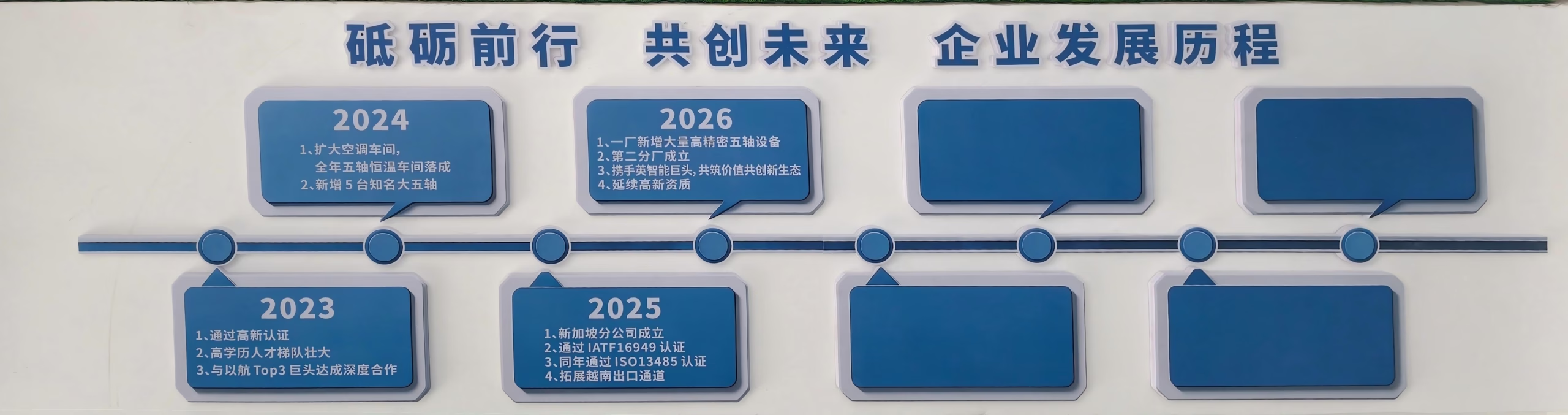
Forge ahead with determination and create the future together.
15 yearsForging and machining since 2011
3 plantsDongguan and Singapore
127 machinesHigh-precision CNC fleet
±0.005 mmMachined tolerance on forged blanks
Where it goes wrong

Four problems that show up after the die is cut

Most trouble is not the press. It is the decisions made earlier.

01

The die was cut before the draft angles were checked

A 1° draft on a 60 mm deep pocket pulls the part out with torn corners. Rework means welding the die, re-sinking it and re-qualifying. Four to six weeks gone, and the second cut is never as clean as the first.

02

Flash was planned for, then machined off

Flash lines add 0.8–2 mm of stock on the parting plane. If the trim die is worn, that stock varies side to side and the CNC op has to cut uneven depths. Tool life drops and the first article may not clean up.

03

Scale and shrink were guessed

Steel shrinks about 1% from forging temperature, but not evenly. Ribs cool faster than bosses. A die built to nominal size often lands 0.4–0.7 mm off, and the finishing operation has to chase it.

04

Heat treat was quoted somewhere else

Hardening after forging moves the part. If the heat treater and the machinist never talk, the finish cut is programmed to a size that no longer exists. Distortion shows up as a bowed shaft or an out-of-round bore.

How we run it

Forge to near net shape, then machine to drawing

One team owns the die, the heat treat cycle and the CNC program.

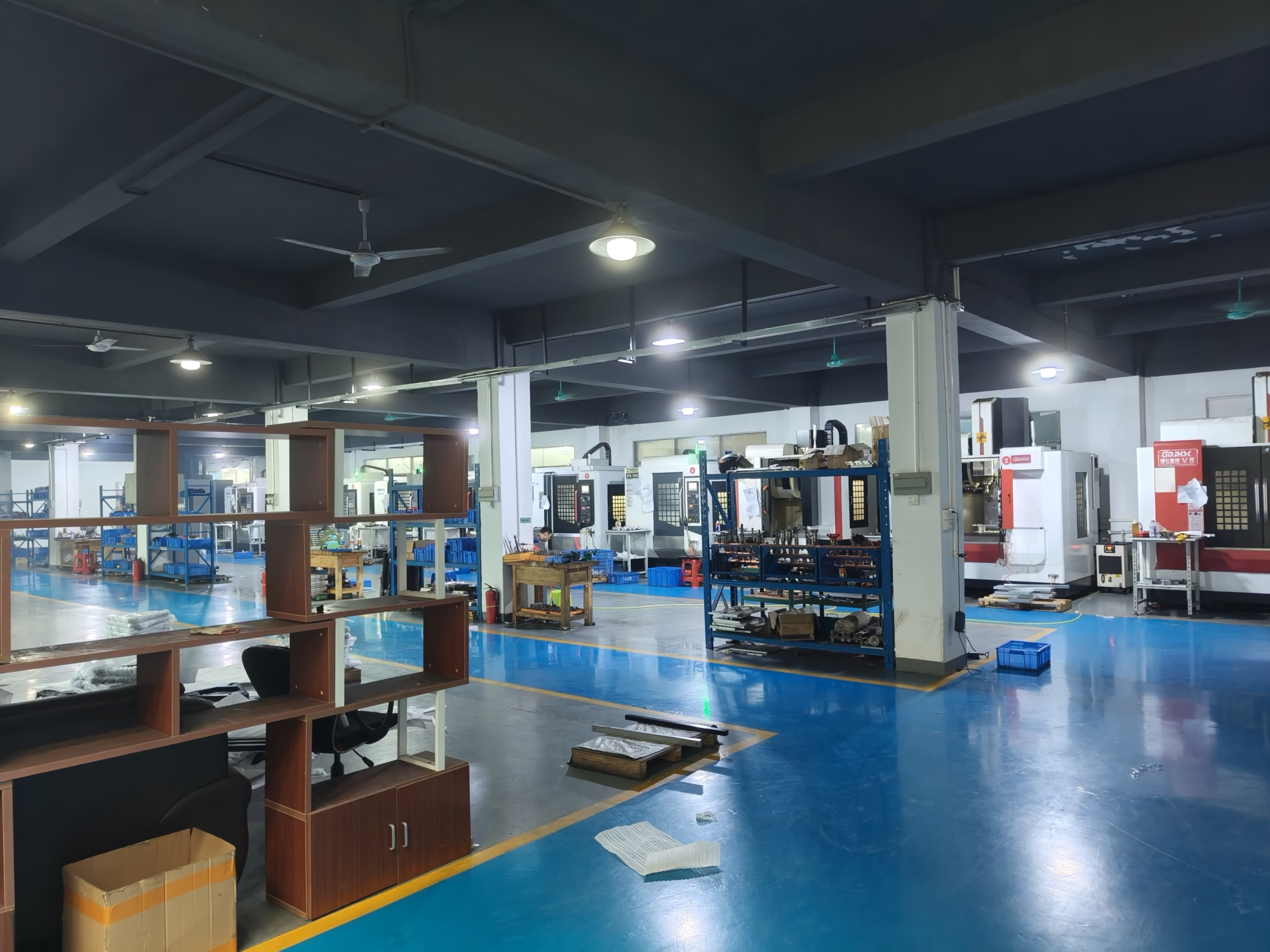
GreatLight Metal new factory building
Process control

Closed-die forging with a real trim step

We hot forge between 1,050 °C and 1,250 °C depending on grade. Billets go through a controlled furnace, not a hand torch, so the whole batch reaches temperature before the first strike. Blockers and finishers are struck in sequence, then trimmed in the same setup.

The payoff is grain flow. A forged hook or flange has continuous fibers that follow the part shape. A part hogged from bar has cut fibers at the surface. Under fatigue load that difference decides whether a crack starts at 50,000 cycles or 500,000.

  • 1
    Near-net blanks0.5–1.5 mm stock left for the finishing cut, not 5 mm
  • 2
    Closed-die and flashlessFlashless where draft and volume allow, closed-die for deep ribs
  • 3
    In-house trim and coiningFlash removed and parting line flattened before machining
  • 4
    Heat treat in the same flowNormalize, quench and temper scheduled with the machining sequence

Get Instant Quote

CNC Lathe Technical Specifications Terminology
When forging is the wrong call

Knowing when to say no saves the most money

Forging earns its tooling cost when a part sees load, shock or fatigue. A bracket that carries 2 tonnes, a knuckle that steers a vehicle, a hook that lifts. Those parts need grain flow and a dense surface. Forging gives both.

If the part is a low-load cover with a few holes, a die is wasted money. Die casting, vacuum casting or machining from plate will land cheaper and faster. We will say so in the DFM note rather than quote you a die you do not need. Same for quantities under a few hundred pieces with simple geometry.

  • 1
    Good fitLoad-bearing, fatigue-critical, shock-loaded, safety-relevant parts
  • 2
    Good fitRuns where tooling cost spreads over hundreds to thousands of pieces
  • 3
    Poor fitThin cosmetic panels, tight internal cavities, one-off prototypes
  • 4
    Poor fitParts that can be cut from plate with no strength penalty

Get Instant Quote

Material selection

What we forge and what it is used for

Stock grades held for forging and finishing.

Material groupGradesTypical parts
Carbon steel1018, 1045, A36Shafts, yokes, levers, brackets
Alloy steel4130, 4140, 4340Knuckles, hooks, high-load links
Stainless steel303, 304, 316, 316L, 17-4PHMarine hardware, valve bodies, food equipment
Tool steelTool steel gradesPunches, dies, wear plates
Aluminum6061, 6082, 7075Lightweight arms, housings, mounts
Titanium and nickelTA1, TA2, TC4 (Ti-6Al-4V), InconelAerospace fittings, high-temperature brackets
Copper alloysC101, C110, C36000Electrical contacts, bushings, terminals
What we do

Six services around the forging line

A forged blank is rarely the finished part. These are the steps we run in-house.

01

Hot forging

Closed-die and flashless forging in carbon steel, alloy steel, stainless, aluminum and titanium. Near-net blanks with 0.5–1.5 mm of finishing stock.

02

CNC milling and turning

127 machines including 16 simultaneous 5-axis centers and 16 mill-turn centers. Maximum part size 4,000 mm. Drilling, boring, threading and contouring after forging.

03

Heat treatment

Normalizing, hardening, quenching and tempering scheduled with the machining sequence so distortion is accounted for before the finish cut.

04

Surface finishing

Anodizing, electroless nickel, zinc, powder coating, black oxide, bead blasting, tumbling and polishing. Laser marking at 1.5 mm minimum character height.

05

Rapid prototyping

For design checks before the die is cut. Machined or printed prototypes in the same grade where possible, so the test means something.

06

Inspection and reporting

Raw material check, in-process monitoring and 100% final inspection before shipment. Dimensional and material reports on request.

Capability range

What the shop can hold

Numbers that decide whether your part fits our floor.

ItemCapability
Machined tolerance±0.005 mm (±0.0002 in)
Fine surface finishRa 0.2–0.8 μm
High-grade finishRa 0.8–1.6 μm
As-machined finishRa 1.6–3.2 μm
Maximum processing size4,000 mm
Large part travel4,000 × 400 × 150 mm
Rotary tableØ400 mm
Minimum order quantityNone, one piece to 10,000+
Why GreatLight

Six reasons engineers keep the work here

Data points, not adjectives.

15Y

Forging and machining since 2011

Fifteen years of running forged parts through the same building. That history is what tells us a rib will crack before the die is cut.

±0.005

Tolerance on the finished part

After forging and heat treat, we machine to ±0.005 mm where the drawing needs it. Raw material check, in-process monitoring and 100% final inspection back it up.

1D

One shop, fewer handoffs

Forge, heat treat, machine and finish sit under one roof. Nobody blames the other supplier when a bore comes out oval, because there is no other supplier.

Certs

Audited to four standards

ISO 9001:2015, IATF 16949:2016, ISO 13485:2016 and ISO 27001:2022. Relevant for automotive, medical and defense-adjacent programs.

24 h

Fast start after approval

Production can start within 24 hours of drawing approval and material release. Parts ship in 3–5 days on standard runs. Historical late-delivery probability is below 2%.

0 MOQ

No minimum order quantity

One prototype or a 10,000-piece run. Uploads are confidential, and an NDA is available before you send the file if you need one.

Industry fit

What these sectors ask for, and what we deliver

Leader in Cnc Machining Service China

Automotive and EV

Steering and suspension parts need grain flow plus IATF records. We forge 4130 and 4140, heat treat to spec, then machine to ±0.005 mm.

  • IATF 16949:2016
  • 4130 / 4140
  • ±0.005 mm
oplus_262178

Robotics and automation

Arm links and joint housings carry reversing loads. Forged aluminum and steel keeps the section thin without losing stiffness.

  • 6061 / 7075
  • Ra 0.8–1.6 μm
  • Load-bearing
cnc machining

Industrial machinery

Hooks, links and shafts see shock loading. Forging beats hogging from bar on fatigue life, and near-net blanks cut machining time.

  • 4,000 mm max
  • Near-net blanks
  • 100% inspection
cnc machining

New energy and heavy equipment

Brackets and fittings in alloy steel, held to drawing after heat treat. Material and dimensional reports supplied on request.

  • Alloy steel
  • Heat treat in-house
  • Reports on request
FAQs

Questions engineers ask before sending a drawing

What temperature range do you forge at, and does it change the material?

We work between roughly 1,050 °C and 1,250 °C depending on grade. Carbon and alloy steels sit in the upper part of that band, aluminum much lower.

Temperature control matters more than the number itself. A billet that sits cold in the middle strikes unevenly and leaves laps. We run controlled furnace cycles so the whole batch reaches temperature before the first strike.

Should I choose flashless forging or closed-die forging?

Flashless suits parts with enough draft and a simple enough section to fill a fully enclosed die. It saves material and removes the trim operation.

Closed-die suits deep ribs, thin webs and complex parting lines, where the flash acts as a relief for excess metal. If your part has a tall rib, flashless will likely short-fill. We will tell you which one your geometry needs.

How much stock should be left for machining after forging?

Plan 0.5–1.5 mm per surface for a near-net forging. That covers scale, die wear and the slight movement from heat treat without turning the part into a hog-out.

If you leave 5 mm, you lose the grain flow benefit at the surface and pay for cycle time. If you leave 0.2 mm, the part may not clean up after heat treat distortion.

When is forging a worse choice than casting or machining from plate?

Thin cosmetic panels, tight internal cavities and one-off prototypes. Die cost cannot be spread, and the process offers no strength advantage there.

If a part can be cut from plate with no fatigue penalty, machining from plate is usually faster and cheaper. We will say that in the DFM note instead of quoting a die you do not need.

What happens if the part distorts during heat treatment?

Distortion is normal, so the sequence is built around it. We schedule heat treat between roughing and finishing, then take the finish cut on the stabilized part.

For long shafts and thin flanges we may leave extra stock or add a straightening step. The goal is that the final cut removes a predictable amount, not a surprise.

Which materials do you keep in stock for forging?

Carbon steel 1018, 1045 and A36; alloy steel 4130, 4140 and 4340; stainless 303, 304, 316, 316L and 17-4PH; aluminum 6061, 6082 and 7075; titanium TA1, TA2 and TC4; plus Inconel and copper alloys such as C101, C110 and C36000.

If your grade is not on that list, send the spec. We will check availability and whether the grade forges cleanly at our temperatures.

Can you handle both the prototype and the production run?

Yes, and there is no minimum order quantity. One piece or 10,000 plus.

For early design checks we often machine or print a prototype in the same grade before any die is cut. That way the test result means something when you move to forging.

What do you need to quote a forged and machined part?

A 3D model or 2D drawing with tolerances, the material grade, the annual quantity and any heat treat or finish spec. A target weight or existing process helps us compare.

We return a quotation and a DFM analysis within 12 hours. Uploads stay confidential, and an NDA is available on request before you send anything.

Send the drawing. Get a forging quote and a DFM note.

Tell us the grade, the quantity and where the part sees load. We will come back with a process route, a tolerance check and a price.

Quote and DFM in 12 hoursNo minimum order quantity100% inspection before shipmentNDA on request

Trusted by engineers and manufacturers worldwide

Tesla Ford Motor Company BYD Auto Denso Magna International Boeing Airbus Medtronic KUKA FANUC