
Fadal CNC Machines Axis Count: How to Verify What a Machine Has
Most Fadal vertical machining centers left the factory as 3-axis machines. A 4th axis was usually a bolt-on option, and true 5-axis Fadals are rare. This guide shows you how to confirm the Fadal CNC machines axis count on a specific machine, what each configuration can cut, and when the job belongs on a modern 5-axis center instead.
In this article
- 1
- 2
- 3
- 4
- 5
- 6
- 7
Key takeaways
Why 3-axis is the default Fadal configuration
Almost every Fadal vertical machining center was built around three linear axes: X for left and right, Y for front and back, Z for up and down. The spindle stays vertical and the table carries the workpiece. That layout covers the bulk of prismatic work — parts where the cutting happens from the top down and the geometry is mostly orthogonal.
If you are pricing a used machine, the 3-axis answer is the safe assumption. Fadal sold thousands of VMC 15, VMC 40 and VMC 4020 style machines in this configuration for job shops, toolrooms and production cells. The rigidity came from a box way or linear way structure and a heavy cast iron base, which is why they held up well in steel and aluminum.
What 3-axis cannot do is reach the side of a part without you moving it. A hole on a 45° face, a slot wrapping around a boss, or a pocket on the back of a block all need a second setup. Each setup adds a fixture, a re-zero, and a chance for stack-up error. That is the real cost of the missing axes, not the machine itself.
- 1Good fitPlates, brackets, manifolds, mold halves with open geometry
- 2Poor fitParts that need work on four or five faces in one setup
Where the 4th axis comes from on a Fadal
The 4th axis on a Fadal is almost always a rotary table mounted on the machine table, indexing around the X axis. Some machines were ordered new with this option; many more had one fitted later. So when you ask about the Fadal CNC machines axis count on a specific machine, you are often asking whether someone bolted a rotary table on and wired it to the control.
With a 4th axis you can machine four sides of a part in one setup. The table rotates to an index position, clamps, and the cut runs. On a Fadal this is usually positional rather than simultaneous — the rotary axis holds still while X, Y and Z cut. That is fine for drilling radial holes, milling flats on a shaft, or cutting keyways at set angles.
The limits matter. A bolt-on table eats table space and Z travel, so tall parts may not fit. Cable routing and clamp pressure need checking before you trust the index position. And the control has to actually know the axis exists — a rotary table that turns but is not interpolated is a positioner, not a machining axis.
- 1Positional 4th axisRotate, clamp, cut. Most Fadal rotary tables work this way.
- 2Simultaneous 4th axisRare on Fadal. Check the control before you assume it.
- 3Watch Z travelThe rotary table plus chuck can consume 150 mm or more.
5-axis Fadals and what they can actually do
A small number of Fadal machines were built or retrofitted with two rotary axes, giving simultaneous 5-axis motion. These are the exception, not the rule. If a listing claims a 5-axis Fadal, the claim needs proof: two rotary servo drives, a control that supports simultaneous rotary interpolation, and a post processor that matches.
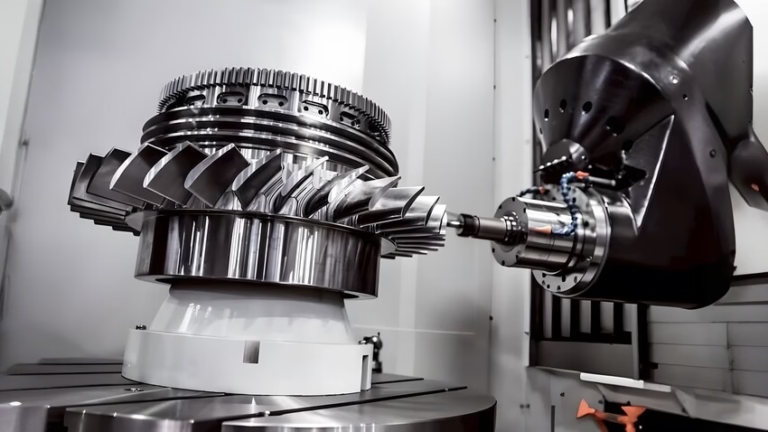
Even when the hardware exists, the practical envelope is narrow. Trunnion or tilting head arrangements on a legacy VMC often have limited tilt range, and the control may only support positioning rather than true simultaneous motion. For contoured surfaces — impellers, turbine blades, complex mold cores — that limitation shows up as faceting and longer cycle times.
This is where the answer to how many axis do Fadal CNC machines have stops being a history question and becomes a sourcing question. If your part needs the tool to approach from any direction in one setup, a legacy 3-axis or add-on 4th axis machine will not get you there. You need a modern simultaneous 5-axis center with the right post and tooling.
- 1Verify two rotary drivesNot one rotary table with a tilting vise.
- 2Check the postSimultaneous motion needs matching CAM output.
- 3Expect narrower travelTrunnion setups lose usable envelope.
What the axis count means for tolerance and cost
Every extra axis removes a setup, and every setup removed removes a source of error. A part cut in one setup on a 4th axis machine typically holds tighter position between features than the same part cut in three operations on a 3-axis machine. That is not about the machine's accuracy specification; it is about re-zeroing and fixture repeatability.
The trade-off is cost and complexity. A rotary table adds a fixture that has to be dialed in, a control axis that has to be tuned, and a post processor that has to be correct. On a legacy Fadal, that overhead is real. For a five-piece job with simple geometry, three setups on a 3-axis machine are often cheaper than chasing a 4th axis setup.
For tighter work, the numbers matter. GreatLight holds ±0.005 mm on production parts, with surface finish from Ra 0.2–0.8 μm on fine work and Ra 0.8–1.6 μm on standard machined surfaces. Those numbers come from machines with the axis count and the thermal stability to hold them, not from a reworked legacy VMC.
So the practical rule is this. If the part can be cut from two or three directions with simple fixturing, a legacy Fadal axis count of three is enough. If the part needs four or five faces in one setup, or continuous contouring on a rotary axis, the axis count has to go up — and that usually means a different machine.
- 1Fewer setups, tighter positionFeature-to-feature error drops when you stop re-zeroing.
- 2More axes, more overheadFixture dial-in and post work cost time on any job.
- 3Match the axis count to the geometryDo not buy axes the part does not need.
How to verify the axis count on a specific machine
- 1Count the servo drives in the cabinetOpen the electrical cabinet and count the axis drives. Three drives means three axes. A fourth drive is a real 4th axis, not a hand wheel. Photograph the drive labels before you travel to see the machine.
- 2Pull up the axis position page on the controlOn a Fadal control, page to the position display. You should see X, Y, Z and, if fitted, a fourth letter such as A or B. A rotary table with no letter on that page is a manual positioner.
- 3Check the machine parameters for the axisLook at the axis configuration parameters. An enabled rotary axis has a resolution, a travel limit and a direction setting. If those fields are blank, the control does not know the axis exists.
- 4Test an index move under powerCommand a 90° index in MDI with the spindle stopped. Listen for the clamp release, watch the table move, and confirm the clamp re-engages. A table that drifts or hesitates under load will scrap parts.
- 5Measure backlash on the rotary axisIndicate off a ground surface on the table, index 90° forward and back, and read the difference. More than about 0.02 mm of lost motion on a legacy rotary table means a rebuild before production work.
- 6Verify the post processor outputPost a simple program with an index move and read the G-code. If the CAM output does not match the control's axis naming, every job becomes a manual edit. Fix the post before quoting the part.
Which Fadal axis configuration fits which part
Use this to decide whether a legacy Fadal can run the job or whether it should go to a modern 5-axis center.
| Configuration | Typical parts | Setup count | When to move on |
|---|---|---|---|
| 3-axis | Plates, brackets, housings, open mold halves | One per face | Work needed on three or more faces |
| 3-axis + indexer | Radial holes, flats on shafts, keyways | One plus manual moves | Angles must be cut simultaneously |
| 4th axis (positional) | Shafts, bushings, cylindrical parts with flats | One setup for four sides | Continuous rotary contouring needed |
| 4th axis (simultaneous) | Cams, worms, helical features | One setup | Two rotary axes are required |
| 5-axis (rare on Fadal) | Impellers, blades, contoured cores | One setup | Tilt range or control limits the part |
| Modern 5-axis center | Aerospace, medical, complex contoured work | One setup | Part is already proven and moving to production |
Common questions
Did Fadal ever build a factory 5-axis machine?
A small number of machines left the factory with two rotary axes, and more were retrofitted by integrators. They are rare compared with the 3-axis volume.
If a listing claims 5-axis, ask for the control model, the number of rotary servo drives, and a photo of the axis position page. Those three items settle it.
Can I add a 4th axis to a 3-axis Fadal?
Yes, if the control supports an additional axis and has a spare drive. Many Fadals were ordered with the wiring and parameters ready for a rotary table.
You will need a matching rotary table, a drive, cable, and parameter changes. Budget for dial-in time and a post processor update.
Is a 4th axis on a Fadal simultaneous or just indexing?
Most are indexing or positional. The table rotates to an angle, clamps, and the cut runs with X, Y and Z.
Simultaneous rotary motion needs control support and a matching post. Confirm both before quoting contoured work.
How much Z travel does a rotary table consume?
A rotary table plus chuck typically takes 150 mm or more of Z height. On a compact machine that can be a large share of the available travel.
Measure the tallest part plus the fixture before you commit. Running out of Z mid-job is an expensive surprise.
When should a Fadal job move to a modern 5-axis center?
Move it when the part needs four or five faces in one setup, when the surface is continuously contoured, or when the tolerance stack from multiple setups will not close.
GreatLight runs 16 simultaneous 5-axis machining centers with a 4,000 mm maximum processing size, so parts that outgrow a legacy VMC envelope have somewhere to go.
Does axis count change the achievable tolerance?
Indirectly, yes. Fewer setups mean less re-zeroing error between features, which is often the dominant error source on multi-face parts.
The machine's own accuracy still sets the floor. GreatLight holds ±0.005 mm with 100% inspection before shipment and reports on request.
Send the part, not the machine question
Upload your drawing and we will tell you which axis configuration the geometry actually needs, with DFM feedback inside 12 hours.
12-hour quote100% inspectionNo minimum order quantity
More machining notes
We publish setup notes, tooling trials and inspection data from the factory floor.











