
How Much Cost CNC Machine: A 7-Step Costing Method
Machine price is only the first line. This guide walks through the numbers that decide how much cost cnc machine ownership really adds up to, from spindle class to floor space and tooling. Built for engineers and sourcing managers who need a defensible budget figure, not a range pulled from a forum.
In this article
- 1
- 2
- 3
- 4
- 5
- 6
- 7
- 8
Key takeaways
How Much Cost CNC Machine Price Breaks Down by Class
Machine price tracks three things: work envelope, spindle power and axis count. A compact 3-axis vertical mill with a 500 × 500 × 450 mm travel sits at the bottom of the scale. A simultaneous 5-axis machining center with a Ø400 mm rotary table sits near the top. Frame weight, spindle taper and control brand do the rest.
The jump between classes is not linear. Moving from 3-axis to 4-axis adds a rotary indexer and a control channel. Moving to simultaneous 5-axis adds a trunnion, thermal compensation and post-processor work. That last step is where the bill grows fastest, often more than the base machine itself.
Buyers often compare spindle speeds when they should compare spindle torque at low rpm. Aluminum at 6061 cuts well on a 12,000 rpm spindle. Ti-6Al-4V and 17-4PH stainless need low-rpm torque and high-pressure coolant. Choosing the wrong spindle for your material mix is the most expensive mistake on this list.
One more variable: machine size. A 4,000 mm travel gantry costs several times a 600 × 600 × 600 mm VMC, but it also removes the need to outsource long parts. Whether that trade pays off depends on how many long parts you actually have.
Total Cost of Ownership Beyond the Purchase Order
Purchase price is the entry ticket. Total cost of ownership adds installation, power, coolant, tooling, labor, maintenance and the floor area you give up. On a mid-size vertical mill running one shift, those items usually add 15–30% to the annual figure compared with the machine's amortized price.
Power and cooling are the ones people underestimate. A spindle under load plus a chiller, compressor and lights pulls real current. If the building has no 3-phase feed, the service upgrade alone can cost more than the tooling package. Heat also matters: a shop that swings 10 °C between morning and afternoon will fight thermal drift all day.
Labor is the largest running item. A machine running 4,000 hours a year needs an operator, a programmer and someone to load tools. If your parts run unattended overnight, the math changes in your favor. If they need constant fixturing, it does not.
Consumables deserve a line of their own. Carbide end mills, inserts, drills and taps are not one-time buys. Track cost per part, not cost per order. A shop that replaces a 6 mm cutter every 200 aluminum parts is spending differently than one that replaces it every 40 titanium parts.
Tolerance and Surface Finish Drive the Real Number
Two parts with the same drawing envelope can need very different machines. Holding ±0.05 mm on a bracket is routine work. Holding ±0.005 mm on the same bracket requires a machine that repeats to a fraction of that band, plus temperature control and a probing routine.
Surface finish follows the same logic. Ra 1.6–3.2 μm comes off the cutter with normal parameters. Ra 0.8–1.6 μm needs tighter stepover control and sharp tooling. Ra 0.2–0.8 μm usually means a finishing pass with a small tool, which multiplies cycle time and cutter wear.
This is where a cheap machine becomes expensive. If the machine cannot hold the band, you add a second operation, a hand lap or a rework loop. Each of those adds labor and scrap. The machine that holds tolerance in one setup is often the cheaper one over a year.
Ask a simple question before you buy: what is the tightest tolerance on 80% of my parts? Size the machine to that, not to the one heroic part you make twice a year.
What Outsourced Machining Cost Actually Includes
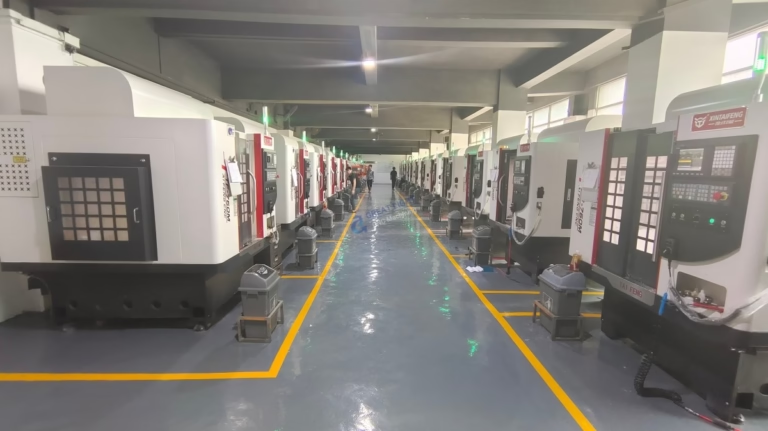
When you send a part out, the quoted price covers more than spindle time. It includes programming, fixturing, material, tooling wear, inspection and the supplier's overhead. A shop running 127 high-precision CNC machines spreads those costs differently than a five-machine job shop, and that shows up in the quote.
Material is often the biggest single line. A 6061-T6 aluminum housing and a Ti-6Al-4V housing with the same envelope can differ by an order of magnitude in stock cost. Bar stock, plate and near-net forgings also change how much material gets removed, which changes cycle time.
Setup count drives price more than most buyers expect. A part that runs in one 5-axis cycle is cheaper than an identical part that needs three 3-axis setups, even if the machine rate is higher. When you compare quotes, compare setups, not just hourly rates.
Inspection scope matters too. A first-article report, material certificate and full dimensional report add cost. If your drawing does not need them, say so. If it does, budget for them rather than arguing about them later.
Where the Cost Estimates Usually Go Wrong
The most common error is budgeting the machine and forgetting the ecosystem. Holders, a probe, a tool presetter, software seats and a chiller all arrive on separate invoices. Together they can add a third to the machine line item before you cut the first chip.
The second error is sizing to the worst part. A shop buys a large machine for one annual job and then runs small parts on it all year at low spindle utilization. The better path is usually to outsource the outlier and size the machine to the core family.
The third error is ignoring programming time. A 5-axis part with compound angles needs a CAM programmer, a verified post-processor and a simulation pass. That is skilled hours per new part, and it repeats every time the design changes.
The fourth is underestimating scrap during ramp-up. New fixtures, new parameters and new material lots all produce learning scrap. Budget a few percent on the first runs and treat it as a real cost, not a surprise.
How to Build a Defensible Cost Figure in 7 Steps
Work through these in order. Each step narrows the number.
- 11. List your parts, not your wishesTake the last 12 months of drawings. Note material, envelope, tightest tolerance and annual quantity for each. Group them into 3–5 families. This list, not a brochure, sets your machine class.
- 22. Fix the tolerance band you must holdWrite down the tightest band on 80% of parts. If it is ±0.05 mm, a 3-axis VMC is enough. If it is ±0.005 mm, add probing, temperature control and a machine with verified repeatability.
- 33. Count the setups each part needsParts with features on 5 faces need either 3 setups or one 5-axis cycle. Three setups means three fixture builds, three chances for error and roughly triple the labor. Price the 5-axis option before you dismiss it.
- 44. Add the tooling and workholding packageBudget holders, collets, vises, soft jaws, a probe and a starter cutter set. For titanium and stainless, add high-pressure coolant and through-tool holders. This package commonly runs 5–15% of machine price.
- 55. Price the site, not just the machineCheck 3-phase supply, floor load rating, chiller and compressed air. A 4,000 mm gantry may need a foundation. Get electrician and rigging quotes before you sign the machine order.
- 66. Model running cost per hourAdd power, coolant, tooling, labor, maintenance and floor cost, then divide by realistic spindle hours per year. Use 4,000 hours for one shift, less if you run job-shop work. That hourly figure is your true comparison unit.
- 77. Compare against outsourcingTake your hourly figure plus programming and inspection time, and compare it with a quoted part price at your annual volume. Below roughly 2,000 parts per year per family, outsourcing usually wins on cash flow.
Buy or Outsource: Match the Case to the Path
Numbers are typical planning ranges, not quotes.
| Situation | Buy In-House | Outsource |
|---|---|---|
| Annual volume per part family | Above 5,000 parts | Below 2,000 parts |
| Part geometry changes | Stable for 2+ years | Changes every quarter |
| Tolerance needed | ±0.05 mm or looser | ±0.005 mm, needs certified inspection |
| Capital available | Machine + tooling + site funded | Pay per part, no capex |
| Skill on staff | Programmer and setter in place | None, supplier handles it |
| Certification need | You already hold the audit | IATF 16949 or ISO 13485 required |
| Demand pattern | Steady, 2 shifts | Seasonal or prototype-heavy |
Size the machine to your 80% part, then compare against a per-part quote
If your core family runs under about 2,000 parts a year or changes shape every quarter, outsourcing keeps capital free and still gives you ±0.005 mm when the drawing needs it.
Questions Buyers Ask Next
Does a higher machine price always mean a lower part cost?
No. A more expensive machine pays off only when it removes a setup, holds a tighter band in one pass or runs unattended. If your parts are simple and volumes are low, the cheaper machine wins on cash flow.
Compare cost per good part, including scrap and inspection, not list price.
How do I estimate cost without a formal quote?
Start with material volume, then add cycle time at your machine or supplier hourly rate, then add setup and inspection. That gets you within a reasonable planning band.
A formal quote with a DFM review will tighten it, and it usually takes less than a day to receive one.
Should tolerance or part size set the machine class?
Tolerance first. Size only rules out machines that physically cannot hold the part. A large machine with a loose spindle is worse than a small machine that repeats well.
Then check whether the envelope fits your 80% part family.
What hidden costs appear after installation?
Power service upgrades, chiller and compressed air, foundation work, tooling replacement, software maintenance and operator training.
Track them per spindle hour so they show up in your part cost.
When does outsourcing beat buying?
When volumes are low, geometries change often, or you need certifications and inspection reports you do not want to maintain in-house.
Paying per part also keeps capital free for design and sales.
Can a supplier hold ±0.005 mm on production parts?
Yes, with the right machine class, temperature control, probing and 100% inspection before shipment.
Ask for the inspection method and the report format before you place the order, not after.
Send a Drawing, Get a Costed Answer
Upload your part and we return a quotation with free DFM analysis within 12 hours, plus the setup and inspection steps behind the number.
12-hour quoteFree DFM analysisNo minimum order quantity
More machining cost breakdowns
We publish setup notes, tooling trials and inspection data from the factory floor.











