
How Much Does Custom CNC Machining Cost?
There is no single price for a turned or milled part. Custom CNC machining cost is built from seven measurable inputs: setup, cycle time, material, tolerance, finish, inspection and quantity. This guide shows you how to estimate each one and how to read a quote line by line.
In this article
- 1
- 2
- 3
- 4
- 5
- 6
- 7
- 8
- 9
Key takeaways
What actually makes up a custom CNC machining cost
A quote is not one number pulled from a price list. It is a sum of hours, material and risk. When we price a part, we add setup time, programming time, cycle time per part, raw stock, finishing, inspection, and a small margin for scrap. Each one can be argued down or up, and each one leaves a fingerprint on the final figure.
The confusing part is that the biggest drivers are invisible on a drawing. A 40 mm aluminium plate with four holes and a 40 mm titanium plate with four holes look identical on paper. The machining time is not. Titanium conducts heat poorly, work-hardens at the cut, and forces slower feeds and lighter depths of cut.
So the honest answer to how much custom CNC machining cost runs is a range, not a figure. Simple plastic and aluminium prototypes sit at the low end. Complex multi-axis metal parts with tight tolerance, fine surface finish and full inspection sit far higher. The gap between those two ends is mostly time, not material.
Read every quote as a time estimate. If a supplier cannot tell you roughly how many minutes of spindle time your part needs, they are guessing, and you are paying for that guess.
Cost driver 1: part geometry and how many axes the cut needs
Geometry decides which machine the job lands on, and machine rate follows. A part with straight walls, through holes and open pockets can be cut on a 3-axis mill in one or two setups. Add an undercut, a curved organic surface or a deep cavity with a drafted wall, and the job moves to 4-axis or simultaneous 5-axis.
GreatLight runs 16 simultaneous 5-axis machining centers, 12 four-axis mills, 27 three-axis machines and 16 mill-turn centers. A five-axis machine removes material from angles a three-axis machine cannot reach without a second fixture, which is exactly why it costs more per hour to run and program.
The practical test is setup count. Every extra setup adds a fixture, a re-datum, and the risk of stacking error. A part that needs four setups on a 3-axis machine is often cheaper on a 5-axis machine in one setup, even though the hourly rate is higher. Ask for both versions of the quote.
Deep cavities are the other trap. A pocket deeper than 4× its tool diameter needs a longer, thinner cutter that must run slower and take lighter passes. If you can open the corner radius to 1.5× the depth, cycle time drops fast.
Cost driver 2: material choice and machinability
Material hits cost twice: once at the stock supplier, once at the spindle. Aluminium 6061 and 6061-T6 are the default for a reason. Light, stable, easy to cut, widely stocked in bar, plate and extrusion. Plastics such as POM, ABS, PC and PEEK cut even faster but deform if you clamp them too hard.
Stainless 303 and 304 machine reasonably. 316L and 17-4PH are tougher, gummier, and demand more rigid setups. Tool steel, Inconel and titanium sit at the top. Titanium is roughly 3-5× the price of aluminium per kilogram, and it also cuts several times slower, so you pay the premium twice.
Stock form matters as much as grade. Plate is cheaper per kilogram than bar for flat parts, but a tall part cut from plate wastes material. Near-net forgings or castings reduce machining volume on large parts, though they add tooling cost and lead time.
One more line item people miss: leftover stock. If your part needs a 250 mm diameter billet and the mill only stocks 200 mm, the supplier has to buy a larger size and you absorb the drop. Ask what stock size the quote assumes.
Cost driver 3: tolerance, surface finish and inspection
Tolerance is a cost multiplier, not a checkbox. A general machining tolerance of ±0.05 mm is achievable on a stable setup with standard tooling. Tightening to ±0.005 mm changes the process: temperature control, more frequent in-process checks, sharper tooling, and sometimes a separate finishing operation on a different machine.
Surface finish behaves the same way. As-machined at Ra 1.6–3.2 μm comes straight off the cutter. Ra 0.8–1.6 μm usually needs a finishing pass with a smaller stepover. Ra 0.2–0.8 μm may need polishing or a dedicated finishing pass, and it is rarely worth specifying on a surface that is not sealing, sliding or optical.
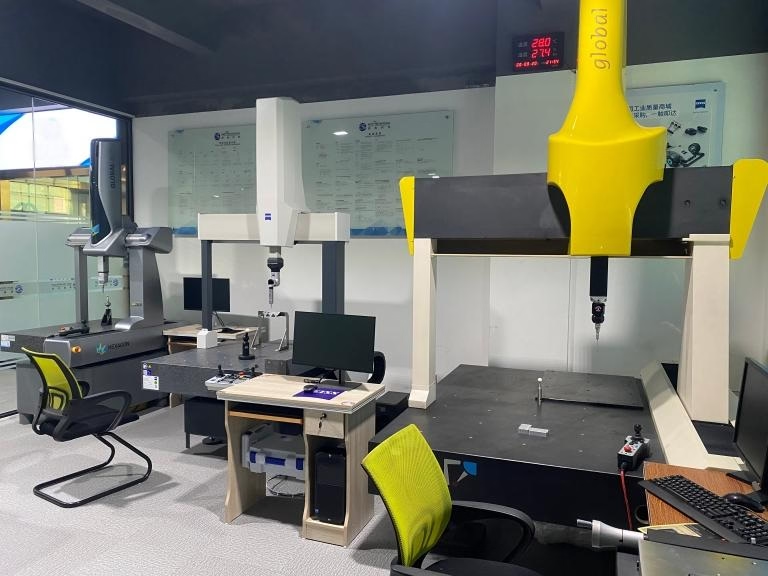
Inspection is the third hidden line. A first-article report, a full dimensional report or a CMM report on every part all add time. GreatLight inspects 100% of parts before shipment and provides reports on request, so the question is which report level your application truly needs.
A practical rule: put tight tolerance and fine finish only where the function demands it. Blanket-tolerancing an entire drawing to ±0.005 mm can multiply the price without improving how the part works.
Cost driver 4: quantity, setup amortization and finishing
Setup cost is fixed. If a fixture and program cost the equivalent of several hours, that amount is divided across however many parts you order. One piece carries it alone. A hundred pieces carry 1% each. This is why the unit price curve falls steeply between 1 and 50 pieces and flattens after that.
There is no minimum order quantity at GreatLight. We run from a single prototype to 10,000+ part runs. But you should still think about the quantity break points before you request a quote, because the supplier will quote what you ask for.
Quantity also changes the process. Above a few hundred pieces, it may pay to build a soft jaw or a dedicated fixture, which lowers cycle time per part. Above several thousand, a casting or forging blank plus finish machining can beat cutting the whole shape from solid.
Finishing adds its own per-part cost and often its own queue. Anodizing, plating, powder coating, bead blasting and laser marking are priced per batch or per part depending on volume. Laser marking has a minimum character height of 1.5 mm, so fine text needs a different method.
How to read a quote without a factory visit
Ask for the quote broken into four lines: material, machining, finishing and inspection. If a supplier only gives a lump sum, you cannot tell which input to change when the price is too high. A broken quote also lets you compare two suppliers fairly.
Then check the assumptions. What stock size is priced? How many setups are assumed? What tolerance band is included in the base price? Does the finishing line cover masking, or is masking extra? These are the four questions that most often explain a price gap between suppliers.
Timing matters too. GreatLight returns a quotation and a free DFM analysis within 12 hours, production can start within 24 hours, and parts ship in 3–5 days. A rushed job with a compressed schedule costs more than a planned one, so send drawings early.
Finally, treat the DFM report as a cost tool, not paperwork. Moving one hole, opening one corner radius, or adding a 0.5 mm chamfer to a sharp edge can cut cycle time without touching the function of the part.
How to estimate and reduce your custom CNC machining cost
- 11. Classify the part before you send it outNote the largest envelope, the deepest pocket, and whether any feature is unreachable from three orthogonal directions. That single answer decides 3-axis, 4-axis, 5-axis or mill-turn.
- 22. Set tolerance per feature, not per drawingUse ±0.05 mm as the default, and reserve ±0.005 mm for mating bores, bearing seats and sealing faces. Mark each tight feature on the drawing.
- 33. Pick the finish the function needsAs-machined Ra 1.6–3.2 μm for brackets and covers. Ra 0.8–1.6 μm for sliding or sealing surfaces. Only call Ra 0.2–0.8 μm when a spec demands it.
- 44. Choose material from a stocked grade6061-T6, 303 stainless, 1018 steel and POM cover most jobs and are stocked. If you need Inconel, TC4 or 17-4PH, expect longer cutting time and shorter tool life.
- 55. Ask for a quantity ladderRequest pricing at 1, 10, 50 and 200 pieces in the same RFQ. Seeing the curve tells you where setup stops dominating.
- 66. Reduce setups in the design reviewAdd a datum surface, standardize hole sizes, and open deep pocket corners to 1.5× depth. Each removed setup takes a fixture and a re-datum out of the price.
- 77. Confirm the inspection levelState whether you need a first-article report, a full dimensional report, or a CMM report on every part. Extra reporting adds time, not machining.
What moves the price: low-cost vs high-cost choices
Typical ranges for a milled metal part. Your design will sit somewhere on each row.
| Input | Lower cost choice | Higher cost choice | Effect on price |
|---|---|---|---|
| Machine axes | 3-axis, 1-2 setups | Simultaneous 5-axis | Higher hourly rate, fewer setups |
| Geometry | Open pockets, straight walls | Deep cavities, undercuts | Cycle time rises sharply |
| Material | 6061-T6, 303 stainless | Inconel, TC4 titanium | 3-5× stock cost, slower cutting |
| Tolerance | ±0.05 mm general | ±0.005 mm on bores | Extra passes and checks |
| Finish | As-machined Ra 1.6–3.2 μm | Ra 0.2–0.8 μm polished | Separate finishing operation |
| Quantity | 200+ pieces per run | 1-5 pieces | Setup spread over few parts |
| Inspection | Standard final check | Full dimensional + CMM | Reporting time per batch |
| Stock form | Standard plate or bar | Near-net forging | Tooling plus lead time |
The price follows the drawing, not the supplier
Most of your custom CNC machining cost is decided before the RFQ goes out: axis count, tolerance band, finish callouts and quantity. Fix those four and you control the number.
Custom CNC machining cost questions engineers ask
Why are two quotes for the same drawing so far apart?
The gap is almost always in the assumptions, not the machine rate. One shop may price a larger stock size, count an extra setup, or include a finishing pass that the other left out.
Ask each supplier for the stock size, setup count, tolerance band and inspection level behind their number. Once those four match, the quotes usually converge.
Does a tighter tolerance always cost more?
Only where it is applied. A general tolerance of ±0.05 mm on a stable setup is close to standard practice. Going to ±0.005 mm requires temperature control, sharper tooling and more frequent measuring.
Apply the tight band to the two or three features that mate with something else. Blanket tolerance drives cost with no functional gain.
Is titanium really worth the extra cost?
Only when you need the strength-to-weight ratio or corrosion resistance. TC4 (Ti-6Al-4V) costs roughly 3-5× aluminium per kilogram and cuts several times slower, so the premium appears twice.
If the part is a bracket with no weight limit, 6061-T6 or 7075 does the same job for far less.
How does order quantity change the unit price?
Setup is fixed, so it dominates small orders. At 1 piece you pay the full fixture and programming cost. At 50 pieces that cost is divided fifty ways.
Past a few hundred pieces the curve flattens, and the remaining cost is cycle time, material and finishing. Ask for a ladder at 1, 10, 50 and 200 pieces to see where it bends.
Do surface finishes and anodizing add much?
They add a separate operation, a queue slot, and sometimes masking labor. Anodizing, plating, powder coating, bead blasting and laser marking are each priced differently.
Specify finish only on surfaces that need it. Leaving a non-critical face as-machined removes a masking step and a handling step.
Can you work from a 3D model only, without a drawing?
Yes. Send STEP or native CAD and we return a quotation plus a free DFM analysis within 12 hours. Uploads are secure and confidential, and an NDA is available on request.
A marked-up drawing still helps for tolerance, finish and critical features, because those cannot be read from geometry alone.
Send drawings, get a costed DFM report back
Upload your CAD files and we return a quotation with a free DFM analysis within 12 hours. No minimum order quantity, from one prototype to 10,000+ part runs.
12-hour quote100% inspection±0.005 mmNo MOQ
More machining guides and shop notes
We publish setup notes, tooling trials and inspection data from the factory floor.











