
How Often Should CNC Machines Be Down for Maintenance?
There is no single calendar answer. Scheduled downtime should follow running hours, spindle load, and part tolerance. This page gives a tiered schedule you can copy, plus the signals that say a machine should stop cutting today.
In this article
- 1
- 2
- 3
- 4
- 5
- 6
Key takeaways
How often should CNC machines down for maintenance? Start with running hours
The honest answer is that downtime should follow machine hours, not the calendar. A 3-axis mill running one shift per week ages about five times slower than a mill-turn center running three shifts on stainless. Scheduling both on the same monthly date wastes hours on one machine and starves the other.
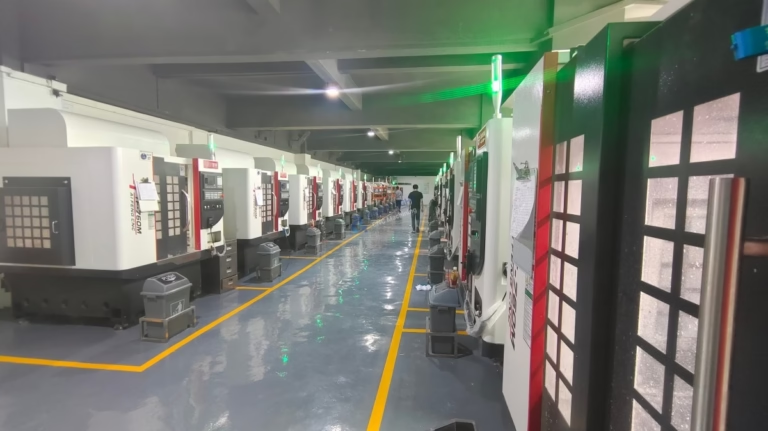
In our plants in Dongguan and Singapore, we track spindle hours and axis travel separately for all 127 high-precision CNC machines. The rule we use: every machine gets a daily check, a weekly check, and a level check every 500 spindle hours. From there, service intervals scale with duty cycle.
A shop holding ±0.005 mm on aluminum at 12,000 rpm needs tighter intervals than a shop roughing mild steel at 3,000 rpm. Thermal growth, chip load, and coolant condition all move faster at higher speeds. So does the wear on linear guides.
Planned maintenance should land between 4% and 8% of available machine hours. Below 4%, you are skipping checks. Above 8%, your intervals are too short or your machines are already in poor condition.
- 1One shift, light alloysDaily check, weekly clean, level check at 500 h.
- 2Three shifts, hard materialsSame daily check, but 500 h tasks move to 350–400 h.
- 3High-speed spindlesGrease life drops with rpm; plan spindle service earlier than the manual states.
Daily and weekly tasks: the downtime nobody notices
Daily maintenance should cost 10 to 15 minutes and happen at shift change, with the spindle stopped. Wipe the way covers, check the coolant level and concentration, look for chips packed around the linear guides, and confirm the air pressure is steady. This is not a repair window. It is a look-and-listen window.
Weekly tasks take 30 to 60 minutes. Clean the coolant tank screen, check the automatic lubrication reservoir, inspect the tool holders for fretting, and run a short warm-up cycle. A 15-minute warm-up before the first cut matters more than most operators think, especially on machines that hold tight tolerances.
The most common mistake here is treating the daily check as optional when the schedule is tight. Skipped daily checks are how a clogged coolant line becomes a scrapped batch three weeks later.
Keep a simple log per machine. Date, hours, what was checked, what was topped up. The log is what turns guesswork into an interval you can defend.
500-hour and 2,000-hour service windows
At 500 spindle hours, the machine comes down for a half day. Check the level of the machine with a precision level, inspect the ball screw and linear guide lubrication, measure backlash on each axis, and check the spindle taper for fretting or scoring. On a 5-axis machine, add the rotary table to the list. We use a Ø400 mm rotary table on several cells, and its clamp force and backlash are checked at every 500-hour window.
At 2,000 hours, plan a full day or more. Spindle service, grease replacement, belt and coupling inspection, coolant system flush, and a full geometric check. On a three-shift machine, that is roughly every four to five months. On a one-shift machine, it is closer to a year.
The 2,000-hour number is not arbitrary. It comes from bearing grease life and the wear rate of the spindle bearings under normal load. Run the spindle at very high rpm for long stretches, and that number should come down.
When a machine holds ±0.005 mm, a full geometric check at 2,000 hours is not optional. Squareness and parallelism drift slowly, and you will not see it in a single part.
Step by step: building a maintenance schedule that holds tolerance
Copy this sequence for each machine in your shop.
- 1Log spindle hours, not wall-clock hoursInstall an hour meter or read the control's spindle-on counter. Use that number for every interval. A machine that sits idle should not be serviced on the same date as one that runs three shifts.
- 2Set the daily window at shift change10–15 minutes. Spindle stopped, power off for the wipe-down. Check coolant concentration at 6–10% for most water-soluble coolants, and top up the way lube reservoir.
- 3Fix the weekly block in the calendar30–60 minutes. Clean coolant screen, inspect tool holders, run a 15-minute warm-up cycle. Do not skip the warm-up on a machine that holds tight tolerances.
- 4Book the 500-hour window as a half dayPrecision level check, backlash measurement, guide lubrication, spindle taper inspection. On 5-axis machines, add the rotary table clamp check.
- 5Plan the 2,000-hour service as a full daySpindle service, grease replacement, coolant flush, geometric check. On a three-shift machine this lands roughly every four to five months.
- 6Record the result of every checkBacklash value, level reading, taper condition. When a number starts to move, you catch it before the first out-of-tolerance part ships.
- 7Review intervals once a yearIf you are scrapping parts or seeing drift, shorten the interval. If the log shows no movement, you can extend it carefully.
CNC machines down for maintenance: interval table by duty cycle
Hours are spindle hours, not calendar time.
| Task | One shift, light alloy | Three shifts, stainless |
|---|---|---|
| Daily check | 10–15 min, every shift change | 10–15 min, every shift change |
| Weekly clean and warm-up | 30–60 min | 30–60 min |
| Level and backlash check | Every 500 h | Every 350–400 h |
| Spindle service | Every 2,000 h | Every 1,500–1,800 h |
| Full geometric check | Every 2,000 h or yearly | Every 1,500 h or twice yearly |
| Coolant flush | Every 1,000 h | Every 500–700 h |
| Planned downtime share | Roughly 4–5% | Roughly 6–8% |
The short version
Schedule downtime by spindle hours, not by the calendar. Daily checks stay daily, and the 500-hour and 2,000-hour windows scale with duty cycle. Keep planned downtime under 8% of available hours.
Common questions
How often should CNC machines be down for maintenance in a one-shift shop?
Daily checks stay daily. The 500-hour and 2,000-hour tasks stretch out, because a one-shift machine accumulates spindle hours slowly. On a standard 8-hour shift, 2,000 spindle hours is close to a year of running.
Keep the daily and weekly tasks fixed. Those are about condition, not hours.
What is the most common cause of unplanned downtime?
Tool failure, chip packing around the guides, and coolant problems. All three show up in a daily check before they become a breakdown.
Spindle bearing failure is rarer, but it is the most expensive. It usually shows as a rise in noise and vibration long before it seizes.
Can we run production while a machine is down for service?
Yes, if you plan it. Move the work to another machine in the cell, or schedule the window between batches. On a 5-axis job with no spare capacity, book the window before the order starts, not during it.
Does a machine that sits idle need the same schedule?
No. Idle machines still need the daily wipe-down and weekly warm-up, because moisture and coolant separation cause their own problems. But the 500-hour and 2,000-hour windows stretch with actual spindle hours.
How do we know when to shorten the interval?
Watch three numbers: backlash on each axis, level reading, and surface finish on a known part. If any of them drifts between scheduled checks, shorten the interval for that machine.
A drift past ±0.005 mm on a warm machine is a stop signal. Diagnose it before the next batch.
What records should we keep?
Date, spindle hours, task performed, and the measured values. Backlash, level, and taper condition are the three that predict failures best. The log also tells you whether your intervals are right.
Send us your drawing and get a quote in 12 hours
Upload your files and we will return a quotation with a free DFM analysis. Production can start within 24 hours, and parts ship in 3–5 days.
12-hour quote100% inspectionISO 9001:2015No minimum order
More from GreatLight
We publish setup notes, tooling trials and inspection data from the factory floor.











