
How to Determine WPC CNC Machine Requirements for Your Part
Wood-plastic composite cuts like wood and wears tools like plastic. This guide shows how to determine WPC CNC machine specs from your drawing: axis count, spindle power, rigidity, tooling and dust control. You finish with a spec list you can send to any supplier.
In this article
- 1
- 2
- 3
- 4
- 5
- 6
- 7
Key takeaways
Why WPC Behaves Differently at the Cutter
WPC is roughly 50 to 70 percent wood flour or fiber bound in polyethylene, polypropylene or PVC. That mix gives you two materials in one cut. The wood fraction is abrasive and dulls carbide fast. The polymer fraction softens somewhere between 120 °C and 160 °C depending on the resin, and once it softens it smears instead of shearing.
The practical result is a narrow window. Cut too slow and the tool rubs, which builds heat and melts the matrix. Cut too fast and the edge chips out at the fiber bundles. A sharp two-flute or three-flute compression cutter at 12,000–18,000 rpm usually lands inside that window on a rigid machine.
Dust behaves differently from metal chips. WPC swarf is light, fibrous and slightly sticky. It bridges in ducting and packs around the fixture. If extraction is weak, recutting that swarf doubles the heat at the edge. Plan for chip evacuation before you plan for spindle speed.
None of this is exotic, but it does mean you cannot pick a machine from a brochure. The machine has to match the section thickness, the profile depth and the surface finish your drawing calls for.
- 1Abrasive fiberCarbide edges dull in one to three shifts on dense board.
- 2Thermal sensitivityMatrix softens near 120–160 °C and smears.
- 3Light, stringy swarfNeeds high-volume extraction, not a metal chip conveyor.
How to Determine WPC CNC Machine Axis Count and Travel
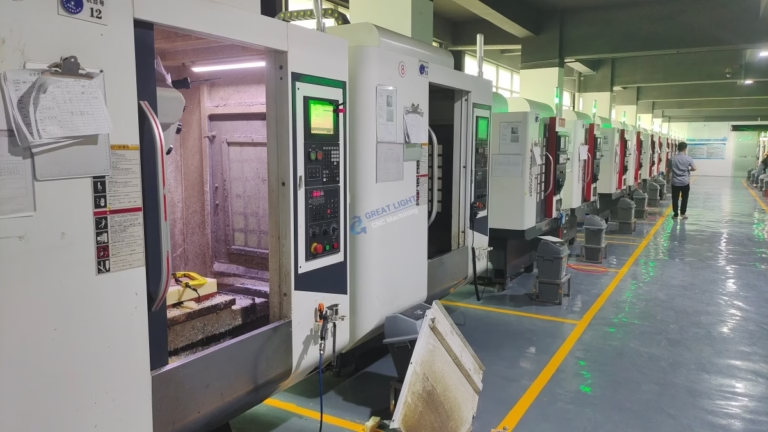
Start with the part, not the machine. Lay the drawing flat and ask one question: can a tool reach every surface from one direction? If yes, a 3-axis machine will do the job. Flat furniture panels, deck boards, cladding strips and simple trim all fall here. Our 3-axis machines cover 27 of the 127 spindles on our floor, with travels like 750 × 1,150 × 550 mm.
If the part has holes on a side face, a wrap-around profile or an undercut, you need a fourth axis or an indexer. A 4-axis machine with a Ø400 mm rotary table machines four sides in one setup, which removes a re-fixturing step and the error that comes with it. That matters on WPC because the material is soft enough that a second clamp can dent a finished face.
Curved architectural trim, interlocking profiles and molds with compound angles belong on a 5-axis machine. Simultaneous motion lets the cutter stay normal to the surface, so you hold the profile without tilting the part. Our 16 simultaneous 5-axis centers handle this work, and 16 mill-turn centers cover cylindrical WPC parts such as handrail sections and sleeves.
Travel is the other half of the decision. Measure the finished part envelope and add the fixture. Our largest platform handles 4,000 mm of length on a 4,000 × 400 × 150 mm envelope. If your part is longer than that, it needs a different process, not a different machine.
One caution. Buying 5-axis capacity for parts that are flat wastes money and adds programming time. Match the axis count to the geometry you actually run. If 80 percent of your volume is flat panels, a 3-axis machine with good extraction will outrun a 5-axis machine on cost per part.
- 13-axisFlat panels, trim, decking, simple pockets.
- 24-axisSide holes, four-sided parts, rotary indexing.
- 35-axisUndercuts, compound angles, wrap-around profiles.
Spindle Power, Rigidity and Tooling for WPC
Spindle power sets your depth of cut. WPC is soft, but it is also springy, and a light spindle will chatter before it stalls. Below 3 kW you are limited to shallow passes in thick sections. A 6 to 9 kW spindle with variable speed gives you room to run a 12 mm cutter at 6 to 10 mm depth in one pass on a rigid frame.
Speed control matters as much as peak power. You want to dial rpm down for large-diameter tools and up for small ones, keeping surface speed roughly constant. A spindle that only runs at one speed forces you to compromise the feed, and the feed is what controls heat.
Rigidity is where WPC punishes light machines. The material damps vibration poorly, so any flex in the gantry or the fixture shows up as a ripple on the cut face. Cast-iron or heavily ribbed frames hold better than welded tube. If finish matters, weigh the machine, then weigh the fixture.
Tooling should be carbide, and preferably diamond-coated for long runs. Two-flute and three-flute compression cutters give clean top and bottom edges on laminated board. Keep a separate set of tools for WPC; the abrasive filler wears an edge that still looks sharp.
Plan on tool changes rather than fighting them. A worn edge raises cutting temperature, and temperature is what ruins a WPC part. Changing at a fixed interval is cheaper than sorting scrap.
- 1Power6–9 kW gives stable cuts at 6–10 mm depth.
- 2FrameCast iron or ribbed structures resist ripple.
- 3CuttersCarbide, diamond-coated for production runs.
What Tolerance and Finish to Expect
WPC moves. It absorbs moisture, and it relaxes after machining. That does not stop you from holding tight dimensions, but it changes how you hold them. Machine the part, let it stabilize, then check. Our standard tolerance is ±0.005 mm (±0.0002 in) on features that the fixture controls, and dimensional checks come from 100 percent inspection before shipment.
Finish is easier to predict. As-machined WPC lands around Ra 1.6–3.2 μm with a sharp cutter and good extraction. Fine finishes down to Ra 0.2–0.8 μm are reachable on our machines, but they usually need a finishing pass with a smaller stepover rather than a different machine.
Surface defects almost always trace back to heat or swarf, not to the machine. A glazed, shiny edge means the matrix melted. A fuzzy edge means the fiber tore. Fuzz points to a dull tool. Glaze points to feed or rpm.
If your drawing specifies a cosmetic face, say so. We plan the setup order around it and can add bead blasting, tumbling, brushing or polishing from our surface finishing line. Laser marking is available down to 1.5 mm character height for part IDs.
- 1Tolerance±0.005 mm with a stable fixture and settled stock.
- 2As-machinedRa 1.6–3.2 μm is normal for WPC.
- 3Glaze vs fuzzGlaze means heat; fuzz means a dull edge.
Step by Step: How to Determine WPC CNC Machine Fit
- 11. Read the drawing for reachList every surface, hole and undercut. If a single tool direction reaches all of them, mark the part 3-axis. Any side feature pushes you to 4-axis or an indexer.
- 22. Measure the envelopeAdd 50 to 100 mm of fixture allowance to the largest part dimension. Compare that to machine travel, not to table size. Our largest envelope is 4,000 × 400 × 150 mm.
- 33. Set section thicknessNote the thickest wall you must cut. Above 20 mm, budget a 6 to 9 kW spindle and 6 to 10 mm roughing passes. Thin sections can run on lighter machines.
- 44. Choose the tool familyPick two-flute or three-flute compression cutters for laminated faces. Add a diamond coating if the run exceeds a few hundred parts. Order spares before the first setup.
- 55. Define dust extractionSpecify extraction at the cutter with enough air volume to clear stringy swarf. Weak extraction is the most common cause of a glazed edge on WPC.
- 66. Fix the tolerance calloutWrite the tolerance you actually need on the drawing. Tightening a non-critical feature adds cost and inspection time without improving the part.
- 77. Run a first-article checkCut one part, let it stabilize, then measure. Adjust feed and rpm from the chip and the edge quality. Do not sign off on a full run from the first cut.
WPC Part Type vs Machine Configuration
Match the geometry column to your drawing, then read across for the machine and the main risk.
| Part geometry | Machine | Main risk |
|---|---|---|
| Flat panel, simple profile | 3-axis, 6 kW spindle | Dust packing, edge fuzz |
| Four-sided part, side holes | 4-axis with rotary table | Re-clamping marks |
| Compound angle, undercut | 5-axis simultaneous | Programming time |
| Cylindrical sleeve, handrail | Mill-turn center | Roundness drift |
| Long trim, up to 4,000 mm | Large 3-axis gantry | Fixture sag |
| Thin cosmetic face | 3-axis, finishing pass | Glaze from heat |
| High volume, 1,000+ parts | 3-axis with diamond tooling | Tool wear cost |
Pick the machine from the part, not the catalog
Write down reach, envelope, section thickness and tolerance before you talk to any supplier. Those four numbers decide the machine. Everything else is negotiation.
WPC CNC Machining Questions
Can a standard wood router cut WPC?
It can cut it, but it will not hold tolerance for long. Wood routers are built for soft stock and light loads, and WPC's abrasive filler wears their spindles and bearings faster.
For prototypes or loose-tolerance trim, a wood router is workable. For parts with a ±0.005 mm callout or a cosmetic face, use a metal-cutting frame with a sealed spindle.
Does WPC need coolant?
No. Flood coolant makes the swarf stick and turns it into a paste. The right answer is air blast plus high-volume extraction at the cutter.
If heat is still a problem, reduce the feed rather than adding fluid. Heat comes from rubbing, and rubbing comes from too light a chip load.
What tolerance is realistic on WPC?
We hold ±0.005 mm (±0.0002 in) on features controlled by the fixture. The material relaxes after machining, so parts should stabilize before final measurement.
Tighter than that is possible on small features, but it usually costs more than the part needs. Tell us which dimensions are functional.
How do you avoid a glazed or fuzzy edge?
Glaze comes from heat. Check rpm, feed and cutter sharpness, then confirm extraction. Fuzz comes from a dull edge or a fiber-rich batch of stock.
Run a short test cut, measure the edge, and adjust one variable at a time. Changing feed and rpm together makes the result hard to read.
Can you machine WPC from a prototype to a full run?
Yes. There is no minimum order quantity, so a single prototype and a 10,000+ part run go through the same process.
Quotation and free DFM analysis come back within 12 hours, and production can start within 24 hours of approval.
What post-processing is available for WPC parts?
We offer bead blasting, tumbling, brushing and polishing, plus laser marking down to 1.5 mm character height. Plating and anodizing apply to metal parts, not to WPC.
If your part needs a painted or coated face, tell us at the quote stage so we can plan the machining allowance.
Send Your WPC Drawing for a Machine and Process Review
Upload your file and we return a quotation with free DFM analysis within 12 hours. Uploads are secure and confidential, and an NDA is available on request.
12-hour quote100% inspectionNo MOQ±0.005 mm
More machining notes from the shop floor
We publish setup notes, tooling trials and inspection data from the factory floor.











