
How to Select Chinese Metal Die Casting Importer
A practical, engineer-led guide for procurement teams qualifying a die casting partner in China. You will learn how to audit tooling capability, read a quality certificate, check tolerances and finishing, and avoid the common traps that stall a program after the mold is cut.
In this article
- 1
- 2
- 3
- 4
- 5
- 6
- 7
- 8
- 9
Key takeaways
What a die casting importer actually does for you
When you select chinese metal die casting importer partners, you are not just choosing a foundry. You are choosing a supply chain that owns the mold, runs the casting cell, machines the part, finishes it and inspects it before it leaves China. Some suppliers only cast. Others cast and then sub-contract the machining to a third shop, which adds a week and a second tolerance stack-up.
The distinction matters most for parts with tight interfaces. A housing that bolts to a machined assembly needs its mounting face flat and its bore concentric. If the casting shop ships raw castings to another vendor, the flatness and concentricity callouts now depend on two companies sharing one drawing. Ask who signs the final inspection report.
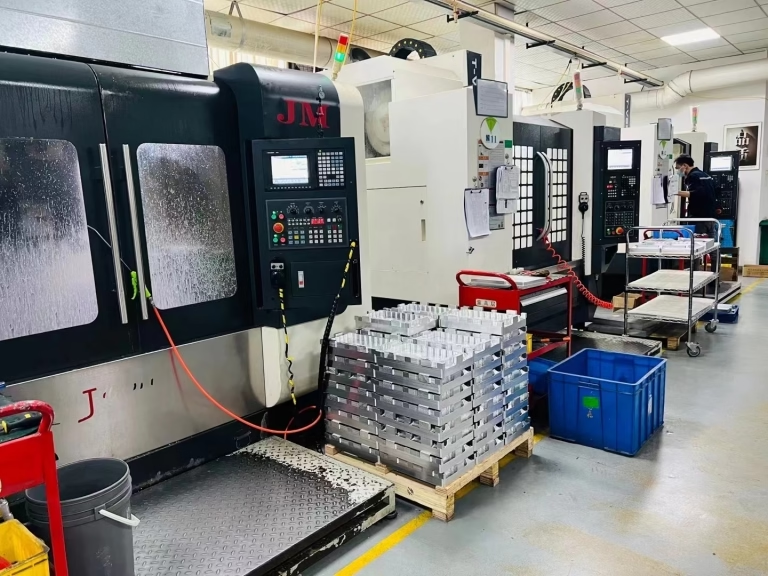
GreatLight runs die casting alongside 127 high-precision CNC machines, so a cast part can move from the casting cell to a 5-axis machining center under one roof. That removes the hand-off risk. For simple brackets and covers, a pure casting supplier may be enough. For structural or sealing parts, an integrated shop is usually the safer call.
- 1Pure casterLowest casting price, but machining and finishing are sub-contracted.
- 2Integrated supplierCasting, CNC machining, finishing and inspection under one quality system.
- 3Trading companyAggregates several shops; convenient for simple parts, thin engineering support.
How to check die casting capability before you send an RFQ
Machine tonnage is the first number to ask for, because it sets the maximum projected area your part can have. A 1,200 t cold chamber machine handles a different part family than a 400 t machine. If the supplier cannot state the tonnage range in writing, stop there. Tonnage is not a trade secret.
Next, ask about the die itself. Mold life is usually quoted as a shot count, and 100,000 shots is a common figure for a hardened H13 die. Ask whether the die has a thermal management plan: cooling channel diameter, distance from the cavity wall, and whether the shop runs a thermal simulation before cutting steel. Poor cooling shows up later as porosity and warpage.
For aluminum, ADC12 is the workhorse alloy for housings and covers because it casts well and machines cleanly. For parts needing higher strength or better corrosion resistance, A380 or A360 may be specified instead. Ask the supplier which alloys they stock and whether they can provide certification for the heat lot.
Finally, check the vacuum assist option. Vacuum die casting pulls gas out of the cavity during fill, which reduces porosity in thick sections. If your part will be leak-tested or anodized, porosity is not cosmetic; it is a scrap cause. Not every part needs vacuum, but the supplier should be able to explain when they would use it.
Reading quality certificates and inspection reports
A certificate is only useful when you read the scope. ISO 9001:2015 tells you the shop has a documented quality system. IATF 16949:2016 is the automotive-specific standard and includes requirements for traceability, PPAP and change control. ISO 13485:2016 applies to medical device work. ISO 27001:2022 covers information security, which matters when you send CAD files and customer drawings.
Ask for the certificate number and the issuing body, then verify the scope covers die casting or machining at the site that will make your part. A certificate held by a parent company does not automatically cover a satellite plant. This is one of the most common gaps found during a supplier audit.
Inspection reports should show the measurement method, not just pass or fail. For a die cast part, the report should list the critical dimensions, the gauge used, and whether the part was checked before or after machining. A final inspection that happens before the machining step is not a final inspection at all.
GreatLight inspects 100% of parts before shipment and can provide raw material checks, in-process monitoring records and final inspection data on request. If a supplier cannot produce a dimensional report for a sample, they will not produce one for a production lot either.
- 1ISO 9001:2015Baseline quality system for general industrial work.
- 2IATF 16949:2016Required for automotive and EV programs; adds PPAP and traceability.
- 3ISO 13485:2016Medical device quality management.
- 4ISO 27001:2022Information security for drawings and customer data.
DFM feedback: the fastest way to judge an engineering team
Send the same STEP file to three suppliers and compare the DFM notes you get back. A good team will comment on draft angle, wall thickness transitions, gate location and where machining stock is needed. A weak team will send a price and a lead time with no engineering comment. The DFM response is a free sample of how they will handle change requests later.
Wall thickness is the classic die casting constraint. Aluminum parts generally cast well between 2 mm and 4 mm wall. Below 1.5 mm, fill becomes difficult and porosity risk rises. Above 5 mm, thick sections cool slowly and shrink, which can create internal voids. A supplier who flags this before cutting steel saves you a mold revision.
Draft angle is the second constraint. Most surfaces need 1° to 2° of draft so the part releases cleanly. Zero-draft features are possible with slides, but each slide adds tooling cost and maintenance. Ask the supplier to mark which features require slides and what that adds to the mold price.
At GreatLight, quotation and free DFM analysis come back within 12 hours. That turnaround is not a marketing claim; it is the working rhythm the engineering team runs on. Use it as a test. If a supplier takes a week to return basic DFM notes, they will take longer on a production issue.
Tolerances, finishing and post-casting machining
As-cast tolerances are not the same as machined tolerances. Die casting typically holds around ±0.1 mm on cast features, depending on part size and alloy. If your drawing calls for ±0.005 mm, that feature must be machined after casting. GreatLight machines cast parts on 5-axis centers and can hold ±0.005 mm on critical features, with surface finish down to Ra 0.2–0.8 μm when specified.
Decide early which features stay as-cast and which get machined. Every machined feature adds cycle time, fixturing and inspection. A part with six machined faces costs more than a part with two. If the part only needs a flat mounting face and two dowel holes, say so in the RFQ and ask for a cast-plus-machined price breakdown.
Finishing follows the same logic. Anodizing, powder coating, electroless nickel and bead blasting all have process-specific requirements. Anodizing a porous casting can show blotchy color, which is why vacuum casting or a denser alloy is sometimes chosen for visible parts. Laser marking needs a minimum character height of 1.5 mm to stay legible.
For sealing surfaces, ask for a leak test before and after machining. A casting that passes a visual check can still fail a pressure test. Suppliers who leak-test in-house catch this before shipment, not after the container arrives.
Commercial terms, IP protection and communication
MOQ is a real filter. Some die casting shops will not quote below 5,000 pieces, which rules them out for pilot builds. GreatLight has no minimum order quantity and runs from one prototype to 10,000+ part runs, so the same supplier can carry a program from first article to volume. That continuity avoids a second qualification cycle.
Lead time should be broken into stages: DFM and quote, mold design and build, first article, production, finishing and shipping. A single number like "30 days" hides the risk. Ask for the mold build lead time separately, because that is where schedules usually slip. Production can start within 24 hours once tooling and material are ready.
IP protection is not optional when you send CAD files. Ask whether the supplier signs an NDA, who has access to the files, and whether the data is stored on a controlled server. GreatLight offers an NDA on request and keeps uploads secure and confidential. ISO 27001:2022 certification supports that claim.
Communication style matters more than English fluency. The best suppliers respond with a drawing mark-up, a photo of the tool, or a measured dimension. If answers arrive as vague reassurances, expect the same during a production problem.
7 steps to select a chinese metal die casting importer
Work through these in order. Each step filters out suppliers before you spend money on tooling.
- 11. Define the part and the critical featuresMark which dimensions are as-cast and which need machining. State alloy (ADC12, A380, A360), annual volume and whether the part will be leak-tested or anodized. This one page saves weeks of back-and-forth.
- 22. Shortlist suppliers with in-house casting and machiningFilter for shops that own both the casting cell and the CNC department. Confirm machine tonnage range and whether 5-axis machining is available for ±0.005 mm features.
- 33. Send the same STEP file to three suppliersCompare DFM notes, not just price. Look for comments on wall thickness, draft angle, gate location and machining stock. A useful DFM reply comes back within 12 hours.
- 44. Verify certificates against the actual siteCheck certificate number, issuing body and scope. Confirm IATF 16949:2016 or ISO 13485:2016 if your industry requires it. A parent-company certificate does not cover a satellite plant.
- 55. Ask for a mold life and cooling planRequest shot count, cooling channel layout and whether thermal simulation was run. A 100,000-shot H13 die with poor cooling will still produce porous parts.
- 66. Order a sample before production toolingUse a prototype or vacuum cast sample to check fit, finish and leak behavior. Measure the sample against the drawing. Do not approve a hardened steel mold on a 3D render alone.
- 77. Agree on inspection, packaging and IP termsConfirm 100% inspection before shipment, report format, NDA coverage and who owns the mold. Put the mold ownership clause in writing before the first PO.
Supplier type comparison for die casting programs
Match the supplier type to your part complexity, volume and quality requirement.
| Supplier type | Best for | Watch out for | Typical fit |
|---|---|---|---|
| Pure die caster | Simple covers, brackets, high volume | Machining sub-contracted, second tolerance stack-up | Low-complexity parts |
| Integrated cast + CNC shop | Structural parts, sealing faces, tight bores | Higher quoted piece price than casting only | Complex, mission-critical parts |
| Trading company | Simple prototypes, fast digital quotes | Thin engineering support, unclear factory control | Early-stage sourcing |
| Vacuum casting specialist | Thick sections, cosmetic anodized parts | Higher tooling and cycle cost | Leak-tight or visible parts |
| Regional low-cost shop | Non-critical, loose-tolerance parts | Certificate scope gaps, inconsistent finishing | Cost-driven programs |
Pick the supplier who answers with a drawing, not a promise
The right die casting partner replies to your STEP file with DFM notes, tooling data and an inspection plan. If the first reply is only a price, keep looking.
Frequently asked questions
What is the difference between a die casting supplier and a die casting importer?
A die casting supplier owns the casting equipment and makes the part. An importer may or may not own equipment; they coordinate sourcing, quality and shipping between you and one or more factories.
For engineering work, the practical question is who controls the process. If the importer does not own the casting cell or the CNC department, changes and corrective actions pass through an extra layer.
Which certifications should a die casting supplier hold?
ISO 9001:2015 is the baseline for industrial work. IATF 16949:2016 is required for automotive and EV programs. ISO 13485:2016 applies to medical devices, and ISO 27001:2022 covers information security for your drawings and data.
Always check the scope and the site. A certificate issued to one plant does not automatically cover another location.
What tolerance can be held on a die cast part?
As-cast features typically hold around ±0.1 mm, depending on part size and alloy. Features that need ±0.005 mm must be machined after casting.
GreatLight machines cast parts on 5-axis centers and can reach ±0.005 mm on critical features, with surface finish down to Ra 0.2–0.8 μm when specified.
How long does die casting tooling and production take?
Separate the lead time into stages: DFM and quote, mold design and build, first article, production, finishing and shipping. The mold build stage is where schedules usually slip.
At GreatLight, quotation and free DFM analysis return within 12 hours, production can start within 24 hours, and parts ship in 3–5 days once tooling and material are ready.
Is there a minimum order quantity for die casting?
It depends on the supplier. Many die casting shops set MOQs in the thousands of pieces because mold cost has to be amortized.
GreatLight has no minimum order quantity and runs from one prototype to 10,000+ part runs, so the same supplier can carry a program from first article to volume.
How do I protect my design when sourcing in China?
Sign an NDA before sending CAD files, and confirm who inside the supplier can access the data. Ask whether files are stored on a controlled server.
GreatLight offers an NDA on request and keeps uploads secure and confidential. ISO 27001:2022 certification supports the information security controls behind that.
Send your drawing and get DFM feedback in 12 hours
Upload a STEP file and our engineers will return a quote with DFM notes, tooling comments and an inspection plan. No MOQ, NDA on request.
12-hour quote100% inspectionNo MOQNDA on request
More die casting and CNC machining notes
We publish setup notes, tooling trials and inspection data from the factory floor.











