
How to Select OEM CNC Milling & Turning Importer
A practical vetting sequence for engineers and sourcing managers who buy machined parts from overseas. You will learn what to check first, which numbers matter, and when a supplier is the wrong fit for your part.
In this article
- 1
- 2
- 3
- 4
- 5
- 6
- 7
- 8
- 9
Key takeaways
Separate a real factory from a trading office
Most suppliers you find online describe themselves as manufacturers. Some are. Others take your drawing, forward it to an anonymous shop, and add margin. The difference shows up later, when a tolerance problem needs a process change rather than an email chain.
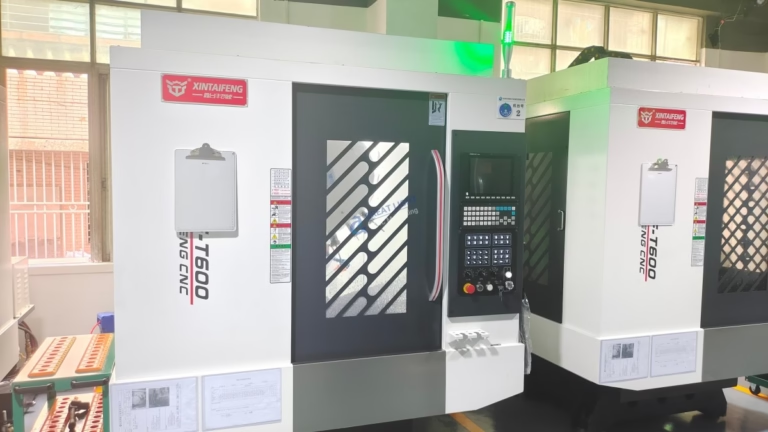
Ask for the machine list first. A real milling and turning supplier can tell you how many 5-axis, 4-axis and 3-axis machines sit on the floor, plus mill-turn centers and the maximum travel of each group. A trading office usually answers with a range or a link to a partner factory.
Then ask which machine will run your part. If your housing is 4,000 mm long, only a handful of shops can hold it. If your part needs five faces in one setup, the answer should name a simultaneous 5-axis center, not a 3-axis mill with a fixture plan.
One more filter: ask who programs the job. In-house CAM engineers can adjust stepover, feed and workholding when the first article drifts. Outsourced programming turns every change into a two-day negotiation.
- 1Machine list with axis countNumbers, model families and travel, not a photo gallery.
- 2Named machine for your partTells you whether the quote is real or aspirational.
- 3In-house programmingShortens the loop between first article and correction.
- 4Plant addressA visitable address beats a virtual office.
Check whether the process chain is actually complete
Your part rarely leaves the machine finished. A typical bracket gets milled, deburred, anodized, laser marked and packed. Every handoff outside the supplier's control adds days and a place for damage to happen.
Ask which steps are in-house. Milling, turning and inspection should be. Finishing can be subcontracted, but the supplier should own the schedule and the quality of that step rather than hand you a phone number.
Heat treatment is the usual gap. If your 17-4PH part needs H900 condition, confirm who runs the furnace and how hardness is verified. A certificate that arrives with no traceable batch number is not evidence.
For prototypes, a complete chain matters even more. You may need five parts in three materials with different finishes. A supplier that can run 3D printing, vacuum casting and CNC under one roof saves you from managing three vendors before the design is frozen.
- 1In-house milling and turningThe core operation should never be brokered out.
- 2Finishing under their scheduleAnodizing, plating, powder coating, laser marking.
- 3Traceable heat treatmentBatch numbers and hardness data, not just a stamp.
- 4Prototype routesCNC, 3D printing, vacuum casting, sheet metal.
Test the precision claim with data
Every supplier advertises tight tolerance. Fewer can show you the inspection record that proves it. Before you accept ±0.005 mm, ask for a first article report from a part with similar geometry, material and feature size.
Look at what was measured and how. A CMM report with position data on hole patterns tells you more than a single caliper reading on an outside diameter. For bores and fits, check whether the report includes roundness and cylindricity, not just diameter.
Surface finish is the second half of the story. Ra 0.8–1.6 μm is a normal machined finish. If your seal or bearing surface needs Ra 0.2–0.8 μm, ask which machine and which tool path achieve it, and whether that step is included in the quoted price.
Finally, confirm inspection coverage. Spot checks on a 10,000-part run leave gaps. Ask whether every part is inspected before shipment and whether raw material, in-process and final checks are documented.
- 1First article reportFrom a comparable part, with the measurement method stated.
- 2GD&T data, not one dimensionPosition, roundness, cylindricity where the fit depends on it.
- 3Finish tied to a processWhich tool path reaches Ra 0.2–0.8 μm.
- 4Inspection coverage100% before shipment beats sampling on critical parts.
Match certifications to your industry
Certificates are a filter, not a score. ISO 9001:2015 covers a basic quality system and most serious shops hold it. It does not tell you whether the shop can run your automotive or medical program.
For automotive and EV parts, look for IATF 16949:2016. It brings PPAP discipline, control plans and change management. Without it, your quality team will spend weeks rebuilding documentation the supplier should already keep.
Medical device work usually needs ISO 13485:2016 plus a clean handling and traceability routine. If your drawings are confidential, ISO 27001:2022 shows the supplier treats your files as controlled data rather than email attachments.
Check the certificate scope and expiry date. A certificate issued to a sister company, or one that expired last year, tells you the paperwork is decorative.
- 1ISO 9001:2015Baseline quality system for general industrial parts.
- 2IATF 16949:2016Automotive and EV programs with PPAP expectations.
- 3ISO 13485:2016Medical devices and traceable production records.
- 4ISO 27001:2022Information security for your drawings and CAD files.
Read the commercial terms before the price
A low unit price hides cost in three places: minimum order quantity, tooling and freight. Ask for the MOQ in writing. If you are at prototype stage, a supplier that accepts a single part removes the pressure to guess volumes too early.
Ask when production can start after you approve the DFM report. Some shops quote two weeks of queue time before chips fly. Others can start within 24 hours once the drawing and material are confirmed.
Freight and packaging deserve a sentence in the quote. Heavy stainless parts in a thin carton arrive with dents. Confirm the packing method for your part weight and whether the supplier ships to your door or to a port.
Keep confidentiality separate from price. If your design is not public, ask for an NDA before you upload CAD. A supplier that hesitates on a mutual NDA is telling you something about how they handle everything else.
- 1MOQ in writingFrom one prototype to 10,000+ part runs.
- 2Production start dateNot the quote date. When the spindle turns.
- 3Packing for weightStainless and steel parts need real protection.
- 4NDA before uploadSecure file handling from the first drawing.
Judge engineering depth by the questions they ask
A capable supplier pushes back on your drawing. They will flag a 0.5 mm wall on a 7075 part, a deep pocket that needs a longer reach tool, or a thread too close to an edge for the material you chose.
Send a DFM question with your RFQ instead of a clean drawing. Something like a 12 mm deep pocket with a 2 mm corner radius in 316L will show whether they understand tool deflection and chip evacuation or just forward your file.
Response time is part of engineering depth. A quote that arrives with real DFM notes within 12 hours means someone read the drawing. A price-only reply three days later usually means nobody did.
Ask how they handle a first article that misses tolerance. The answer should describe a process change, not a discount. Re-machining with adjusted offsets or a new fixture is the correct response.
- 1Design feedback on the RFQThin walls, deep pockets, thread margins, tool reach.
- 2Material-specific advice6061 versus 7075, 303 versus 316L, titanium speeds.
- 3Fast DFM turnaroundQuote and analysis within 12 hours.
- 4Correction plan, not a discountOffsets, fixtures and re-inspection.
7 steps to select OEM CNC milling turning importer
Run these in order. Each step filters out a class of supplier before you spend time on samples.
- 11. Build a shortlist of five suppliersPick shops whose listed machine range covers your part envelope. For a 4,000 mm frame, drop anyone whose largest travel is 1,200 mm. For a Ø400 mm rotary part, confirm a matching rotary table.
- 22. Request the machine list and plant addressYou want axis count and travel per group. A supplier with 16 simultaneous 5-axis centers, 12 four-axis mills and 16 mill-turn centers can route your job several ways. A broker cannot.
- 33. Send a drawing with a real DFM questionInclude a feature that is hard in your material. Note how fast the reply comes and whether it names a process. Quote and free DFM within 12 hours is a reasonable benchmark.
- 44. Ask for a first article report on a similar partCompare the measurement method with your critical dimensions. If your tolerance is ±0.005 mm, the report should show CMM data, not a caliper photo.
- 55. Verify certifications against your industryISO 9001:2015 as the floor, IATF 16949:2016 for automotive, ISO 13485:2016 for medical, ISO 27001:2022 for file security. Check scope and expiry.
- 66. Order a small batch before committing volumeOne to five parts in the final material and finish. Measure them yourself. This is where a no-MOQ supplier earns trust and where a tolerance gap appears cheaply.
- 77. Lock the terms: MOQ, lead time, packing, NDAPut MOQ, production start, shipping window and packing method in the PO. Sign the NDA before releasing full CAD. Review the first shipment against the inspection report.
What to check and what a weak answer looks like
Use the right column as your rejection trigger.
| Check | Strong answer | Weak answer |
|---|---|---|
| Machines | Named models, axis count, travel per group | Photos and a factory video |
| Tolerance proof | CMM report from a comparable part | A tolerance number on the website |
| Surface finish | Tool path stated for Ra 0.2–0.8 μm | One finish value for all parts |
| Certifications | Current certs matching your industry | Expired or out-of-scope certificate |
| MOQ | One prototype accepted | Minimum 500 pieces to quote |
| DFM response | Notes within 12 hours | Price only, several days later |
| Inspection | 100% before shipment, reports on request | Sampling only, no records |
| Confidentiality | NDA available before upload | Refuses to sign an NDA |
Run the checks before you commit volume
A supplier that shows machines, CMM data and certificates before you ask is worth a small trial order. One that only sends a price is not.
Frequently asked questions
Is it cheaper to buy from a trading company than a factory?
Not once you count the hidden steps. A trading company adds margin and a communication layer, and your DFM feedback travels through someone who does not run the machine.
The exception is a very small order in a process the factory does not offer. Even then, check whether the trading company controls the schedule and the inspection.
How do I confirm a supplier can hold ±0.005 mm?
Ask for a first article report on a part with similar material and feature size, and read the measurement method. CMM position data on hole patterns is stronger evidence than a single diameter reading.
Then order a small batch and measure it yourself. A supplier confident in the process will accept a small order; the price of five parts is cheap compared with a failed production run.
Which materials should I expect an importer to stock or source?
Aluminium 6061, 6061-T6, 7075 and 2024; stainless 303, 304, 316L and 17-4PH; steel 1018, 1045, 4140 and 4340; brass C36000; titanium TC4 (Ti-6Al-4V).
Ask for the mill certificate with the material lot. If the supplier cannot trace the heat number, your material certification is only a label.
What should the quote include besides the unit price?
MOQ, production start after DFM approval, finishing steps, inspection coverage, packing method and shipping terms. A quote without these is a starting point, not a commitment.
Ask separately whether finishing and heat treatment are in-house or subcontracted. That answer drives the real lead time.
How long should prototype parts take?
With a mature shop, production can start within 24 hours after drawing and material are confirmed, and parts ship in 3–5 days.
Add time for finishing if you ordered anodizing, plating or laser marking. Confirm the finishing window in the same quote so it does not surprise you later.
When is a supplier the wrong fit for my part?
When the part exceeds their travel, when your tolerance needs a machine they do not own, or when your industry requires a certification they do not hold.
Also walk away if they quote without reading the drawing. A price that arrives with no questions is usually wrong in both directions.
Send a drawing, get a quote and DFM notes
Upload your CAD and we return a price with manufacturability feedback within 12 hours. No minimum order quantity, NDA on request, 100% inspection before shipment.
12-hour quoteNo MOQ100% inspectionNDA available
More machining notes
We publish setup notes, tooling trials and inspection data from the factory floor.











