
Is Coolant From CNC Machines Bad to Inhale?
Cutting fluid mist is an aerosol, not a vapor, and it carries coolant chemistry into the deep lung. This page explains how the mist forms, which components matter, where exposure limits sit, and which controls actually move the number. Written for engineers and buyers who judge a supplier's coolant management, not just its warning labels.
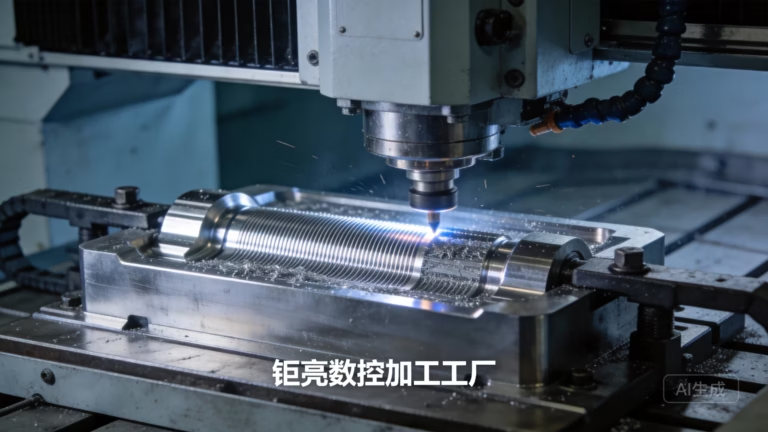
How coolant from cnc machines becomes airborne
Coolant leaves the sump as a liquid. It only reaches your lungs after it is broken into droplets small enough to stay suspended. The cutting edge does most of that work. So does the high-pressure nozzle, the spinning tool holder, and the chip conveyor. Droplets below roughly 10 μm behave like a gas: they drift, they follow air currents, and they bypass the nose's filter.
This is why the hazard is described as mist, not vapor. Vapor is a gas phase change and depends on temperature. Mist is mechanical. A water-based emulsion at 22 °C can still fill the enclosure with aerosol if the delivery pressure is high enough and the enclosure door is open.
Three variables set the concentration you actually breathe. Fluid type and concentration, the energy put into the cut, and how well the machine contains and extracts the aerosol. Change any one and the exposure number moves.
- 1Water-miscible emulsionDilution typically 5–10 percent; more mist, better cooling.
- 2Neat oilLower droplet count, more oil film on the floor.
- 3Synthetic and semi-syntheticNo mineral oil, but additives still aerosolize.
- 4High-pressure through-tool70–150 bar produces the finest, most respirable droplets.
What the aerosol actually carries
A metalworking fluid is not one chemical. It is a formulated package: base oil or synthetic ester, emulsifiers, corrosion inhibitors, biocides, defoamers, extreme-pressure additives, and the tramp oil and metal fines that accumulate during use. Every one of those can end up in a droplet.
The components that draw regulatory attention fall into a few groups. Mineral oil mist itself is a known respiratory irritant and, at long-term high exposure, an occupational concern. Biocides such as formaldehyde releasers are sensitizers and irritants. Nitrosamines and polycyclic aromatic hydrocarbons can form as the fluid degrades, especially when nitrite-containing fluids meet amine additives or when the sump runs hot and dirty.
Bacteria and endotoxin are the part most shops ignore. A sump left at 30 °C with tramp oil on top becomes a bioreactor. The aerosol then delivers not just chemistry but biological agents, which is where many of the acute flu-like complaints come from.
- 1Mineral oilIrritant; long-term high exposure is the main chronic concern.
- 2BiocidesSkin and airway sensitizers at low concentrations.
- 3Nitrosamines / PAHsForm in degraded, contaminated fluid; suspected carcinogens.
- 4EndotoxinFrom bacterial growth; drives acute fever and cough.
Acute symptoms versus long-term risk
Short-term exposure produces symptoms you can see within a shift or a week. Watery eyes, blocked nose, dry throat, cough, and a rash on the forearms. Machinists often call the worst case Monday fever or metal fume flu, though the mechanism here is endotoxin and fine mist, not zinc fume. Symptoms usually clear after a few days away from the machine.
Long-term risk is a different argument. It depends on concentration, hours per day, and years of exposure. Epidemiological work has linked sustained high-level exposure to metalworking fluid mist with elevated rates of respiratory and digestive tract disease. That does not mean any exposure is dangerous. It means the dose-response curve is real, and the only lever you control is dose.
Dermatitis deserves its own line. It is the most common reported problem in machining, and it comes as much from touching wet parts and dipping hands in the sump as from breathing. Gloves and barrier cream are not optional extras.
- 1Within hours to daysEye and nose irritation, cough, headache, skin rash.
- 2Within monthsOccupational asthma and contact dermatitis can develop.
- 3Over yearsDose-dependent respiratory and digestive tract risk.
Where the exposure limits sit
Most shops work to a metalworking fluid mist limit expressed as mass of aerosol per cubic meter of air over an 8-hour shift. The commonly cited figure is 0.5 mg/m³ for water-miscible fluid mist, with 5 mg/m³ often used for neat oil. National rules differ, so confirm the number that applies to your site before you write a control plan.
A limit is a ceiling, not a target. Responsible shops run to ALARA, keeping exposure as low as reasonably achievable, because the limit was set for a healthy adult and does not account for sensitized workers or mixed exposures.
Measurement is the part people skip. A single personal sample on one operator tells you almost nothing. You need sampling across shifts, machines, and seasons, because coolant concentration drifts, enclosures leak, and ventilation filters load up over time.
- 10.5 mg/m³Common 8-hour limit for water-miscible mist.
- 25 mg/m³Common figure applied to neat oil mist.
- 3ALARADesign to stay well under the limit, not at it.
What actually reduces exposure on the floor
Engineering controls come first, and they are cheaper than respirators over a decade. A closed enclosure with a properly sized mist collector, ducted to the cutting zone, removes most of the aerosol at the source. Machine doors stay shut while cutting. That single habit does more than any personal protective equipment.
Fluid management is the second lever, and it is mostly discipline. Keep the sump at the specified concentration instead of topping up with neat concentrate. Skim tramp oil daily. Change fluid on a schedule, not when it smells. Run a biocide program that rotates active ingredients so resistance does not build.
Administrative controls close the gap. Rotate operators out of the heaviest mist zones, keep compressed air out of the enclosure for chip clearing, and never blow parts dry with an open nozzle. If a respirator is needed, it means the engineering controls have failed, and it should be treated as a signal to fix the machine, not to hand out masks.
- 1Source extractionMist collector sized to the enclosure volume, filter changed on schedule.
- 2Sump disciplineRefractometer checks, daily tramp oil skimming, scheduled dump.
- 3HousekeepingNo compressed-air blow-off inside the enclosure.
- 4RespiratorsLast resort, not the primary control.
How to judge a supplier's coolant practice
When you audit a machining supplier, ask what fluid they run and at what concentration. A shop that cannot answer from memory is not tracking its sumps. Ask how often fluid is changed and how tramp oil is removed. Ask whether the machines have mist collectors and when the filters were last swapped.
Walk the floor and look for two things. Are the doors closed while the spindle is running, and is the air near the machines visibly hazy under a strong light? Haze under a work light is a rough proxy for aerosol you cannot see otherwise.
Certification matters here. ISO 9001:2015 and IATF 16949:2016 both require documented control of the work environment, and ISO 14001-style environmental discipline usually rides alongside good fluid management. GreatLight runs three wholly-owned plants with 150 technicians across 7,600 m² in Dongguan, and holds ISO 9001:2015, IATF 16949:2016, ISO 13485:2016 and ISO 27001:2022.
- 1Ask for fluid and concentrationA vague answer means nobody is measuring.
- 2Ask for the change logScheduled replacement beats smell-based replacement.
- 3Look at the doorsClosed during cutting is the simplest honest indicator.
Which control to reach for first
Match the situation to the control that removes the most exposure for the least disruption.
| Situation | First control | Why |
|---|---|---|
| Open-door manual mill | Enclosure + local extraction | Stops aerosol before it reaches the breathing zone |
| High-pressure through-tool | Sized mist collector, ducted | 70–150 bar creates the finest droplets |
| Sump smells sour | Dump, clean, recharge fluid | Bacteria and endotoxin drive acute symptoms |
| Skin rash on operators | Gloves, barrier cream, no bare dip | Contact dermatitis is the most common complaint |
| Visible haze under light | Check filter, seal, extraction balance | Haze means the collector is not keeping up |
| New large part program | Sample air before and after | Confirms the control actually works |
Short answer, with a condition
Coolant mist is not harmless, but the dose is controllable. If a shop runs closed enclosures, sized extraction, and disciplined sump management, exposure stays low and the risk is small. If it runs open doors, sour fluid, and no sampling, the risk is real and it will show up in operator health and turnover.
Questions engineers ask next
Is neat oil mist safer than water-miscible mist?
Not automatically. Neat oil produces fewer airborne droplets because the fluid is not diluted and does not evaporate as readily, and its mass limit is usually set higher.
But neat oil carries its own additives and can form oil film on every surface, and long-term exposure to oil mist is still a recognized concern. The right comparison is measured concentration against the applicable limit, not fluid type alone.
Does a mask solve the problem?
A correctly fitted respirator reduces what the wearer inhales, if it is the right class and worn for the whole exposure period.
It does nothing for everyone else in the bay, and compliance over a full shift is poor in practice. Treat respirators as a temporary measure while you fix extraction and enclosure seals.
How often should coolant be changed?
There is no universal interval. It depends on fluid chemistry, metal being cut, tramp oil ingress, and water hardness.
A workable approach is scheduled testing for concentration, pH, and microbial count, with replacement triggered by the trend rather than a fixed calendar. Many shops find 3 to 6 months practical for water-miscible fluids, but the data should decide.
Can coolant mist make you sick after one shift?
Yes, in the acute sense. Irritation, cough, blocked nose, headache, and a flu-like feeling within hours of a heavy exposure are well described.
These symptoms usually resolve after time away. The concern is repeated episodes, which can progress to occupational asthma in sensitized individuals.
Does the part material change the mist risk?
It changes the aerosol load. Aluminum and cast iron produce different chip forms and different fine particulate, and cast iron dust adds its own respiratory burden on top of the fluid mist.
Titanium and nickel alloys often need higher-pressure delivery and more aggressive fluid, which pushes droplet counts up. Match the control to the hardest material the cell runs, not the average job.
What should I ask a supplier before placing an order?
Ask which fluids they run, at what concentration, how sumps are monitored, and whether machines have mist extraction with a filter change log.
If they can answer those four questions with records, their environmental control is probably in order. If not, ask what they intend to change before your parts are machined.
Send the drawing, get a quote in 12 hours
Upload your files and we will return a quotation with free DFM analysis within 12 hours, produced on machines that run closed enclosures and managed coolant.
12-hour quote100% inspectionNo minimum order quantityNDA on request
More machining notes
We publish setup notes, tooling trials and inspection data from the factory floor.











