
Selecting CNC tool: key points for engineers and buyers
Tool choice sets your tolerance, cycle time, and scrap rate before the first chip. This guide is for engineers and buyers specifying cutters for milling and turning jobs. Read it and you can judge whether a quoted tooling plan will hold ±0.005 mm and Ra 0.8–1.6 μm on your material.
In this article
- 1
- 2
- 3
- 4
- 5
- 6
- 7
- 8
Key takeaways
Selecting CNC tool by material and operation
Match the row to your workpiece, then confirm with a test cut.
| Workpiece | Substrate / coating | Geometry note | Watch out for |
|---|---|---|---|
| 6061 / 7075 aluminum | Uncoated or ZrN carbide | 2–3 flutes, 35–45° helix | Built-up edge at low speed |
| 304 / 316 stainless | AlTiN or TiAlN | 4–5 flutes, 38–45° helix | Work hardening on light passes |
| 1018 / 4140 steel | TiAlN or AlCrN | 4–6 flutes, strong core | Chatter on long overhangs |
| Ti-6Al-4V titanium | AlTiN, polished flutes | Variable helix, 4 flutes | Heat at the cutting edge |
| Inconel / nickel alloys | AlTiN or AlCrN, ceramic option | Heavy core, small rake | Notch wear at the depth line |
| POM / PEEK plastics | Uncoated, polished carbide | 1–2 flutes, sharp edge | Melting and chip welding |
The verdict
Match the tool to the material, control runout at the holder, and buy custom geometry only when volume or part shape pays for it.
Match tool substrate and coating to the workpiece
The workpiece picks the tool family before anything else. Aluminum cuts cleanly with uncoated carbide or a thin ZrN layer, because the metal is soft and the chip carries heat away fast. Steel, stainless, and titanium need a hard coating that survives 800–1,100 °C at the edge. AlTiN and TiAlN are the common choices; AlCrN holds up better in dry or near-dry cuts.
Coatings are not interchangeable. A TiN layer rated for general steel will fail quickly on 316 stainless, where the surface work hardens under a dull edge. On Inconel, a coated carbide with a light hone runs longer than a sharp uncoated tool, even though the sharp tool feels better on the first pass.
Hardness of the substrate matters too. Sub-micrograin carbide grades hold a keener edge for finishing, while coarse-grain grades resist chipping in roughing. Buying a premium grade for a roughing pass on 1018 steel is wasted money. A standard grade with the right geometry will do the job at a lower cost per part.
- 1AluminumUncoated or ZrN, high helix, sharp edge.
- 2Stainless and titaniumAlTiN or TiAlN, polished flutes, strong core.
- 3PlasticsUncoated, polished, low flute count.
Read tool geometry before you read the catalog price
Helix angle, rake angle, and core diameter decide how the cutter behaves. A 45° helix moves chips out of a deep pocket fast and reduces radial load on thin walls. A 30° helix leaves a stronger edge for interrupted cuts in castings or welded joints. Neither is better in the abstract; the part shape decides.
Flute count trades chip room against stiffness. Two or three flutes give aluminum a large gullet for chip evacuation. Five or six flutes stiffen the tool for finishing steel and let you push feed per tooth, but they clog fast in soft gummy material. A six-flute cutter in 6061 often welds chips to the flutes within one pocket.
Corner geometry is the quiet variable. A sharp corner on the cutter transfers stress into the part and the tool. A 0.4–0.8 mm corner radius spreads load along the edge and improves finish on vertical walls. For a feature that needs ±0.005 mm, the radius on the cutter has to match the radius on the drawing, or the tool path will leave the corner undersized.
Control runout, holder, and coolant before blaming the cutter
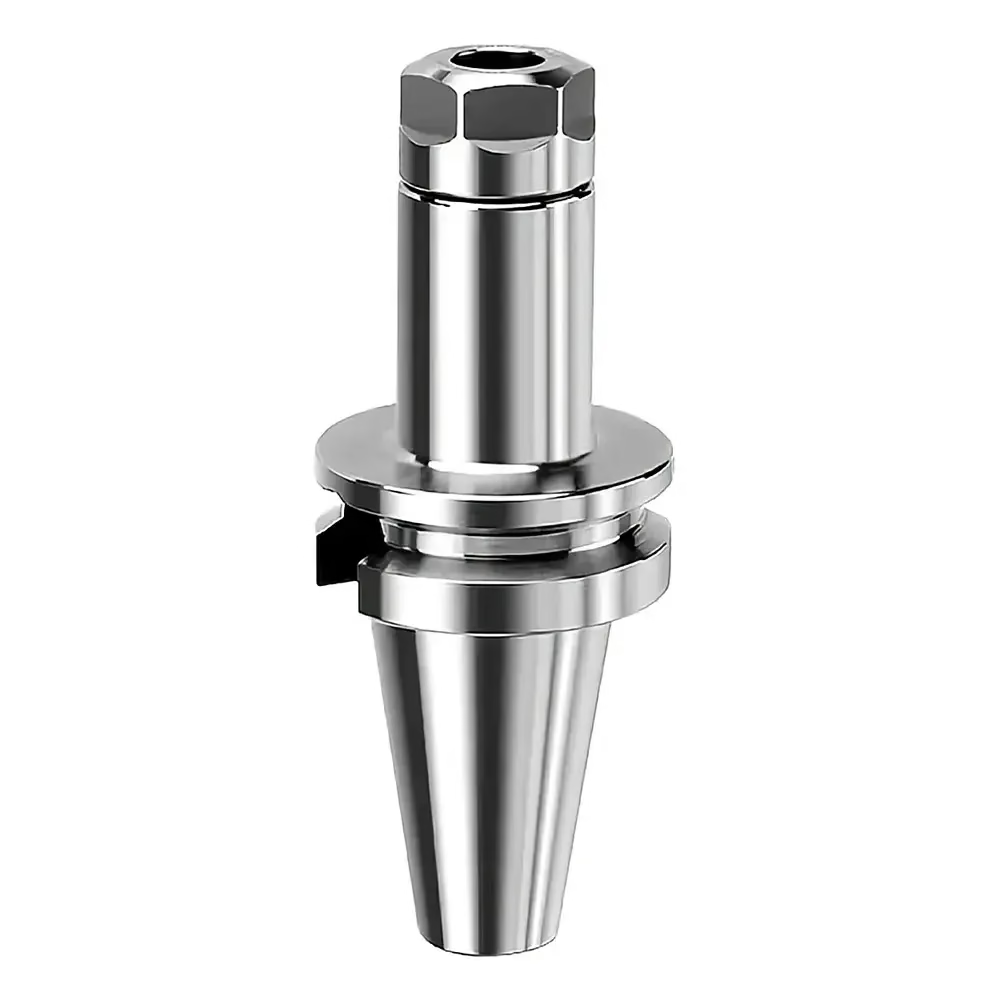
Runout is the number one reason a good cutter performs badly. A tool spinning 0.02 mm off center cuts with one flute doing most of the work. That flute heats up, wears fast, and leaves a poor finish on one side of the cut. Measuring runout with a dial indicator at the flute tips, not the shank, takes two minutes and explains most finish problems.
The holder sets the ceiling on runout. A shrink-fit or hydraulic holder holds 0.003–0.005 mm TIR at 3× diameter. A standard collet chuck may sit near 0.01 mm. If the job calls for Ra 0.2–0.8 μm on a deep wall, the holder is often the cheaper upgrade, not a new cutter.
Coolant strategy follows the material. Aluminum likes flood or high-pressure through-spindle coolant to clear chips. Titanium and Inconel need high pressure aimed at the edge to break the heat barrier. Running these alloys dry or with a weak air blast shortens tool life, regardless of how good the coating is.
- 1Check TIR at the flutesAim for 0.005 mm or less on finishing tools.
- 2Match holder to toleranceShrink-fit for tight walls, collet for roughing.
- 3Aim coolant at the edgeNot at the chip, not at the part.
Decide when a standard cutter is enough
Special tooling pays off when a feature repeats across thousands of parts, or when a standard cutter cannot reach the geometry at all. A form tool that cuts a radius and a chamfer in one pass saves cycle time on a high-volume run. On a one-off prototype, that same tool adds lead time and cost with no payoff.
The cutoff is usually volume and feature count. If a part has one deep slot and a few holes, a standard 3-flute cutter and a couple of drills will finish it. If the part has 40 identical undercut grooves, a custom ground cutter starts to make sense. Ask the shop to show the cycle time estimate both ways.
Long-reach features are the other case. A standard cutter on a long holder will deflect and chatter. A necked cutter with a reduced shank, or a tool with a tapered core, gives the reach without the flex. These are stock items at most suppliers, so lead time stays short.
What to ask a supplier about tooling
A quote that lists only machine time hides the tooling decision. Ask which cutters will run the critical features, what runout the shop holds on finishing tools, and how they plan to inspect the result. A shop that tracks tool life and replaces on a count, not on a feeling, delivers a more stable process.
Ask about the first-article plan too. Tool wear shows up in the last parts of a run, not the first. If the shop measures only the first part, a 10,000-piece order can drift out of tolerance near the end. In-process checks at set intervals catch that drift early.
Finally, ask how the shop handles a change in material. Switching from 6061 to 7075, or from 304 to 17-4PH, changes speeds, feeds, and sometimes the cutter family. A supplier that treats all aluminum or all stainless the same will burn tools and miss tolerances on the harder grades.
Step by step: qualifying a tool for a new job
Run these in order. Skipping the runout check is the most common mistake.
- 1Read the drawing and pick the critical featureNote the tightest tolerance and the finest surface callout. Those two features set the tooling plan.
- 2Choose the substrate and coatingMatch to the material family. Aluminum: uncoated or ZrN. Steel and stainless: AlTiN or TiAlN.
- 3Pick flute count and helix2–3 flutes and 35–45° helix for aluminum; 4–6 flutes and 38–45° helix for steel.
- 4Select the holderShrink-fit or hydraulic for finishing, collet for roughing. Target 0.005 mm TIR or less.
- 5Measure runout at the flute tipsUse a dial indicator. If it reads above 0.01 mm, reseat or change the holder before cutting.
- 6Run a test cut and inspect the surfaceCheck finish and size. Adjust speed and feed in 10% steps, not large jumps.
- 7Log tool life and set a change intervalReplace on a count. Do not wait for visible wear on the flank.
Selecting CNC tool: common questions
How many flutes should a cutter have for aluminum?
Two or three flutes for roughing and deep pockets, because the large gullet clears chips fast.
For finishing aluminum walls, a three-flute cutter with a 45° helix gives a good balance of finish and chip room. A six-flute cutter will clog in soft 6061 unless coolant pressure is high.
Does a coating fix a poor finish?
No. Finish problems usually come from runout, holder condition, or the wrong helix and rake angle.
A coating controls heat and wear at the edge. If the tool is running 0.02 mm off center, the coating will not bring the surface back into Ra 0.8–1.6 μm.
When is a custom ground cutter worth the cost?
When a feature repeats across a high-volume run, or when the geometry cannot be reached with a standard cutter.
For a one-off prototype, a standard cutter plus a second operation is usually faster and cheaper.
What runout should a finishing tool hold?
Target 0.005 mm or less at the flute tips. Above 0.01 mm, one flute does most of the cutting and finish suffers on one side of the wall.
Shrink-fit and hydraulic holders reach that range more reliably than standard collets.
Do titanium and stainless need different tools?
Yes. Titanium (Ti-6Al-4V) work hardens and holds heat at the edge, so it wants a polished AlTiN-coated tool with a strong core and high-pressure coolant.
Austenitic stainless such as 304 and 316 also work hardens, but a 4–5 flute AlTiN cutter with a light hone handles it well when the feed per tooth stays high enough to cut under the hardened layer.
How does tool choice affect lead time?
Standard cutters ship from stock, so they do not add to the schedule. Custom ground tools add design and grinding time before the first cut.
If a part is quote-ready, we return a quotation and free DFM analysis within 12 hours, and production can start within 24 hours.
Send your drawing, get a tooling plan
We review your material, tolerance, and feature list, then propose the cutters and holder setup before quoting.
12-hour quote100% inspectionNo MOQ
More from GreatLight
We publish setup notes, tooling trials and inspection data from the factory floor.











