
Master 7 Axis CNC Machining: How the Extra Axes Change the Cut
A plain explanation of what the seventh axis does, how the kinematics stack up, and which parts actually benefit. Written for engineers and buyers who need to decide between 5-axis and 7-axis work before they send an RFQ.
In this article
- 1
- 2
- 3
- 4
- 5
- 6
Why the seventh axis exists in master 7 axis CNC machining
A 5-axis machining center already moves the tool along X, Y and Z and rotates the part or the head about two of those axes. Adding a sixth and seventh controlled motion does not make the machine spin faster. It changes which surfaces can be reached without unclamping the part.
Most machines sold as 7-axis are 5-axis platforms with a live tool turret or a second rotary table. The two extra motions usually sit on the workholding side, not the spindle side. That matters, because the kinematics decide what you can cut and what you cannot.
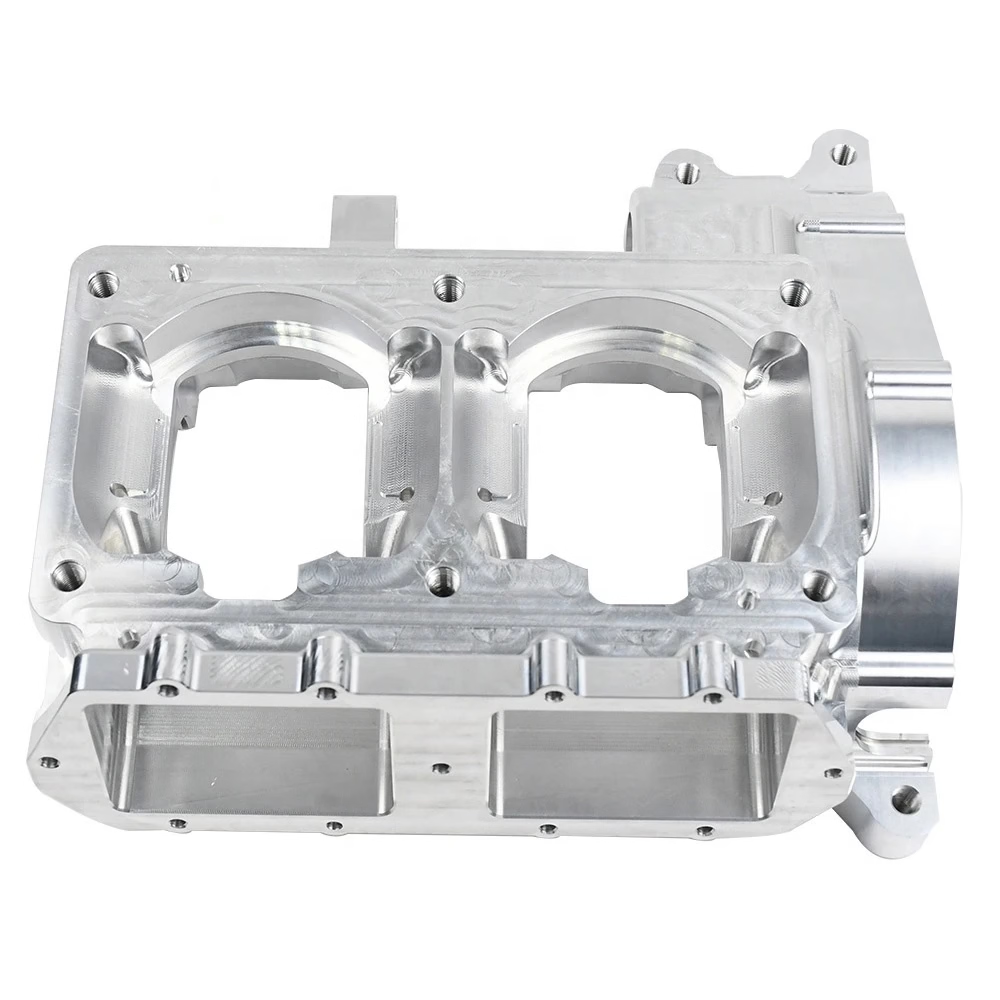
Picture a hydraulic manifold with ports on four faces and a drilled cross-hole that meets them at a compound angle. On a 3-axis mill you would fixture it three or four times. Each refixture adds setup error and eats an hour. With two more rotary motions the same part comes off one setup.
- 13 linear axesX, Y, Z. Every CNC mill has these.
- 22 rotary axesTilt and swivel, typically A and C on a trunnion.
- 32 extra motionsOften a second table or live tooling on mill-turn platforms.
Two common machine layouts and what they do well
Layout one is a trunnion table: a tilting cradle holding a rotating table, with the spindle on a gantry above. The part moves under a fixed tool. This is the classic 5-axis arrangement, and it extends cleanly when a second rotary table is added for back-side work.
Layout two is a mill-turn center. The spindle holds the bar or blank and turns it like a lathe, while a B-axis tool head swings in to mill, drill and tap off-center features. Add a sub-spindle and you get a second controlled rotary motion, which is where the seventh axis usually comes from.
Neither layout is better in the abstract. Trunnion machines reach prismatic parts up to 4,000 mm in our shop. Mill-turn centers win on round parts with milled flats, cross-holes and threads, because turning and milling happen without a second operation.
- 1Trunnion tableBest for prismatic housings, brackets, plates with angled features.
- 2Mill-turn centerBest for shafts, bushings, fittings with cross-drilled ports.
Why more axes does not automatically mean tighter tolerance
Every rotary axis adds stack-up. A tilt error of 0.01° sounds tiny until you apply it 200 mm from the center of rotation, where it becomes roughly 0.035 mm of position error at the cut. That is why rotary calibration and thermal stability matter more than the axis count on the brochure.
The practical result: a well-maintained 5-axis machine holds ±0.005 mm on a 300 mm part. A poorly set-up 7-axis machine does not. Extra axes buy accessibility and setup reduction, not free accuracy.
On our floor we check rotary centerline drift on a schedule, and we run a test cut before a tight-tolerance job starts. In-process probing catches drift before a batch is scrapped. Final inspection runs on 100% of parts before shipment.
- 1Rotary calibrationCenterline and backlash checked on a schedule, not once a year.
- 2Thermal driftWarm up the spindle and rotary axes before the first cut.
- 3ProbingIn-process checks catch drift mid-batch.
When master 7 axis CNC machining is the right call
The strongest case is a part with features on five or six faces that must be concentric to each other. One setup means one datum. Hole-to-hole position stays consistent because nothing moves between operations.
The second case is a part too awkward to fixture. A turbine-style impeller blade, a curved impeller shroud, or a manifold with compound-angle ports can be reached by tilting the table rather than building a dedicated angle plate. Fixture cost drops and lead time follows.
The third case is low volume with high mix. If you make 10 to 50 pieces of a complex part, the setup savings from extra axes usually beat the hourly rate gap. Above a few thousand parts, a dedicated fixture on a 3-axis machine can be cheaper per piece.
- 1Concentric multi-face featuresOne datum, one setup, no re-indicating.
- 2Awkward geometryCompound angles and undercuts reached by tilting.
- 3High mix, low volumeSetup time dominates the cost equation.
Where the extra axes stop paying off
Simple parts do not benefit. A flat plate with through-holes is faster on a 3-axis machine with a good fixture, and the hourly rate is lower. Adding rotary motion to a job that does not need it just adds programming time and cycle time.
Rigidity has limits too. A part held out on a tilted rotary table is less supported than the same part clamped flat on the bed. Deep pockets in hard steel, or heavy interrupted cuts in titanium, can chatter where a 3-axis setup would not.
Then there is the programming side. Simultaneous motion requires a post-processor that handles the machine's real kinematics, plus collision simulation. If the CAM setup is wrong, the first scrapped part is the one that teaches you.
- 1Flat prismatic parts3-axis with a fixture is faster and cheaper.
- 2Heavy interrupted cutsCantilevered rotary setups lose rigidity.
- 3Thin-wall partsRotary clamping can distort the blank.
3-axis, 5-axis and 7-axis: which setup fits the part
Match the machine to the geometry, not to the spec sheet.
| Part characteristic | 3-axis | 5-axis | 7-axis / mill-turn |
|---|---|---|---|
| Features on 2 faces | Good fit | Overkill | Overkill |
| Features on 5–6 faces | Multiple setups | Good fit | Good fit |
| Compound-angle ports | Needs angle plate | Good fit | Good fit |
| Round part with cross-holes | Two operations | Workable | Best fit |
| Volume 1–50 pcs | Fixture cost bites | Good fit | Best fit |
| Volume 5,000+ pcs | Best per piece | Good fit | Rate premium |
| Deep pocket in 4140 steel | Most rigid | Good fit | Less rigid |
| Thin-wall aluminium housing | Good fit | Watch clamping | Watch clamping |
The short answer
If the part has features on five or six faces that must stay concentric, choose 7-axis and pay for one setup. If the part is flat, prismatic, and runs in the thousands, choose 3-axis with a dedicated fixture and keep the money.
Questions engineers ask about 7-axis work
Is a 7-axis machine always more accurate than a 5-axis machine?
No. Accuracy comes from calibration, thermal control and probing, not from axis count. A well-kept 5-axis machine holds ±0.005 mm on a 300 mm part.
What the extra axes buy is access and setup reduction, so there is less chance for a refixturing error to creep in.
What is the difference between 5-axis and 7-axis in practice?
A 5-axis machine rotates the part or the head about two axes. A 7-axis setup adds two more controlled motions, usually a second rotary table or live tooling on a mill-turn platform.
The result is more reachable surfaces per setup, not a faster spindle or a finer tolerance.
Can 7-axis machining cut titanium and Inconel?
Yes, within rigidity limits. TC4 (Ti-6Al-4V), Inconel and magnesium AZ31B are all in our material list.
Heavy interrupted cuts in these alloys favor a part clamped flat on the bed. A cantilevered rotary setup can chatter, so we adjust speeds and stepovers rather than pushing the tool.
Does 7-axis work cost more per part?
The hourly rate is higher, but the setup count is lower. For a 20-piece run of a complex part, the total often comes out close to or below a multi-setup 3-axis job.
For a 5,000-piece run of a simple bracket, it usually does not.
What do you need from me to quote a 7-axis job?
A STEP or IGES file plus a drawing with tolerances, material and finish. If the datum scheme is open, tell us which faces matter most.
We return a quotation and a free DFM analysis within 12 hours, and production can start within 24 hours of approval.
How do you keep drawings confidential?
Uploads are secure and confidential, and we sign an NDA on request before files change hands.
We hold ISO 27001:2022 for information security, alongside ISO 9001:2015, IATF 16949:2016 and ISO 13485:2016.
Send the part, get a real answer
Upload a STEP file and we will tell you whether the job belongs on a 3-axis, 5-axis or 7-axis machine, with a quote and DFM notes in 12 hours.
12-hour quoteNo minimum order100% inspection
More machining notes
We publish setup notes, tooling trials and inspection data from the factory floor.











