
One Stop OEM CNC Machining Services: A 7-Point Buyer Checklist
This guide is for engineers and procurement staff comparing one stop OEM CNC machining services. It covers in-house process range, tolerance and finish, certifications, order size, and how to read a quote before you release a PO.
In this article
- 1
- 2
- 3
- 4
- 5
- 6
- 7
Key takeaways
Judging a one stop OEM CNC machining supplier
Use this table as a first pass. Anything you cannot answer for a supplier is a question to send before you release a PO.
| Criterion | What to ask | Good answer looks like |
|---|---|---|
| Process range | Which operations are in-house? | Turning, 3-, 4-, 5-axis milling, finishing, inspection |
| Tolerance | Which features hold ±0.005 mm? | Named features plus the CMM method used to check them |
| Finish | What Ra can you hold? | Ra 0.8–1.6 μm as machined-to-fine, Ra 0.2–0.8 μm on request |
| Certifications | Which certs apply to my part? | ISO 9001, plus IATF 16949 / ISO 13485 / ISO 27001 as needed |
| Order size | Is there a minimum? | No MOQ; one prototype up to 10,000+ piece runs |
| Quote speed | How fast is DFM feedback? | Quotation and free DFM analysis within 12 hours |
| Lead time | When can production start? | Production start within 24 hours once data and material are fixed |
| Inspection | What ships with the parts? | 100% inspection before shipment, reports on request |
The short version
If your part needs three or more operations, or a datum that must survive a finishing step, one supplier running the whole route is usually cheaper than four quotes that each look low.
What a real one stop OEM CNC machining services partner does
A one stop shop is not a broker with a long vendor list. It is a plant that holds your drawing from DFM through to packed parts, so nobody re-interprets the model halfway. That matters most when a part needs more than one operation, because every handoff is a chance to lose a datum.
The first real test is DFM. Before a chip is cut, the supplier should read your CAD model and flag thin walls, deep pockets, sharp internal corners and features that need a tool you cannot buy. Good feedback names the feature and suggests a change; a vague note about manufacturability is not useful.
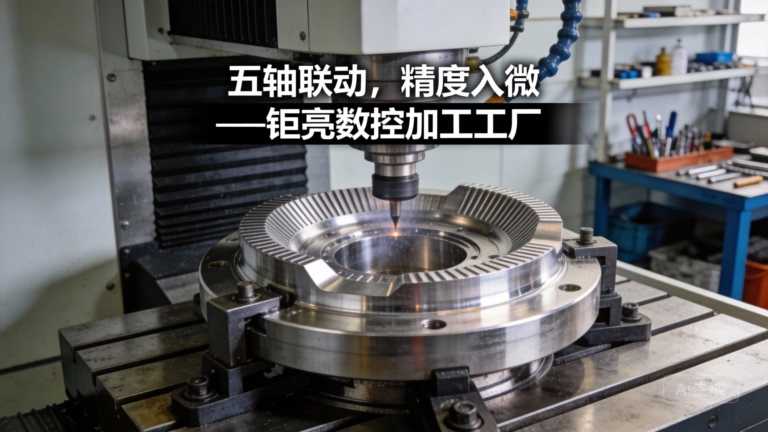
The second test is process coverage. Turning alone cannot finish a part that also needs 5-axis work and hardcoat anodizing. When those steps stay in one building, the shop controls the schedule and the tolerances at each stage. GreatLight runs 127 high-precision CNC machines, including 16 simultaneous 5-axis machining centers, across 3 wholly-owned plants in 7,600 m².
Size range is the third test. A shop limited to small work will subcontract the large parts and lose control of the schedule. Maximum processing size of 4,000 mm, with a Ø400 mm rotary table for round work, covers most industrial housings, brackets and shafts without splitting the order.
The hidden cost of splitting an order across vendors
Splitting work looks cheaper on a per-step quote. Turning goes to one shop, 5-axis milling to another, anodizing to a third, and inspection to whoever is closest. Each vendor prices its own step well. The cost shows up somewhere else.
Every handoff needs a new setup, a new fixture and a new first-article check. Datum chains get rebuilt from a print instead of carrying through from the first operation. On a part with a ±0.005 mm bore-to-bore relationship, that rebuild is where scrap comes from.
Files also multiply. Four vendors means four copies of your CAD data and four confidentiality agreements to track. An NDA and secure upload handling reduce that exposure, but fewer hands is the simpler answer.
Scheduling is the last hidden cost. When one step slips, you do not hear about it until the next vendor asks where the parts are. A supplier that runs the whole route owns that conversation and the recovery plan.
Quality systems you should verify, not just read
A certificate proves an audit happened. It does not prove your part will be measured the way you measure it. Ask how inspection is planned for your specific drawing: which features, which instrument, and what the report contains.
For general industrial work, ISO 9001:2015 is the baseline management system. Automotive and EV programs usually require IATF 16949:2016. Medical device work points to ISO 13485:2016. If your drawings or production data are sensitive, ISO 27001:2022 covers information security.
Inspection practice matters more than the wall certificate. Raw material check, in-process monitoring and final inspection before shipment are the three points where problems are usually caught. GreatLight inspects 100% of parts before shipment and provides reports on request.
A useful question is what happens when a feature is out. A shop that can re-measure on a CMM and show you the data resolves a dispute in a day. A shop that only repeats the print number does not.
When a one stop supplier is the right call, and when it is not
One stop fits parts that need more than one process, tight tolerance between features, and a fixed launch date. It also fits programs that start as a prototype and move toward 10,000+ pieces, because the same process and inspection data carry forward.
It fits poorly when your part is a single simple turning job with a loose tolerance and you already have a local shop that ships in two days. Adding a full DFM and inspection route to a cheap bracket adds cost without adding value.
Consider a specialist instead when the process is outside normal machining. Large die castings, vacuum casting for low-volume shells and sheet metal work are separate disciplines, even when one supplier can coordinate them.
The practical test is the number of operations on the routing. One or two operations: a local machine shop is fine. Four or more, or any operation where the datum must survive a finish: one stop usually wins on total cost.
How to evaluate a supplier in 6 steps
Run these in order. Steps 1 to 3 you can do alone; steps 4 to 6 need the supplier to answer.
- 1Count the operations on your routingList every step from raw stock to packed part: turning, milling, heat treat, finishing, marking. Four or more operations is where a fragmented chain starts to cost you.
- 2Mark the critical featuresOn the drawing, mark the features that carry function and the tolerance each one needs. Note which relationships must survive a second setup. This list becomes your inspection plan.
- 3Check the size envelopeCompare your largest part against the supplier envelope. GreatLight handles up to 4,000 mm, with travels of 4,000 × 400 × 150 mm and 750 × 1,150 × 550 mm for mid-size work.
- 4Send the model for DFM, not just a priceA good return names specific features: a 0.8 mm wall, a 4:1 deep pocket, a corner radius smaller than the cutter. Ask what changes they recommend and what each change saves.
- 5Match certifications to your industryGeneral industrial work: ISO 9001:2015. Automotive: IATF 16949:2016. Medical: ISO 13485:2016. Sensitive data: ISO 27001:2022. Ask which applies to your part number.
- 6Fix the commercial terms before the POConfirm order size, finish spec, inspection report, marking and delivery window in writing. No minimum order quantity means a single prototype and a 10,000+ run follow the same route.
Questions buyers ask before the first order
How do I know the quoted tolerance is real?
Ask which features hold ±0.005 mm and how they will be measured. A supplier that can name the instrument and the setup is quoting from the process, not from a brochure.
Imperial drawings are fine: ±0.005 mm is about ±0.0002 in. Keep one unit system on the drawing to avoid a conversion error at the machine.
What surface finish can I expect without extra processing?
As-machined surfaces typically land at Ra 1.6–3.2 μm. Fine machining reaches Ra 0.8–1.6 μm, and Ra 0.2–0.8 μm is available where the geometry allows.
Tell us which faces are sealing or sliding surfaces. Polishing every face costs money and can round an edge you need sharp.
Is there a minimum order quantity?
No minimum order quantity. Orders run from one prototype to 10,000+ pieces, and the same routing and inspection plan apply at both ends.
For prototype runs, send the final model rather than a simplified one. A prototype made on a different route does not predict production behavior.
How fast can I get a quote and a first article?
Quotation and free DFM analysis come back within 12 hours. Production can start within 24 hours once material and data are confirmed, and parts ship in 3–5 days.
The clock depends on material availability. Exotic stock such as Inconel or Ti-6Al-4V may add sourcing time before machining starts.
Which materials and finishes are handled in-house?
Aluminum grades include 6061, 7075 and 6082; stainless includes 303, 304, 316L, 17-4PH and 440C; steel includes 1018, 1045, 4140 and 4340. Titanium TA1, TA2 and TC4 are also machined.
Finishes cover anodizing, electroless nickel and other plating, powder coating, black oxide, bead blasting, polishing, and laser marking down to 1.5 mm character height.
How is my design data protected?
Uploads are handled as secure and confidential, and an NDA is available on request before files are shared.
Fewer vendors means fewer copies of your model. If your routing needs four operations, keeping them under one roof removes three transfers of your CAD data.
Send your drawing and get a DFM read in 12 hours
Upload the model and tell us the annual quantity and the critical features. We return a quotation and a free DFM analysis within 12 hours, with no minimum order quantity.
12-hour quoteFree DFM analysisNo MOQ100% inspection
More from GreatLight
We publish setup notes, tooling trials and inspection data from the factory floor.











