
Paris CNC Parts Suppliers: 7 Checks Before You Order
This guide is for engineers and sourcing teams comparing Paris CNC parts suppliers, or weighing a local French shop against an overseas machining partner. It covers the checks that actually change part cost and risk: tolerance, lead time, MOQ, certifications and how a quote is written. Read it and you can judge a supplier in one call.
In this article
- 1
- 2
- 3
- 4
- 5
- 6
- 7
What matters most when you compare Paris CNC parts suppliers
How to score a Paris CNC parts supplier
Use these five rows as a scoring sheet. Any shop that cannot answer two of them in writing is a risk on a first order.
| What to check | Weak answer | Strong answer |
|---|---|---|
| Achievable tolerance | "We hold 0.01 mm on everything" | Gives a tolerance per feature and per material |
| Lead time | "About a month" | Quote time and first-chip time stated separately |
| MOQ | 1,000 pieces minimum | From one prototype to 10,000+ part runs |
| Certifications | ISO 9001 only, unnamed scope | ISO 9001, IATF 16949, ISO 13485, ISO 27001 |
| Inspection | "We check the important ones" | 100% inspection before shipment, reports on request |
| Quoting method | One total price, no breakdown | DFM notes plus material, setup and finishing lines |
| Confidentiality | Nothing mentioned | Secure uploads and an NDA on request |
Pick the supplier that answers the hard questions first
If your part is simple and the deadline is close, a local Paris shop is often the low-risk choice. If the part is complex, needs tight tolerances on a few features, or has to move from one prototype to volume without re-qualification, judge the supplier on DFM feedback, first-chip date, inspection plan and certificate scope. Those four answers separate a machining partner from a price list.
Tolerance and material fit at Paris CNC parts suppliers
Tolerance is the first number engineers compare, and the first one that gets misused. A shop that can reach ±0.005 mm does not hold that on every surface of a bracket, because it would not help the part work and it would add cost. The useful question is which features carry the tight callout and whether the supplier can name a process for each one.
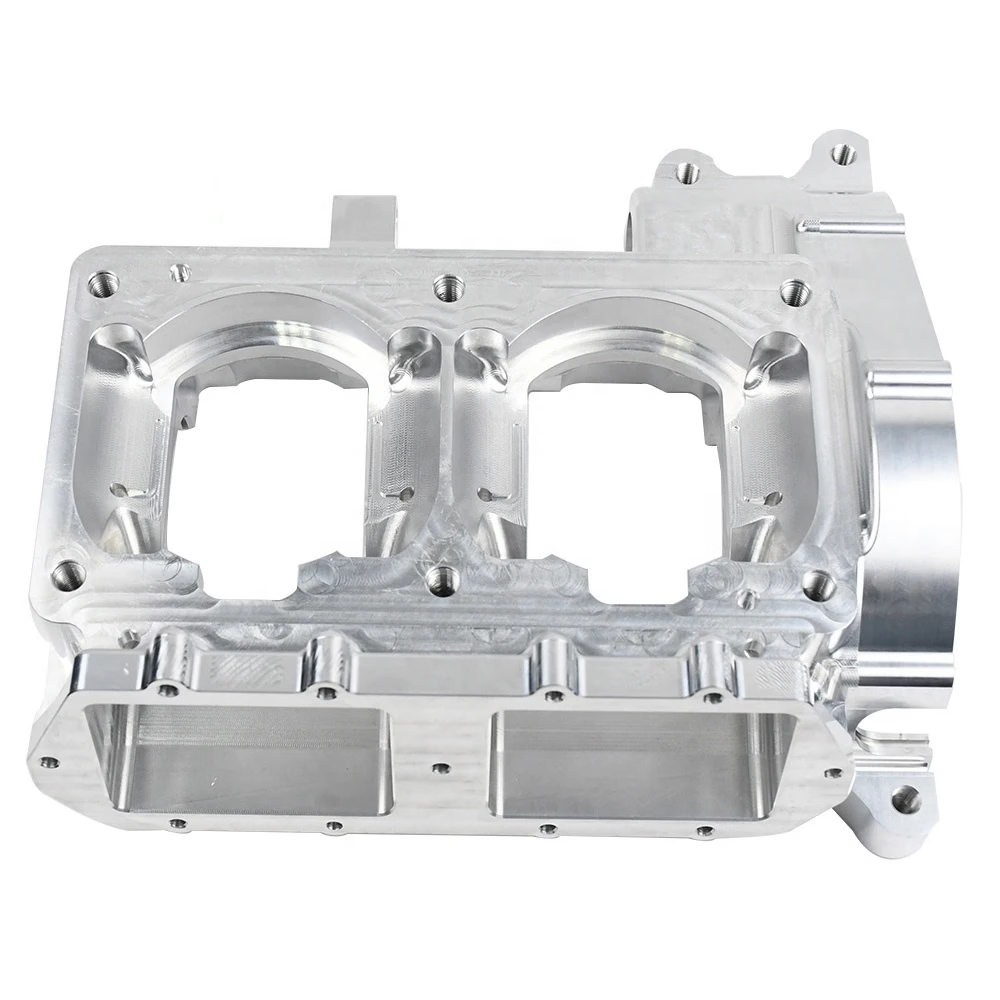
On a milled aluminium housing, a bearing bore at Ø20 H7 is a boring or reaming job. The outer profile at ±0.1 mm is a roughing pass. Those two features should not share a tolerance on the drawing, and they should not share a price. When a supplier quotes a flat rate per part, they are usually ignoring this distinction.
Material choice changes the answer too. Aluminium 6061-T6, 7075 and 6082 machine clean and hold tight limits well. Stainless 316L and 17-4PH move more under heat and need lighter finishing passes. Titanium TC4 (Ti-6Al-4V) and Inconel wear tools quickly, so a tight tolerance on a deep pocket is a slow operation, not a fast one.
- 1Tight only where it mattersMark datum and fit features on the drawing, leave cosmetic surfaces at Ra 1.6–3.2 μm.
- 2Ask for a DFM noteA supplier who returns comments on wall thickness and tool access is reading your file.
- 3Watch thin wallsBelow roughly 1 mm on aluminium, chatter and deflection start to dominate the result.
Lead time, MOQ and how Paris CNC parts suppliers quote
Lead time is usually quoted as one number, which hides the part that matters. Ask two separate questions: how long until the quote arrives, and how long until the first chip is cut. At GreatLight the quote and a free DFM analysis come back within 12 hours, production can start within 24 hours, and parts ship in 3–5 days. Those are three different clocks and a buyer should track all three.
For a Paris buyer, the shipping leg is the extra variable. A local shop may deliver in days but start later, because its machines are booked. An overseas shop may have a longer transit but start immediately. If your build has a hard date, the start time is the number to pin down, not the delivery window.
Minimum order quantity splits suppliers into two groups. A shop with a 1,000-piece minimum is a production house; sending it a single bracket wastes both sides' time. A shop that runs no minimum order quantity, from one prototype to 10,000+ part runs, keeps the same process and inspection on both ends. That continuity matters when a prototype has to become a production part.
- 1Pin the start dateA confirmed order is not a scheduled machine. Ask for the first-chip date.
- 2Check the quote line itemsMaterial, setup, machining, finishing and inspection should be visible.
- 3Ask about late riskHistorical late-delivery probability below 2% is a trackable number, not a promise.
Certifications and inspection: reading the fine print
Certificates are often listed as logos. They are actually scopes, and each one answers a different question. ISO 9001:2015 covers the quality management system as a whole. IATF 16949:2016 adds the automotive and engine hardware requirements, including traceability and change control. ISO 13485:2016 applies to medical devices, where process validation and record keeping carry more weight. ISO 27001:2022 covers information security, which is what protects your CAD files.
If your part goes into a vehicle, a medical device or a customer's confidential product, the certificate must match. A general machining shop with only ISO 9001 can still make an excellent bracket. It is the wrong choice for a brake component or a surgical instrument housing.
Inspection is the second half of this check. 100% inspection before shipment, with raw material check, in-process monitoring and final inspection, is the baseline. Reports should be available on request, and you should know before ordering which features are measured and with what equipment. A first article report on a prototype tells you how the shop will behave at volume.
- 1Match certificate to industryAutomotive, medical and information security each have their own standard.
- 2Ask what is measuredA report covering every tight feature is more useful than a generic one.
- 3Request the NDA earlySign it before sending CAD, not after the tooling is cut.
Capacity and finishing decide whether Paris CNC parts suppliers can scale
A supplier's machine list is a map of what it can and cannot do. 127 high-precision CNC machines across three wholly-owned plants, including 16 simultaneous 5-axis machining centers, 12 four-axis mills, 27 three-axis machines and 16 mill-turn centers, covers most prismatic and turned parts. The limit shows up on size and on geometry.
Maximum processing size is 4,000 mm, with travels of 4,000 × 400 × 150 mm on the large machines, 750 × 1,150 × 550 mm and 600 × 600 × 600 mm in the mid range, and 500 × 500 × 450 mm or 500 × 310 × 200 mm on the compact machines. A Ø400 mm rotary table handles parts that need positional work around a bore. If your part is a long extrusion with features on five faces, that combination is the one to ask about.
Finishing is where quotes often drift. Anodizing in clear, colour, hardcoat or conductive, electroless nickel, zinc, silver and gold plating, powder coating and black oxide, plus bead blasting, tumbling, brushing and polishing, are all separate operations with their own lead time and cost. Laser marking needs a minimum character height of 1.5 mm. If a quote lumps finishing into one line, expect a change order later.
- 1Size drives machine choiceA 2,000 mm part cannot move to a compact 3-axis machine to save time.
- 25-axis reduces setupsFewer setups usually means better position tolerance between features.
- 3Price finishing separatelyMasking, rack marks and color matching are the usual change-order sources.
How to vet Paris CNC parts suppliers step by step
Run these seven steps in order on your next RFQ. Each one is designed to expose a different failure mode.
- 1Send a complete drawing packageInclude 3D STEP, 2D PDF, material, finish and the tolerance per feature. Missing finish callouts are the most common cause of a revised quote.
- 2Ask for DFM feedback with the priceA useful supplier returns comments on wall thickness, tool access and datums within 12 hours. Silence means the file was priced, not read.
- 3Confirm the achievable tolerance per featureAsk which features will be held at ±0.005 mm and which at ±0.05 mm, and why. A shop that answers feature by feature is quoting from the model.
- 4Pin the schedule to three datesQuote date, first-chip date and ship date. Production can start within 24 hours and parts ship in 3–5 days when the order is clean.
- 5Check MOQ against your real demandIf the first order is one prototype and the second is 5,000 units, verify the same plant and process handle both. No minimum order quantity removes the guesswork.
- 6Match certifications to the end useISO 9001:2015 for general work, IATF 16949:2016 for automotive, ISO 13485:2016 for medical, ISO 27001:2022 for file security. Ask for the current scope.
- 7Agree inspection and paperwork before cuttingState which features get measured, request reports, and sign the NDA before uploading CAD. Uploads stay secure and confidential.
Questions buyers ask about Paris CNC parts suppliers
Is a local Paris shop always faster than an overseas supplier?
Not always. The transit leg is shorter locally, but the queue for machine time can be longer. Compare the first-chip date, not the shipping method.
For prototypes and small runs, a supplier that quotes within 12 hours and starts production within 24 hours often reaches the same delivery week as a booked local shop.
What tolerance should I put on my drawing?
Put the tightest limit only on features that function, such as bearing bores, mating faces and dowel holes. Leave cosmetic and clearance surfaces looser.
±0.005 mm is achievable on the right features and materials. Applying it everywhere raises cost without improving the part.
Do I need an NDA before sending CAD files?
If the design is not public, yes. Ask for the NDA before the first upload, not after the quote.
ISO 27001:2022 covers how a supplier manages information security, and it is a reasonable signal that file handling is controlled.
Which certifications matter for automotive and medical parts?
Automotive and engine hardware work points to IATF 16949:2016. Medical devices point to ISO 13485:2016. General industrial parts usually need ISO 9001:2015.
Ask for the certificate scope rather than the logo. Scope tells you which processes and sites are covered.
How do I avoid surprise costs after the quote?
Ask for material, setup, machining, finishing and inspection as separate lines, and confirm the finish callout on the drawing before ordering.
Finishing operations such as anodizing, plating and powder coating are priced separately and are the usual source of change orders.
Can one supplier handle both a prototype and a 10,000-part run?
Yes, if the shop has no minimum order quantity and the same inspection applies to both. Ask how the process changes between one part and volume.
Keeping the same supplier from prototype to production avoids re-qualifying tolerances, finishes and inspection plans a second time.
Send your drawing and get a machinable answer
Upload your STEP and 2D files and we will return a quote with DFM notes within 12 hours. No minimum order quantity, 100% inspection before shipment, and an NDA on request.
12-hour quoteNo MOQ100% inspectionNDA on request
More machining notes from the shop floor
We publish setup notes, tooling trials and inspection data from the factory floor.











