
West Midlands precision CNC machining: a rapidly growing industry
The West Midlands built its reputation on metal. Automotive, aerospace, and medical supply chains there keep pushing tolerances tighter, and the shops that serve them keep adding five-axis capacity. This page explains what that demand actually looks like at the machine, which parts fit precision CNC work, and where the limits sit.
In this article
- 1
- 2
- 3
- 4
- 5
- 6
- 7
- 8
Key takeaways
Why West Midlands precision CNC machining keeps growing
The West Midlands has one of the densest manufacturing clusters in Europe. Vehicle assembly, motorsport, aerospace sub-tiers, and medical device builders all sit within a short drive of each other. That density creates a steady flow of drawing packages that need metal cut to tight numbers, quickly.
That demand does not hit every shop equally. It lands hardest on suppliers who can hold ±0.005 mm across a batch, document the inspection, and repeat the same result six months later. Buyers in this region tend to audit process control, not just the sample part.
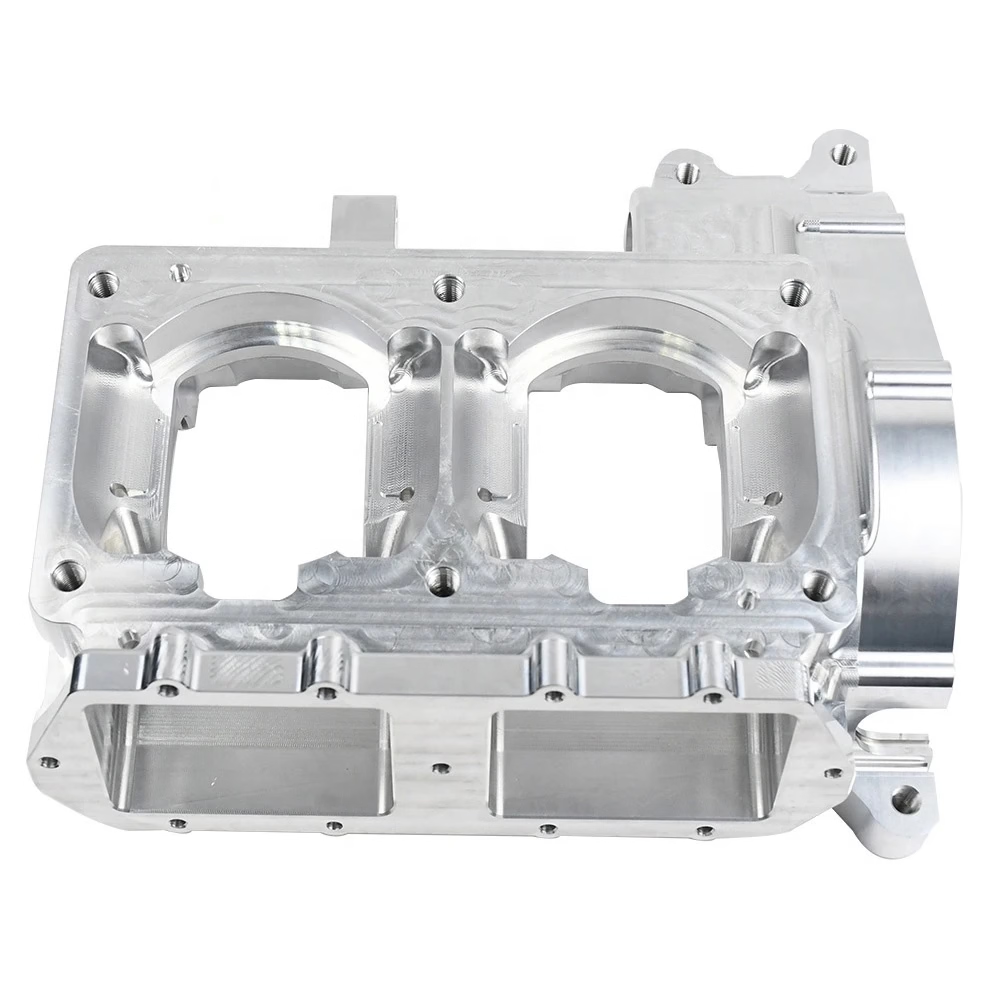
The work itself has shifted too. Ten years ago a typical job was a bracket or a housing with one or two critical dimensions. Now we see thin-wall housings, impeller-style geometry, and manifold blocks with intersecting ports that need five-axis access to reach in one setup.
- 1Cluster effectAutomotive, aerospace, and medical buyers sit close together, so prototype and production demand overlap.
- 2Tighter printsPosition tolerances under 0.02 mm are now common on mating faces and bore patterns.
- 3Smaller batchesRuns of 50 to 500 parts replace the old 5,000-part blanket orders.
What precision CNC machining actually controls
Precision CNC machining is subtractive. A rotating cutter removes material from a solid block, and the machine's servo axes decide where the cutter goes. Precision comes from three things working together: machine geometry, thermal stability, and the fixture that holds the part.
Machine geometry is the easy part to buy. A simultaneous five-axis center with a Ø400 mm rotary table can position a tool at almost any angle, but that only helps if the part is held without distortion. Thin walls move when you clamp them. We plan the fixture before we plan the toolpath.
Thermal drift is the quiet problem. Aluminium grows about 23 μm per metre per °C. A shop floor that swings 5 °C between morning and afternoon will move a 300 mm aluminium part by roughly 0.03 mm. That is six times the tolerance band. Temperature-controlled rooms and in-process probing are not luxuries at this level.
Surface finish follows the same logic. A Ra 1.6–3.2 μm as-machined finish is normal from a sharp cutter at moderate feed. Getting to Ra 0.2–0.8 μm means lighter finishing passes, sometimes a different tool, and often a finishing operation after heat treatment.
- 1Fixture firstSupport the part where it is thin, not where it is convenient.
- 2Probe in processMeasure on the machine before the part leaves the vise.
- 3Control the roomKeep ambient swing inside ±1 °C for sub-0.01 mm work.
Alloys that suit the region's supply chains
Most West Midlands work lands on a small group of alloys. Aluminium 6061-T6 and 7075 are the default for housings, brackets, and fixture plates. They cut fast, hold a good finish, and anodize predictably. If a part needs high strength at low weight, 7075 usually wins over 6061.
Stainless covers the medical and food-equipment side. Grade 316L and 17-4PH (SUS630) are common because they resist corrosion and can be passivated. 17-4PH also responds to heat treatment, which makes it useful for shafts and valve components where hardness matters.
Steel grades 4140 and 4340 appear in motorsport and heavy machinery parts. They machine well in the annealed state but distort during heat treatment, so we leave stock and finish-grind after hardening. Titanium TC4 (Ti-6Al-4V) and Inconel belong in the aerospace tier. Both are slow. Tool life drops, cycle times climb, and the cost per part reflects that.
- 1Aluminium6061, 6061-T6, 2024, 5052, 5083, 6063, 6082, 7075, ADC12
- 2Stainless303, 304, 316, 316L, 420, 430, 431, 440C, 17-4PH (SUS630)
- 3Steel and titanium1018, 1045, 4130, 4140, 4340, A36, TA1, TA2, TC4, Inconel
- 4PlasticsABS, PC, PMMA, POM, PA, PEEK, PP, HDPE, carbon fibre
When precision CNC fits, and when it does not
Precision CNC fits parts with complex geometry, tight tolerances, and a need for material properties that moulding or printing cannot deliver. Manifold blocks, gearbox housings, impellers, surgical instruments, and heat sinks all fall into this group. So do prototype runs where the design is still moving.
It does not fit every job. If a part is a simple flat plate with a ±0.5 mm tolerance and you need 50,000 pieces a year, stamping or die casting will beat machining on unit cost every time. Machining wins on flexibility, not on scale.
There is a middle ground worth naming. Die casting gets you a near-net shape, then precision CNC machining brings the critical bores and faces into tolerance. That pairing is common for automotive housings in the region. You get cast economics on the bulk and machined accuracy where it counts.
The honest test is this: count the critical features. One or two critical dimensions on a simple shape usually means a cheaper process. Five or more critical features on an irregular shape puts you firmly in five-axis territory.
- 1Good fitComplex geometry, tight tolerance, low to mid volume, design still changing.
- 2Poor fitSimple flat parts, wide tolerance, very high annual volume.
- 3HybridCast or forged blank, then machined critical features only.
What a capable supplier brings to the table
A shop serving this region needs breadth. GreatLight runs 127 high-precision CNC machines across three wholly-owned plants covering 7,600 m², with 150 technicians. The mix includes 16 simultaneous five-axis machining centers, 12 four-axis mills, 27 three-axis machines, and 16 mill-turn centers.
Size range matters as much as count. Maximum processing size reaches 4,000 mm, with travels of 4,000 × 400 × 150 mm for long parts and 750 × 1,150 × 550 mm for larger box work. Compact cells at 500 × 500 × 450 mm handle the small, high-mix jobs that keep a prototype line moving.
Quality systems are the other half. We hold ISO 9001:2015, IATF 16949:2016, ISO 13485:2016, and ISO 27001:2022. Every part gets inspected before shipment, covering raw material check, in-process monitoring, and final inspection, with reports on request. The qualification rate sits at 99.99%.
For buyers in the West Midlands, the practical question is not whether a supplier owns a five-axis machine. It is whether that machine runs the same part the same way on the third shipment as it did on the first.
- 1Machines127 total, including 16 simultaneous 5-axis centers and 16 mill-turn centers
- 2SizeUp to 4,000 mm maximum processing size
- 3CertificationsISO 9001, IATF 16949, ISO 13485, ISO 27001
- 4Inspection100% before shipment, reports on request
From drawing to first article
A typical sequence for a new precision CNC job.
- 1Send the drawing and the quantityInclude 3D model, 2D print with GD&T, material, finish, and target volume. Mark the critical dimensions.
- 2Get DFM feedbackWe return a quotation and free DFM analysis within 12 hours. Expect notes on thin walls, tool reach, and tolerance feasibility.
- 3Lock the fixture planFor thin-wall or high-tolerance parts, the fixture and datum scheme get agreed before the toolpath is written.
- 4Cut the first articleProduction can start within 24 hours of approval. The first part is probed on the machine and inspected offline.
- 5Review the inspection reportDimensional report, material cert, and finish data. Adjustments happen here, not after 500 parts.
- 6Run the batchParts ship in 3–5 days for standard jobs. In-process probing keeps the batch centred on nominal.
Choosing a process for a West Midlands part
Match the part to the process before you match it to a shop.
| Part profile | Best process | Why | Watch out for |
|---|---|---|---|
| Complex housing, 5+ critical features | 5-axis CNC | One setup, no re-fixturing error | Fixture cost and cycle time |
| Simple bracket, ±0.1 mm | 3-axis CNC or stamping | Lower cost at volume | Stamping tooling lead time |
| High-volume automotive housing | Die casting + CNC | Cast economics, machined bores | Porosity in the casting |
| Prototype, design still changing | 3-axis or 5-axis CNC | No tooling commitment | Per-part cost at qty 1 |
| Thin-wall impeller | 5-axis CNC | Tool access to blade roots | Chatter on thin blades |
| Titanium or Inconel part | 5-axis CNC | Rigid setup, less tool wear | Long cycle time, tool cost |
The short answer
If your part has five or more critical features on an irregular shape, choose five-axis precision CNC machining and pay for the fixture. If it is a simple flat part with wide tolerance at high volume, choose stamping or die casting and machine only the critical faces.
Questions engineers ask
What tolerance can you hold on a typical aluminium part?
±0.005 mm is achievable on critical features when the fixture supports the part and the shop floor is temperature-controlled.
On a long part, tolerance depends on length. A 4,000 mm aluminium component will not hold ±0.005 mm end to end because thermal expansion alone exceeds that band.
How fast can we get parts to the West Midlands?
Quotation and DFM analysis come back within 12 hours. Production can start within 24 hours of approval, and standard parts ship in 3–5 days.
Shipping time to the UK is separate from production time. Confirm the freight leg with your forwarder before you commit to an assembly date.
Do you work from a 3D model only?
We can, but a 2D print with GD&T is better. The model gives geometry; the print gives datums, tolerances, and which faces actually matter.
If a print is missing, we will flag the critical dimensions during DFM review and ask for confirmation before cutting.
What is the minimum order quantity?
There is no minimum order quantity. We run from a single prototype up to 10,000+ part runs.
Unit cost drops with volume because setup and fixture cost get spread across more parts. A one-off and a 500-part run use the same machine time per part, but not the same setup cost per part.
How do you handle confidentiality?
Uploads are secure and confidential. An NDA is available on request before you send drawings.
We hold ISO 27001:2022 for information security, which covers how design data is stored and accessed.
Which finishes can be applied after machining?
Anodizing in clear, colour, hardcoat, and conductive variants; electroless nickel, zinc, silver, and gold plating; powder coating and black oxide; bead blasting, tumbling, brushing, and polishing.
Laser marking and engraving are also available, with a minimum character height of 1.5 mm.
Send the drawing, get a real answer
Upload your model and print. You get a quotation and DFM analysis within 12 hours, plus a clear read on which features will be hard to hold.
12-hour quote100% inspectionNo minimum order quantityNDA on request
More from the shop floor
We publish setup notes, tooling trials and inspection data from the factory floor.











