
Processing Center and CNC: What Is the Difference?
Most buyers use the two terms as if they mean the same machine. They do not. A processing center and CNC control overlap, but the machine architecture, tool count and part size limits are different. This page compares them and tells you which one fits your part.
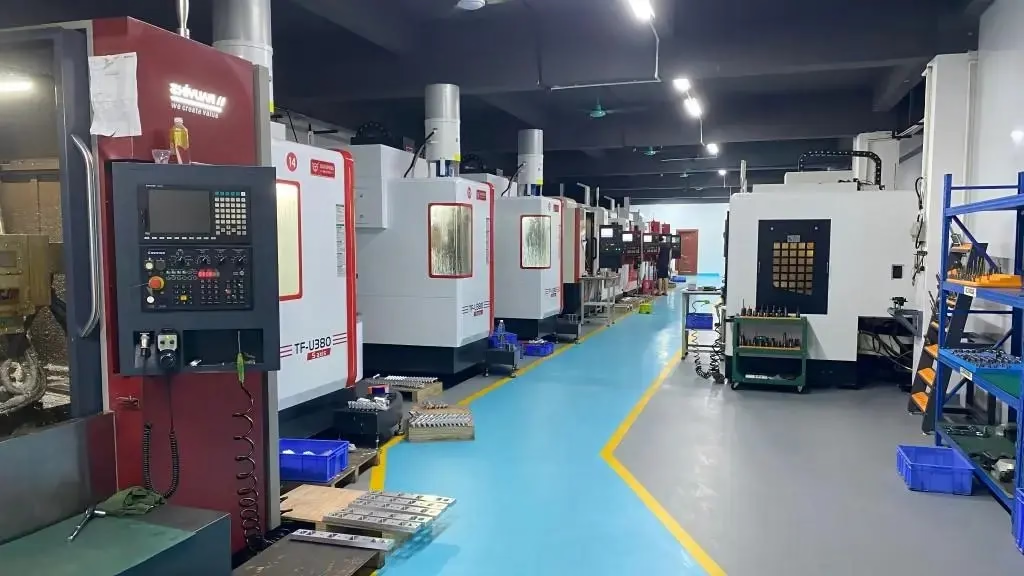
Processing center vs CNC machine: at a glance
Same control, different machine envelope.
| Point | Processing center | CNC machine (mill / lathe) |
|---|---|---|
| Definition | Machining center with automatic tool changer and multiple operations | Computer-controlled machine built around one process |
| Tool capacity | 12–40+ tools in the magazine, changed in seconds | 1–12 tools, often manual or a small turret |
| Operation count | Milling, drilling, boring, tapping, sometimes turning in one setup | One dominant operation per setup |
| Typical part | Complex, multi-feature, mid to large envelope | Simple to moderate geometry, higher volume |
| Setup changes | Part stays clamped, tools change instead | Part may move between machines |
| Best fit | Prototypes and low-volume complex parts | Runs where one operation repeats |
| Weak point | Higher hourly rate, more programming time | Extra setups add stacked tolerance |
| Size range | Up to 4,000 mm travel at GreatLight | Depends on the individual machine |
Is a processing center and CNC the same thing?
A processing center and CNC control are not competing technologies. The control is the brain. The processing center is one kind of body that brain can drive. Every machining center is a CNC machine, but not every CNC machine is a machining center.
On a shop floor the word CNC usually means a machine tied to one job: a vertical mill, a lathe, a surface grinder. The operator loads a part, runs one or two tools, unloads it. The processing center, or machining center, carries a magazine of tools and an automatic tool changer. The part stays clamped while the machine swaps tools and works through many features without anyone touching it.
That difference sounds small until you count setups. Three separate machines for milling, drilling and tapping means three fixtures, three datums and three chances to lose position. One processing center does all three with the part untouched, which is why tight-tolerance work tends to land there.
The practical question is not which machine is better. It is how many distinct features your part has, how tight the tolerances are between them, and how many pieces you need. Those three answers decide the machine.
What separates a machining center from a plain CNC machine
The automatic tool changer is the defining part. A vertical machining center might hold 20 to 40 tools in a drum or chain magazine. Tool-to-tool change time runs from about 1 to 5 seconds depending on the design. That speed only matters when the program calls many tools, which is exactly the case for complex parts.
Enclosure and chip management come next. A processing center is fully enclosed with a coolant system, chip conveyor and often through-spindle coolant. Deep holes and long roughing passes stay under control. A basic CNC mill may run open with flood coolant and a tray, which is fine for light work but slower to clean between parts.
Rigidity is the third divider. Machining centers are built heavier, with linear guideways or box ways sized for interrupted cuts. That stiffness holds ±0.005 mm on features produced back to back. A lighter CNC machine can hit the same number on one feature, but drift shows up once you add a second and third operation on a different setup.
Finally, look at the control features. A machining center typically carries a larger tool offset table, work coordinate systems for multiple fixtures, and probing routines. Those are the tools that let one operator run several parts unattended.
Where each machine type actually fits
Three-axis machining centers cut from one direction. They suit plates, housings, brackets and mold plates where features sit on one face. Four-axis machines add a rotary table, usually Ø400 mm or similar, so the part indexes between faces without a re-fixture. Five-axis machines move the tool or the table on two extra axes at once, which lets a cutter reach undercuts and angled faces in a single setup.
CNC lathes and mill-turn centers take round parts. A lathe turns diameters, faces and threads; a mill-turn center adds live tooling so cross-holes and flats come off the same spindle. If your part is mostly cylindrical with a few milled features, a mill-turn center usually beats a machining center on cycle time.
Simple CNC mills and drills still earn their place. A batch of flat plates with a hole pattern does not need a 40-tool magazine. Running it on a basic mill keeps the hourly rate down and frees the machining centers for work that actually needs them.
The mistake we see most is a buyer sending a simple two-operation part to a five-axis center, then wondering why the quote is high. Matching the machine to the geometry is the whole game.
How to choose for your part
Start with feature count. If the part needs more than three distinct tools and the features must hold position to each other, a processing center is the safer route. If it needs one hole pattern and a face mill, a plain CNC machine will do the job at a lower rate.
Then check tolerance stack-up. Every re-fixture adds error. A part with ±0.05 mm between two faces can survive two setups. A part with ±0.01 mm between them usually cannot, and the fix is one setup on a machine with enough axes.
Volume matters too. At one to a few hundred pieces, programming and fixture time dominate, so one flexible setup wins. At several thousand identical pieces, a dedicated CNC machine or a lathe with a bar feeder can beat a general-purpose center on cost per part.
Material comes last but not least. Titanium, Inconel and 17-4PH punish light machines. Rigid machining centers with through-spindle coolant handle them; a small open mill will burn tools and lose size.
The short answer
If your part has several features that must stay aligned and you need one to a few hundred pieces, choose a processing center. If it repeats one operation at high volume, or the geometry is simple, a dedicated CNC machine is cheaper and just as accurate.
Questions engineers ask
Is every machining center a CNC machine?
Yes. The machining center is one machine type under the CNC umbrella. It is defined by the automatic tool changer and the ability to run many operations without moving the part.
The reverse is not true. A manual-tool-change CNC mill or a CNC lathe is a CNC machine but not a machining center.
Can a processing center do turning?
Some can, if they are mill-turn centers or have a rotary table with rotary tooling. A standard three-axis machining center cannot spin a workpiece as a lathe does.
If turning is the main operation and milling is secondary, a mill-turn center is the better starting point.
Which one holds tighter tolerance?
It depends less on the category and more on the specific machine. A rigid CNC lathe can hold ±0.005 mm on a diameter all day. A worn machining center will not.
The category still matters in one way: fewer setups means less accumulated error on parts with features on several faces.
Does a machining center always cost more per hour?
Usually, yes. Higher purchase price, more programming and a larger tooling inventory push the rate up.
Whether that raises your part price depends on the alternative. Two extra setups on cheaper machines can cost more than the machining center's rate.
How do I know which machine my quote used?
Ask. A shop should be able to say which machine ran the part and why. If the answer is vague, the quote may be padded.
Send the drawing and we will tell you which of our machines fits, and what the trade-offs are.
What size parts can a machining center handle?
It varies by machine. At GreatLight, the largest travel is 4,000 × 400 × 150 mm. Medium machines cover 750 × 1,150 × 550 mm and 600 × 600 × 600 mm.
Smaller compact machines run 500 × 500 × 450 mm and 500 × 310 × 200 mm, which suits most prototype work.
Send the drawing, get a machine recommendation
Upload your file and we will return a quote, a DFM note and a free analysis within 12 hours.
12-hour quoteFree DFM analysisNo minimum order quantity
More machining notes
We publish setup notes, tooling trials and inspection data from the factory floor.











