GreatLight CNC Machining Factory logo
CNC Machining
Rapid Prototyping
Materials
Industries
News
About GL

Get Instant Quote

Plastics CNC Machining

PTFE Machining

We mill and turn filled and unfilled PTFE to ±0.005 mm, holding flatness on seals, insulators and valve parts that move with temperature. Send a drawing and get a DFM review in 12 hours.

Ø400 mm rotary tableRa 0.2–0.8 μm availableNo minimum order quantityISO 9001:2015
CNC Lathe Technical Specifications Terminology
127High-precision CNC machines
±0.005 mmAchievable tolerance
15 yearsPolymer machining practice
3–5 daysParts ship after release
Where PTFE parts go wrong

Four failures we see on incoming Teflon drawings

01

The part measures oversize the day after machining

PTFE has a linear thermal expansion around 12 × 10⁻⁵ /°C, roughly ten times that of steel. A 100 mm bushing machined at 22 °C and measured in a 30 °C inspection room can read 0.10 mm larger. If the drawing carries no reference temperature, the gauge and the customer argue about the same part.

02

Burns, smears and a fuzzy edge on the seal lip

The material conducts heat poorly, so the cutting edge keeps the heat instead of the chip. A dull tool rubs, the surface turns waxy, and the sealing lip picks up a burr that will leak. This is a tooling problem, not a feed-rate tweak.

03

Holes close up after the part relaxes

PTFE creeps under sustained load. A press-fit pin or a bolt torqued to a metal standard keeps squeezing the wall, and a Ø6 mm bore can lose several hundredths over weeks. The joint design has to allow for cold flow.

04

Thin-wall washers bow during chucking

Three-jaw pressure deforms a 2 mm wall before the tool touches it. The cut looks fine on the machine and springs back on the bench. Vacuum fixturing or a soft collet solves it, but the setup has to be planned before the first chip.

How we machine PTFE

Cutting geometry, heat control and support for a soft, slippery polymer

Three decisions set the outcome: tool sharpness, how the part is held, and where the heat goes.

cnc machining
Tooling and speeds

Sharp cutters and high spindle speed

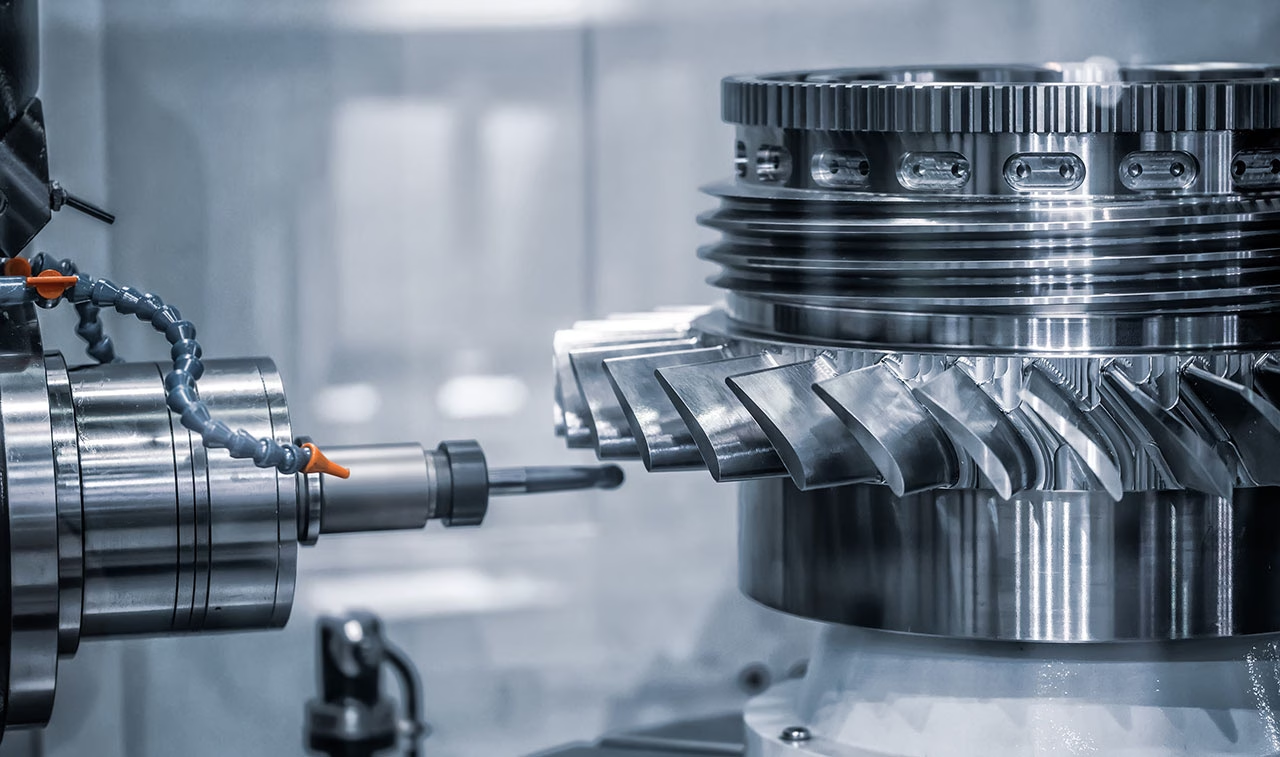
PTFE has a coefficient of friction around 0.04, among the lowest of any solid. A tool with a honed edge rubs instead of shearing, and the rubbed material smears across the face. We run polished high-speed steel or uncoated carbide with a positive rake and a generous clearance angle, so the edge slices the polymer rather than pushing it.

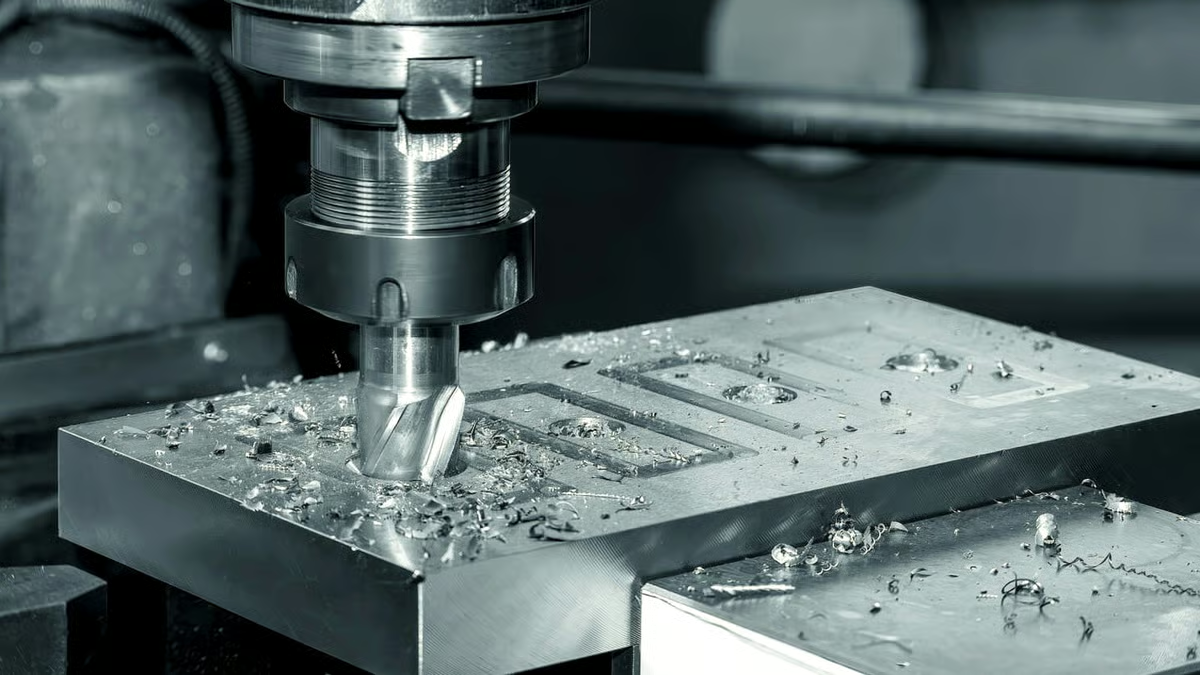
Spindle speed is where the heat balance is set. We run small-diameter end mills in the 15,000–25,000 rpm range, take light radial passes, and keep the chip load high enough that the tool cuts instead of polishing. Flood coolant is normally left off because the material does not carry heat away and wet chips cling to the flutes. Compressed air clears the pocket and cools the edge.

  • 1
    Tool materialPolished HSS or uncoated carbide; coatings tend to flake and drag.
  • 2
    Edge conditionSharp, positive rake, no honed land. Change the cutter before it dulls.
  • 3
    Heat pathAir blast and light passes keep the edge cool; the chip will not do it.

Get Instant Quote

cnc machining
Fixturing and inspection

Hold the part without squeezing it

PTFE is soft and elastic. A vise or three-jaw chuck point-loads the wall, the material deflects under the clamp, and the finished bore is out of round once the pressure comes off. We plan the workholding around the part: soft jaws bored to the actual diameter, vacuum plates for thin washers, and sacrificial backing for long slender seals.

Inspection follows the same logic. We check at a controlled temperature and record it, because a PTFE part has no meaningful size without a reference condition. Where the drawing calls for a tight bore, we cut to the middle of the tolerance band and let the material settle before final measurement. CMM reports and dimensional records are available on request for medical, aerospace and semiconductor parts.

  • 1
    WorkholdingSoft jaws, vacuum plates, no point loading on thin walls.
  • 2
    Datum choiceMachine the sealing face in the same setup as its bore.
  • 3
    MeasurementRecord temperature and let the part relax before final inspection.

Get Instant Quote

Material selection

Which fluoropolymer fits the part

Unfilled PTFE is the default for chemical and electrical duty. Fillers trade some of that away for dimensional stability.

GradeBest forTrade-off to know
Unfilled PTFESeals, gaskets, insulators, linersHighest creep and thermal expansion
25% glass-filledBearing pads, wear ringsLower creep, more abrasive to tooling
Carbon / graphite filledCompressor rings, bushings under loadBetter stiffness and thermal conductivity
Bronze filledHigh-load wear partsNot for strong acids or oxidizers
PFA / FEPMelt-processable linersSofter, lower continuous service temperature
What we run on PTFE

Machining services for Teflon and filled grades

01

CNC milling

Pockets, slots, manifolds and seal faces on 3-axis and 4-axis mills, with air blast and light radial engagement to keep edges clean.

02

CNC turning

Bushings, washers, valve seats and liners on mill-turn centers, up to Ø400 mm on the rotary table. Soft jaws protect thin walls.

03

5-axis machining

Angled ports and contoured sealing surfaces cut in one setup, so a critical face and its bore share a datum.

04

Rapid prototyping

One-off seal samples or test insulators in a few days, before a mold or a production run is committed.

05

Low-volume production

From a single prototype to 10,000+ part runs, with the same setup sheet carried through the batch.

06

Surface finishing

Deburring, tumbling and polishing where the drawing calls for a specific Ra. Laser marking available with a 1.5 mm minimum character height.

Process envelope

What our shop can hold on PTFE

Figures apply to polymer work unless the drawing states otherwise.

CapabilityRangeNotes
Achievable tolerance±0.005 mmOn stable, supported features
Surface finishRa 0.2–0.8 μm fineRa 1.6–3.2 μm as-machined typical
Maximum part size4,000 mmLong liners and profiles
Rotary tableØ400 mmTurning and 4-axis work
Spindle speed15,000–25,000 rpmSmall-diameter cutters
Inspection100% before shipmentMaterial, in-process, final
Why GreatLight

Fifteen years of polymer and metal work under one roof

15Y

Machining since 2011

Three wholly-owned plants in Dongguan and a Singapore facility, 7,600 m² of production space and 150 technicians.

127

CNC machines on the floor

16 simultaneous 5-axis centers, 16 mill-turn centers and 12 four-axis mills. PTFE jobs run on machines set up for light-touch cutting.

±0.005

Tolerance we quote

Held on supported polymer features at a recorded temperature. Imperial equivalent is ±0.0002 in.

99.99%

Qualification rate

Raw material check, in-process monitoring and final inspection on every order.

12 h

Quote and DFM turnaround

We review the drawing, flag creep and expansion risk, and return a quotation with the free DFM analysis.

0

Minimum order quantity

One prototype or a 10,000+ part run. Uploads stay confidential and an NDA is available on request.

4,000 mmMaximum processing size
ISO 9001Quality management
IATF 16949Automotive quality
ISO 13485Medical device quality
Where PTFE parts go

Industry requirements and what we deliver

CNC Machining Services Online

Semiconductor fluid handling

High-purity PTFE manifolds and valve bodies with no metallic contamination at the wetted face.

  • Ra 0.2–0.8 μm
  • Air-blast cutting
  • 100% inspected
6011

Medical device insulators

Machined insulators and seal rings where dimensional records matter as much as the part.

  • ISO 13485:2016
  • ±0.005 mm
  • Reports on request
GreatLight Metal new factory building

Aerospace and EV seals

Low-friction seal rings and bushings that tolerate temperature swings without losing preload.

  • IATF 16949:2016
  • 15,000–25,000 rpm
  • 3–5 day shipping
FAQs

PTFE machining questions engineers ask

Why is PTFE usually CNC machined instead of molded?

The polymer chain is rigid and the melt viscosity is extremely high, so injection molding and extrusion need special equipment and still struggle with tight features. CNC machining cuts the finished geometry directly from rod, tube or plate. That suits low and medium volumes, prototypes, and parts where the sealing face has to be held to a close tolerance.

Which tolerance can you actually hold on PTFE?

We quote ±0.005 mm on supported features measured at a recorded temperature. Thin walls, long unsupported lengths and parts that will see a wide temperature swing are harder, and we will say so in the DFM notes. For those features a realistic band is often two to three times wider.

Do you use coolant when milling Teflon?

Normally no. PTFE does not conduct heat away, and wet chips tend to cling to the flutes and pack the pocket. We use compressed air to clear chips and cool the cutting edge, take light radial passes, and run spindle speeds in the 15,000–25,000 rpm range with small cutters.

How much does the part move after machining?

It depends on the section and the temperature change. With a linear expansion around 12 × 10⁻⁵ /°C, a 100 mm PTFE feature grows roughly 0.12 mm over a 10 °C rise. If the drawing has no reference temperature, agree on one with your inspector before the run. For critical bores we cut to the middle of the band and let the part settle.

Can PTFE parts be press-fit or bolted like metal?

They can, but the joint has to allow for cold flow. Sustained bolt load keeps compressing the polymer, so preload drops over time. Use a metal backing washer, a controlled compression stop, or a design that limits strain. Tell us the mating hardware and we will flag the risk in the DFM review.

Do you machine filled grades such as glass or carbon filled PTFE?

Yes. Glass-filled grades lower creep but wear tooling faster, so we shorten the tool-change interval. Carbon and graphite filled grades cut more cleanly and resist load better. Bronze-filled material is fine for wear parts, but we would not put it in an oxidizing chemical service.

What about PEEK or other polymers?

We also machine PEEK, POM, PA, PC, ABS, PMMA, PP and HDPE, as well as carbon fiber composite. If stiffness, temperature range or wear resistance is the driving requirement rather than chemical inertness, PEEK is often the better starting point. Send the duty cycle and we will compare both.

How fast can I get parts?

Quotation and free DFM analysis come back within 12 hours, and production can start within 24 hours of release. Standard parts ship in 3–5 days. There is no minimum order quantity, so a single prototype and a 10,000+ part run follow the same route.

Send your PTFE drawing and get a DFM review

Upload the model and we will check expansion, wall thickness and workholding, then quote within 12 hours. Every part is inspected before it ships.

12-hour quote100% inspectionNo minimum order quantityNDA on request

Trusted by engineers and manufacturers worldwide

Tesla Ford Motor Company BYD Auto Denso Magna International Boeing Airbus Medtronic KUKA FANUC