
Reduced Production CNC Machining Services: How to Choose a Supplier
This guide is for engineers and buyers sourcing 1 to 500 units that sit between prototype and mass production. It covers the checks that actually decide cost and lead time: batch setup, tolerance band, material availability, inspection paperwork and MOQ. Read it before you send the RFQ.
In this article
- 1
- 2
- 3
- 4
- 5
- 6
- 7
- 8
- 9
Key takeaways
Prototype, reduced production and mass production compared
Use this to decide which quoting model fits your build stage.
| Factor | Prototype (1-10) | Reduced production (1-500) | Mass production (10,000+) |
|---|---|---|---|
| Main cost driver | Programming and setup | Setup plus repeat fixtures | Cycle time and tooling life |
| Typical tolerance | ±0.05 mm | ±0.005 mm to ±0.02 mm | ±0.02 mm, process-controlled |
| Process stability | Not controlled | Controlled, first article checked | SPC and capability studies |
| Tooling approach | Soft jaws, single-use | Dedicated fixtures, quick-change | Hard tooling, automation |
| Inspection depth | Key dimensions only | 100% before shipment | Sampling with SPC records |
| Best fit | Design validation | Pilot builds, market test | Volume shipment |
| When it is wrong | Needed volume past 20 units | Needed volume past 1,000 units | Design still changing |
The verdict
If your design may still change or your volume is under a few thousand units, reduced production on CNC is the right call. If the design is frozen and volume is high, tooling wins. Pick the supplier on setup transparency, inspection scope and material stock, not on unit price alone.
What reduced production cnc machining services actually cover
Reduced production sits between one-off prototyping and high-volume manufacturing. The usual range is 1 to 500 units per run, though pilot builds sometimes stretch to 1,000. The parts are made on the same CNC equipment as volume work, but the planning is different. Fixtures are built for repeatability rather than pure speed, and the first article gets measured before the rest of the batch runs.
The reason buyers use this model is simple. A design that passed prototyping still has to prove it can be assembled, tested and shipped in real quantity. A 200-unit run exposes tolerance stack-up, finish consistency and packaging problems that a single prototype hides. It also gives the sales team hardware to show before committing tooling money.
Not every part belongs here. If the geometry is unlikely to change and the annual volume is above roughly 5,000 units, die casting, forging or injection moulding will beat CNC on unit cost. Reduced production makes sense when the design may still move, when the material is hard to cast, or when the quantity is too small to justify tooling.
- 1Good fitPilot builds, bridge orders, spares, custom or low-volume instruments.
- 2Poor fitStable high-volume parts where tooling pays back inside a year.
- 3Watch forA shop that quotes reduced runs with prototype paperwork only.
How batch setup and fixturing drive your unit price
On a 50-unit order, setup can be 30 to 50 percent of the invoice. That is not padding. Someone has to write the program, prove it out, build soft jaws or a dedicated fixture, and run a first article. Ask the supplier to break setup out from the per-part price. A shop that hides setup inside the unit rate cannot tell you what a repeat order will cost.
Fixture strategy is the second half of this. A quick-change fixture that locates on a machined datum lets the second batch start without re-proving the program. If you expect three or four repeat runs over a year, say so at quoting time. The right fixture adds a little to the first order and removes hours from every order after it.
There is a real trade-off here. Shops that specialize in one-off prototypes often quote low on setup because they never build proper fixtures, and the parts drift across the batch. Shops that only serve volume will not take a 50-piece job at all. The supplier you want is the one that runs both ends of the range and prices setup honestly.
Tolerance, finish and drawing quality before you request a quote
Tolerance should be applied only where the function needs it. A housing face that seals against an O-ring may need ±0.005 mm and Ra 0.8–1.6 μm. The same housing's mounting ears can sit at ±0.1 mm and Ra 3.2 μm with no consequence. When the whole drawing carries a single tight tolerance block, the shop has to hold everything to the tightest callout, and you pay for it in cycle time and scrap risk.
Datum structure matters as much as the numbers. Tolerance stack-up depends on which features are referenced to which datums. If the drawing is ambiguous, two competent machinists will produce two different parts that both pass inspection on paper and both fail at assembly. Fix the datums before the RFQ goes out.
Surface finish interacts with material choice. Aluminium 6061 and 7075 hold a fine finish easily. Stainless 316 and 17-4PH work-harden, so heavy finishing passes on thin walls can distort the part. Titanium TC4 (Ti-6Al-4V) needs slower cutting speeds and generates more tool wear, which shows up in the quote. None of these are problems. They are just reasons the drawing should say what the surface is for.
- 1Tight where it seals±0.005 mm and Ra 0.8–1.6 μm on mating and sealing faces.
- 2Loose where it bolts±0.1 mm and Ra 1.6–3.2 μm on clearance and mounting features.
- 3Always define datumsUnclear datums cause assembly failures that no inspection report catches.
Minimum order quantity, materials and certifications to verify
A minimum order quantity is a statement about how the shop is set up. If the floor is arranged for large runs, a 20-piece job interrupts the schedule and gets priced to discourage you. Suppliers that build fixtures and program for small batches can run one unit or 10,000 units without a minimum. Ask what the smallest job they shipped last month was.
Material availability decides lead time more often than machining does. Common grades such as aluminium 6061-T6, stainless 303 and 304, and steel 1018 are usually on the shelf. Exotics such as Inconel, beryllium copper and magnesium AZ31B may need to be ordered, and that adds days before the first chip is cut. If your drawing names a grade, confirm the shop stocks it or can get it, and ask whether the material certificate is included.
Certifications need to be checked against your industry, not against a logo wall. ISO 9001:2015 covers general quality systems. IATF 16949:2016 matters for automotive and EV work. ISO 13485:2016 applies to medical devices. ISO 27001:2022 covers information security, which matters when you send CAD files to an outside partner. Ask for the certificate scope, not just the certificate.
Quoting, lead time and the pitfalls buyers hit most
A useful quote answers four things: unit price at your quantity, setup cost, lead time from purchase order, and what inspection you receive. If any of those is missing, the quote is not ready to compare against another. Unit price alone hides the differences that matter at 200 units.
Lead time should be split into two parts. The first is time to production start, which depends on material, programming and fixture build. The second is time on the machine plus finishing. A shop that says 3–5 days for parts is describing the second part. Ask what happens before that clock starts, especially if a finish such as anodizing or electroless nickel is on the drawing, because finishing is often subcontracted.
The most common pitfalls are predictable. Tight tolerances specified everywhere, no datums, an exotic material named without checking stock, and a request for a finish with no note on which surfaces get it. Another one: sending a STEP file with no 2D drawing, so the shop guesses at tolerance and finish and the quote comes back either too cheap or too expensive. Send both, and write down which dimensions are critical.
- 1Missing from many quotesSetup cost, inspection scope, and the date production starts.
- 2Finishing adds a stepAnodizing and plating often run off-site and extend the schedule.
- 3Send STEP plus 2DThe 3D model defines shape, the 2D drawing defines tolerance.
Quality evidence you should expect with a reduced production run
At prototype quantity, dimensional checking is often informal. At reduced production, the batch has to be uniform, so the inspection plan should be written before the run starts. That usually means a raw material check when the stock arrives, in-process monitoring on critical features, and a final dimensional inspection before shipment. Reports should be available on request, not offered only when something goes wrong.
First article inspection is the hinge point. The first part off the fixture gets measured against the drawing, and any adjustment to offsets or tooling happens before the rest of the batch runs. Without that step, a small error repeats across every part in the order. Ask whether first article results are sent to you before the batch continues, or only with the shipment.
For regulated products, the paperwork matters as much as the parts. Medical device work under ISO 13485:2016 and automotive work under IATF 16949:2016 both expect traceability from material lot to finished part. If your product falls in those categories, confirm the shop can produce that record trail before you place the order, not after.
Step by step: sourcing a reduced production run
- 11. Fix the drawing before the RFQApply tolerances only where function needs them, define datums, and mark critical dimensions. A drawing with one global tolerance block will be quoted at the tightest value.
- 22. State the quantity and the repeat planSay whether this is a one-time 200-unit order or the first of four runs. Repeat runs justify a better fixture and lower cost later.
- 33. Name the material and finish per surfaceConfirm the grade is stocked. For anodizing or plating, note which faces are cosmetic and which are masked. Add laser marking only if character height is at least 1.5 mm.
- 44. Ask for a broken-out quoteRequire unit price, setup, lead time from PO, and inspection scope as separate lines. Compare suppliers on all four, not on unit price alone.
- 55. Review the DFM feedbackA shop that returns manufacturability notes is telling you where the cost is. Thin walls under 0.8 mm in aluminium and deep pockets with small corner radii are the usual drivers.
- 66. Approve first article before the batchAsk for first article results before the remaining units are machined. This catches offset and fixture errors while they are still cheap to fix.
- 77. Confirm the inspection package with shipmentDecide up front whether you need dimensional reports, material certificates, or finish thickness data, and have that written into the order.
Questions buyers ask about reduced production runs
What quantity counts as reduced production?
Most shops treat 1 to 500 units per run as reduced production. Some pilot builds reach 1,000 units before tooling is justified. The defining feature is not the number itself but the intent: validating a design, testing a market, or bridging to volume.
Below roughly 20 units the work behaves more like prototyping, and above 5,000 units the economics usually point toward casting, forging or moulding.
Why is the unit price higher than a prototype quote I received?
It usually is not higher per part. It is higher in total because the order includes setup, fixturing and a first article that a single prototype does not. On a 50-unit order, those fixed costs spread across fewer parts than on a 5,000-unit order.
If a prototype quote looks cheaper per unit, check whether it includes proper fixtures and an inspection report. Often it does not.
Can tolerances be held at ±0.005 mm across a whole batch?
Yes, on features where the drawing calls for it and where the geometry allows. The limit comes from part stiffness, not from the machine. Thin walls, long unsupported sections and work-hardening stainless grades move during and after cutting.
For those features, expect the shop to suggest a slightly wider band or a stress-relief step. That is a technical answer, not a refusal.
How long should a reduced production order take?
Ask for the schedule in two stages. Programming and fixture build happen before the machine starts, and finishing such as anodizing or plating often runs off-site afterward.
Quoting and DFM analysis can return within 12 hours, and production can begin within 24 hours once the order and material are confirmed. Parts typically ship in 3–5 days after machining starts.
What should be in the inspection package?
At minimum, a dimensional report covering the critical dimensions on the drawing and a material certificate for the grade used. If a finish is applied, ask for coating thickness or anodize class data.
For medical or automotive work, the record trail must connect the material lot to the finished parts. Confirm that before ordering, because it cannot be reconstructed afterward.
Do I need an NDA before sending CAD files?
If the design is not public, yes. A signed NDA before files move is normal practice, and it should cover both the CAD data and any process information you share.
Information security certification is a separate question from an NDA. ISO 27001:2022 covers how a company handles and stores your data, which matters when files sit on someone else's servers.
Send your drawings and get a broken-out quote
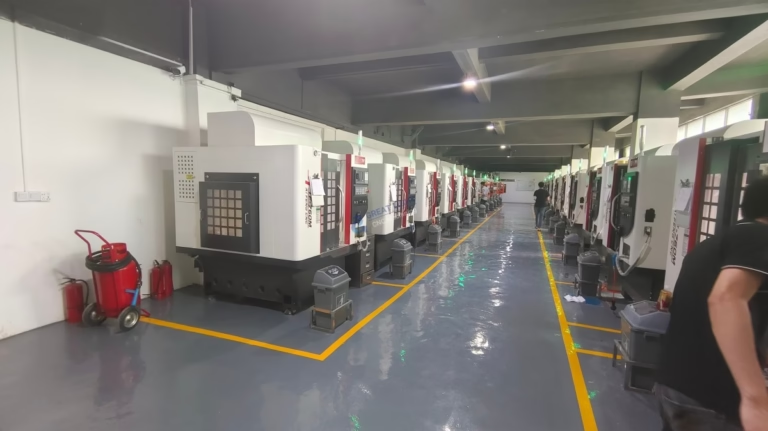
We run reduced production orders from one unit to 10,000+ with no minimum order quantity, on 127 CNC machines across three plants in Dongguan and Singapore.
12-hour quote and DFMNo MOQ100% inspection before shipmentNDA on request
More from GreatLight
We publish setup notes, tooling trials and inspection data from the factory floor.











