
Russian Five-Axis CNC Machining: Advantages and Applications
Russian five-axis CNC machining is a machining approach built around simultaneous five-axis machining centers that produce complex geometry in one setup. This guide is written for engineers and buyers who need to know when that approach pays off, what accuracy it can hold, and which parts are a poor fit. Read it before you send the next RFQ.
In this article
- 1
- 2
- 3
- 4
- 5
- 6
- 7
Key takeaways
What Russian five-axis CNC machining actually changes on the floor
A three-axis machine moves the part in X, Y, and Z. The cutter stays vertical. A five-axis center adds two rotary motions, so the tool can approach the workpiece from almost any direction. Russian five-axis CNC machining uses this configuration to finish contoured surfaces without repositioning the part by hand.
That single change ripples through the whole job. Setup count drops. Datum transfer drops with it. Every time a part moves from one fixture to another, you add a small positional error. Five setups can mean five stacked errors. One setup means one.
The method also changes tool selection. On a three-axis machine, a deep pocket forces a long cutter, and long cutters bend. On a five-axis center, the rotary axes tilt the part so a short, stiff cutter reaches the same floor. Less deflection means better surface finish and longer tool life.
None of this is free. Five-axis programming takes longer, the machines cost more per hour, and the operator needs real training. The advantage is only real when the part geometry needs it.
The 5 advantages of Russian five-axis CNC machining
Advantage one is accuracy. Fewer setups means less stacked error. On a part with bores on five faces, the true position between those bores is decided by the machine, not by how well the operator re-clamped the part. We hold ±0.005 mm on qualified features and inspect 100% before shipment.
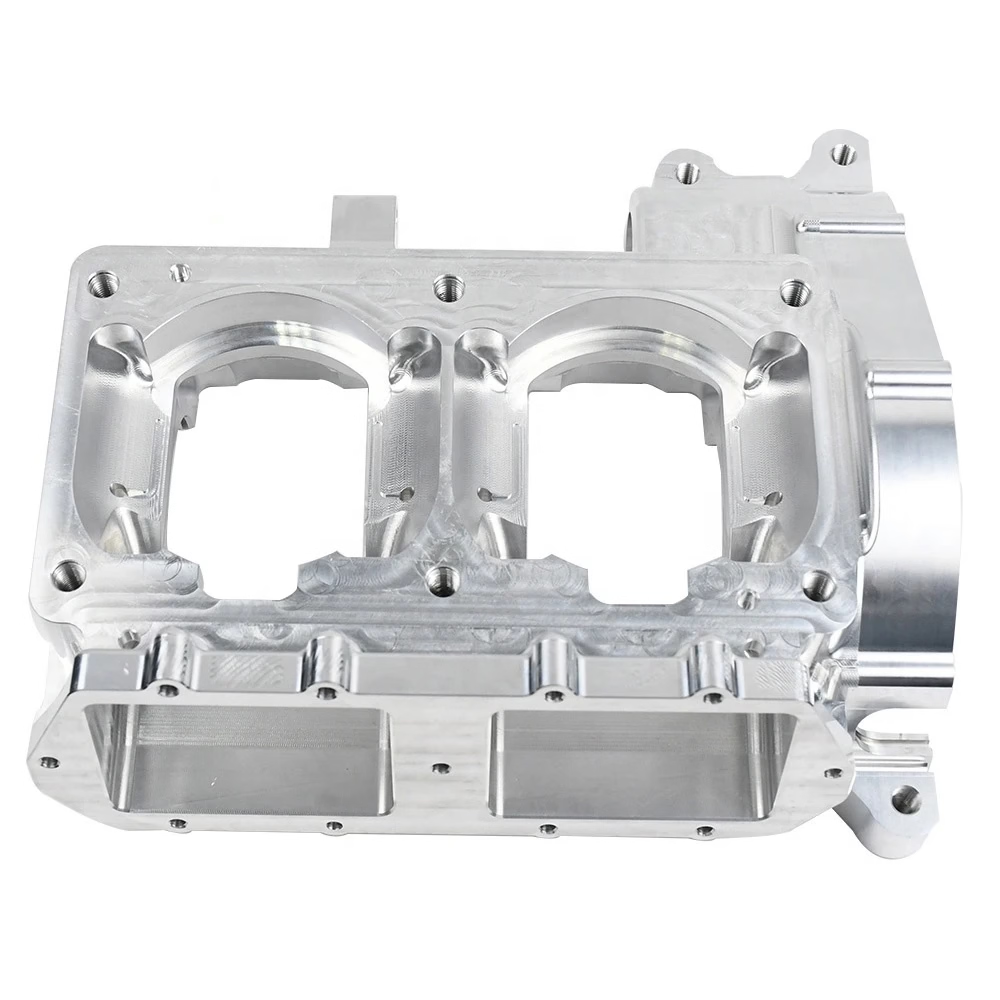
Advantage two is geometry freedom. Undercuts, compound angles, sculpted surfaces, and deep cavities that need a tilted tool all become routine. On three-axis equipment, the same features need custom fixtures or EDM.
Advantage three is cycle time on complex parts. The machine does not stop for re-fixturing. On a housing with features on four sides, moving from four setups to one often removes more time than the higher spindle speed of a three-axis machine ever adds.
Advantage four is surface quality. A short, rigid tool leaves a cleaner floor. Tilting the cutter also lets you use the side of a ball nose tool at the correct contact point instead of the near-zero-speed tip. That alone can move a surface from Ra 3.2 μm to Ra 0.8–1.6 μm.
Advantage five is material savings on expensive stock. Because the tool reaches more of the part in one pass, you can leave less stock and scrap fewer near-net forgings. On titanium or Inconel, that saving is measured in real money.
- 1AccuracyFewer datum transfers, so position error does not stack.
- 2GeometryUndercuts and compound angles without custom fixtures.
- 3Cycle timeNo re-clamping between faces.
- 4Finish and materialShorter tools, better Ra, less scrap on costly stock.
Where Russian five-axis CNC machining fits: applications by industry
Aerospace drives much of the demand. Structural brackets, engine housings, and duct segments carry angled faces and thin walls. The part is often a single billet of 7075 or Ti-6Al-4V, so a scrapped part is expensive. One setup protects the geometry and the material.
Automotive and EV work leans on the same strengths. Motor housings, inverter cases, and suspension components have features on several faces. Five-axis work lets us finish the bores and sealing faces without breaking the surface flatness.
Medical devices use the method for surgical instrument bodies, implant trials, and orthopedic fixtures. These parts are small, often stainless 316L or titanium, and surface finish matters as much as dimension. Short tools and a stable setup help both.
Robotics and automation is a growing area. Joint housings and arm segments have compound angles and mounting patterns that must line up. Industrial machinery and new energy parts follow the same pattern: complex housings, valve bodies, and heat management hardware where flatness and position matter.
When five-axis is the wrong call
If your part is a flat plate with holes, a five-axis center is wasted money. A three-axis mill drills the same holes at a lower hourly rate and a faster cycle. Same for simple turned shafts that only need a milled flat.
Tight-tolerance work on a single face is another poor fit. If all critical features sit on one plane, the rotary axes never engage. Four-axis or three-axis work gives the same result for less.
Very large parts can also rule the method out. Five-axis centers have travel limits. Our largest five-axis capacity covers 4,000 × 400 × 150 mm and 750 × 1,150 × 550 mm envelopes. Anything beyond that has to be split across machines or planned differently.
Finally, loose-tolerance parts do not need it. If your print allows ±0.1 mm and the geometry is simple, the added programming time buys nothing. We will say so in the DFM review rather than sell you the more expensive route.
How we match capacity to a five-axis job
We run 16 simultaneous five-axis machining centers inside a fleet of 127 high-precision CNC machines across three wholly-owned plants. That number matters because five-axis work should not sit behind a queue of simple parts. When a job needs a rotary table, we schedule it on a machine that is free.
The rotary tables are Ø400 mm, which sets a practical limit on part size and weight. Beyond that, we move the work to a larger envelope: 500 × 500 × 450 mm, 600 × 600 × 600 mm, or the 4,000 × 400 × 150 mm bed. Maximum processing size is 4,000 mm.
Material choice shapes the cutting strategy. Aluminium 6061, 7075, and 2024 run fast with high rake angles. Stainless 316L and 17-4PH work harden, so we keep the cutter engaged and avoid dwelling. Titanium TC4 and Inconel need lower surface speed, more coolant, and a rigid setup, which is exactly what five-axis fixturing provides.
Finishing is handled in house: anodizing, electroless nickel, zinc and black oxide, bead blasting, polishing, and laser marking. Keeping those steps under one roof avoids a second round of shipping and re-inspection.
Three-axis vs four-axis vs five-axis: pick by part feature
Use the feature on the print, not the part name, to decide.
| Part feature | Best machine | Why |
|---|---|---|
| Flat plate, all holes on one face | 3-axis | One setup is already enough |
| Shaft with milled flats and slots | 4-axis | Rotary index replaces a second op |
| Bores on four or five faces | 5-axis simultaneous | Position held in one setup |
| Compound-angle ports | 5-axis simultaneous | Tool reaches the angle directly |
| Deep cavity needing a short tool | 5-axis simultaneous | Tilted tool avoids long overhang |
| Sculpted surface, Ra 0.8–1.6 μm | 5-axis simultaneous | Correct contact point on ball nose |
| Turned body with one cross hole | Mill-turn | Turning and milling in one cycle |
| Loose tolerance, ±0.1 mm, simple form | 3-axis | Five-axis adds cost with no gain |
The straight answer
Choose Russian five-axis CNC machining when your part has critical features on three or more faces, compound angles, or a sculpted surface that must hold ±0.005 mm. Stay on three-axis when the geometry is flat and the tolerance is loose.
Questions engineers ask before switching to five-axis
What tolerance can Russian five-axis CNC machining hold in production?
On qualified features we hold ±0.005 mm, or ±0.0002 in. That figure assumes a stable setup, a rigid tool, and a controlled shop temperature.
Tolerance is not fixed by the machine alone. Long tools, thin walls, and hard materials all push the achievable number outward. We flag those cases in the DFM review before cutting.
How do I know if my part needs five axes instead of three?
Count the faces that carry critical features. If bores, sealing faces, or mounting patterns sit on three or more faces, five-axis usually wins because the position is set in one setup.
Then look at the angles. Any feature that is not normal to a single axis is a candidate. If everything is flat and square, stay on three-axis.
Does five-axis machining cost more per part?
The machine hour is higher. The total part cost is often lower on complex geometry because setups, fixtures, and re-inspection disappear.
On simple parts the opposite is true. We will tell you which side of that line your design falls on.
What part size can you handle?
Our rotary table is Ø400 mm. Larger five-axis envelopes include 500 × 500 × 450 mm, 600 × 600 × 600 mm, and 750 × 1,150 × 550 mm.
For long parts we use a 4,000 × 400 × 150 mm bed, with 4,000 mm as the maximum processing size.
Which materials are suitable?
Aluminium 6061, 7075, and 2024; stainless 303, 304, 316L, 17-4PH, and 440C; steel 4130, 4140, and 4340; titanium TC4; Inconel; and magnesium AZ31B or AZ91D.
Plastics such as POM, PEEK, and PC also run well when the setup is rigid and the chip load is controlled.
How fast can a five-axis job start and ship?
Quotation and free DFM analysis come back within 12 hours. Production can start within 24 hours of approval.
Standard parts ship in 3–5 days. There is no minimum order quantity, so a single prototype and a 10,000+ part run follow the same process.
Send the print. Get a real answer on five-axis fit.
Upload your CAD file and we will return a quote, a DFM review, and a clear recommendation on whether five-axis is the right route within 12 hours.
12-hour quote±0.005 mm tolerance100% inspectionNDA on request
More from the shop floor
We publish setup notes, tooling trials and inspection data from the factory floor.











