
Servo Turret Tailstock: How Indexed Tools and a Live Quill Hold Shaft Accuracy
A servo turret tailstock replaces manual turret indexing and hand-cranked quill travel with two independent servo axes. This page explains the mechanism, what each axis controls, and which shaft work justifies the setup cost.
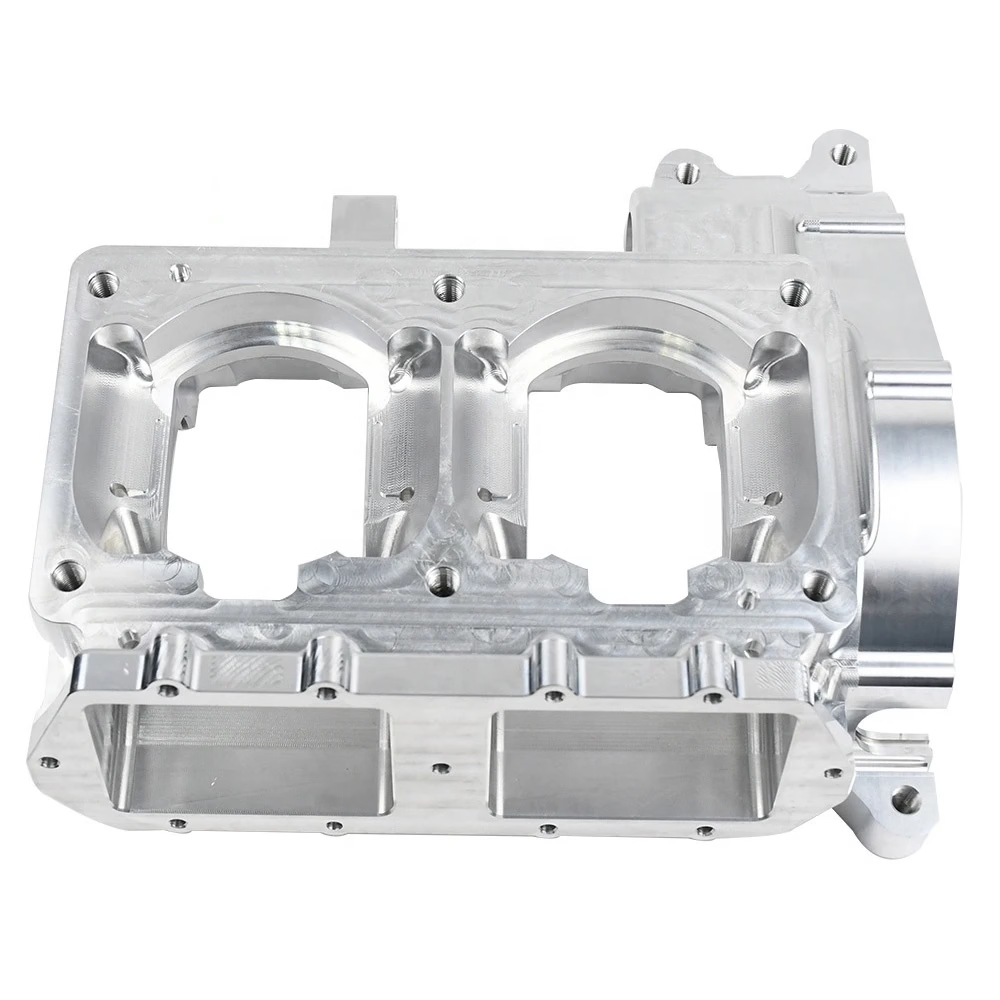
What the turret servo actually controls
On a conventional lathe the turret is indexed by a Geneva mechanism or a hydraulic motor. The turret stops against a pawl, and the repeatable position of each tool tip depends on the condition of that pawl and the index plate. Wear shows up as a few hundredths of a millimeter of drift over a production run. A servo turret replaces that ratchet with a servo motor and an absolute encoder. The controller commands a target angle, the motor drives the disc there, and the encoder confirms the position before the cut starts.
The practical result is that tool N lands within a repeatable band from the first part to the last. On our mill-turn centers we hold ±0.005 mm on turned diameters across a run, and the turret position is one of the variables that makes that possible. It is not the only variable. Thermal growth in the spindle, chip load, and the rigidity of the tool holder all move the cut as well. The servo removes one source of scatter so the others are easier to control.
Indexing time also drops. A servo turret can swing between adjacent stations in a fraction of a second, and the controller knows the position without a mechanical confirmation switch. On a part with six or seven tools, the saved seconds per cycle add up over a batch of several hundred pieces. That is the efficiency argument, and it is real, but it is secondary to the accuracy argument for most shops.
One boundary worth stating: a servo turret does not fix a worn spindle bearing or a tailstock that is out of alignment with the headstock axis. If the machine geometry is off, a precise tool index just moves the error around. Align the machine first, then let the servo do its job.
Why the servo tailstock matters for slender shafts
A manual tailstock is positioned by hand and locked with a clamp. The quill is advanced by a handwheel, and the center pressure depends on how hard the operator turns it. Two operators on the same machine will produce two different center loads, and the same operator will produce different loads on Monday and Friday. On short, stiff parts none of this matters much. On a shaft with an aspect ratio above 5:1 it matters a great deal.
A servo tailstock moves the quill with a servo motor and reads its position from an encoder. The controller can command a specific quill extension for each part in the program, so a family of shafts with different lengths can run without manual resetting. Thrust can be monitored or limited, which keeps the center from over-pressing a small-diameter end and bowing it. That is the mechanism: a controlled force at a known position instead of a guessed force at an unknown position.
Deflection is the reason this matters. A slender shaft pushed by a turning tool bends away from the tool, so the middle of the part cuts larger than the ends. The center at the tailstock resists that bending, and the stiffer and more consistent that support is, the closer the part stays to a straight cylinder. Cylindricity improves, and so does the diameter spread from one end of the shaft to the other.
Where it does not help: very short parts that do not reach the tailstock, parts held in a collet with enough rigidity that a center adds nothing, and parts where the tailstock center would mark a finished face that cannot be reworked. In those cases a servo tailstock is capability you pay for and do not use on that job.
Alignment, thermal drift, and the limits of servo control
Servo control keeps the turret and the quill where the program says they should be. It does not keep the headstock and the tailstock coaxial. That alignment is a mechanical condition, set with a test bar and checked against a dial indicator along the length of the bed. If the tailstock center sits even 0.01 mm high or low relative to the spindle axis, every shaft turned between centers will come out tapered, no matter how precise the servo is.
Thermal drift is the second limit. A lathe warms up as it runs. The spindle grows, ballscrews grow, and the bed can move a few micrometers over the first hour of a shift. A servo axis with an encoder knows where the motor is, but the encoder does not know that the ballscrew between the motor and the carriage has grown by 8 μm. That is why we run a warm-up cycle before tight-tolerance work and why in-process monitoring matters more than a single first-article check.
Chip control is the third limit. A long stringy chip from 316 stainless or 4140 can wrap around a slender shaft and push it off the center, or pack between the quill and the part. No servo corrects that. Tool geometry, coolant pressure, and pecking cycles do. On gummy materials we slow the feed, break the chip deliberately, and sometimes switch to a different insert grade rather than fight the chip with more rigidity.
Finally, the quill itself has a stroke limit. Long parts may need the tailstock body repositioned along the bed, and that repositioning is a mechanical move. Servo quill travel covers the fine adjustment, not the whole length of the machine.
What a servo turret tailstock can and cannot deliver
Servo axes give you repeatability. Repeatability is what lets you hold ±0.005 mm across hundreds of parts after you have dialed the process in. The first part still has to be measured, the offsets still have to be set, and the tool still has to be sharp. A servo machine with a dull insert produces a consistent bad dimension, which is worse than a scattered one because it looks stable until inspection.
Surface finish is a separate matter. Turret rigidity and tailstock support both help, because chatter is a stiffness problem. A shaft that rings during turning will show Ra worse than 1.6 μm even if its diameter is on size. Supporting the free end with a center raises the natural frequency of the workpiece and pushes chatter out of the cut. On our machines, well-supported shafts in 6061 or 1045 routinely come off at Ra 0.8–1.6 μm as machined, with Ra 0.2–0.8 μm available when the process and the finish call for it.
Material choice changes the picture. Aluminum 6061 and 7075 cut freely and deflect less at a given tool load, so slender aluminum shafts are easier than they look. Titanium TC4 (Ti-6Al-4V) and Inconel push back hard, generate heat at the tool tip, and spring away from the cut. For those, a servo tailstock with monitored thrust is not a luxury. It is how you keep the part from bowing while you take the light passes the material demands.
We check 100% of parts before shipment, with raw material checks, in-process monitoring, and a final inspection. Reports are available on request. That schedule exists because a servo axis tells you what the machine did, not what the part measures.
Manual versus servo turret tailstock by job type
Match the machine configuration to the part, not the other way around.
| Job characteristic | Manual turret / manual tailstock | Servo turret tailstock |
|---|---|---|
| Aspect ratio under 3:1 | Adequate | Not needed for stiffness |
| Aspect ratio 5:1 and above | Cylindricity drifts between operators | Consistent center load, tighter cylindricity |
| Batch of 6 tools or more | Index time adds up per cycle | Fast indexing, position confirmed by encoder |
| Mixed shaft lengths in one run | Quill reset by hand each time | Quill position set per program |
| Tolerance tighter than ±0.02 mm | Hard to hold across a run | ±0.005 mm achievable with good geometry |
| One-off repair part | Cheaper setup | Capability you may not use |
| Hardened steel or Inconel | Center wear, inconsistent pressure | Monitored thrust protects the center |
| Small-diameter shaft ends | Risk of bowing from over-pressure | Thrust limit protects the part |
When the servo setup is worth it
If your parts are slender shafts or multi-tool turned work held tighter than ±0.02 mm, a servo turret tailstock pays for itself in scrap and cycle time. If your work is short, single-tool, or one-off, a manual configuration is the better buy. Match the machine to the part, not to the brochure.
Common questions
Does a servo tailstock remove the need for a steady rest?
No. A steady rest supports the middle of a long shaft, while the tailstock supports the free end. On parts with an aspect ratio well above 10:1 you often need both, plus light passes and a follow rest for the sections furthest from either support.
The servo tailstock makes the end support repeatable. It does not extend support to the middle of the part.
How much center pressure should a servo tailstock apply?
Enough to seat the center firmly in the drilled hole without bowing the shaft. For a shaft under 20 mm in diameter, that is usually a light, monitored load. For a heavier shaft, more pressure is acceptable because the part resists bending better.
The right number depends on diameter, material, and the depth of the center hole. We set it per job and watch the first few parts for taper.
Can a servo turret hold position after a crash?
The encoder will report the position, and the controller will alarm if the axis cannot reach its target. That does not mean the turret is still geometrically correct. A crash can shift the turret disc, bend a tool holder, or move the coupling between motor and disc.
After any crash, re-check turret index position with a dial indicator and re-qualify the tools before running production.
Why do turned diameters drift over a long run if the axes are servo driven?
Thermal growth. The spindle, ballscrews, and bed all change dimension as the machine warms. The encoder measures motor rotation, not the position of the tool tip relative to the workpiece.
Warm-up cycles, in-process gauging, and offset updates during the run handle this. It is a process control problem, not a servo problem.
What aspect ratio makes a tailstock necessary?
There is no hard line, but deflection becomes noticeable around 4:1 and clearly problematic above 5:1 for steel and stainless. Aluminum tolerates a little more because it cuts with lower forces.
If the middle of the shaft measures larger than the ends after a pass, the part needs end support or a change in tool load.
Do servo turrets work with bar feeders and automatic loading?
Yes, and the combination is common on production lathes. The controller knows the turret position without a mechanical switch, so it can hand off cleanly to a bar feeder or gantry loader without waiting for a confirmation signal.
The tailstock side is the constraint. A servo quill can retract and re-extend per part, but the tailstock body still has to be positioned along the bed for the part length.
Send us your shaft drawing
Tell us the diameter, length, material, and tolerance, and we will come back with a process plan and a quote within 12 hours.
12-hour quote100% inspectionNo minimum order quantityNDA on request
More from the shop floor
We publish setup notes, tooling trials and inspection data from the factory floor.











