
Spanish CNC machining excellence, explained for engineers
What five-axis work actually changes on the shop floor, where the limits sit, and when a three-axis machine still wins. Written for engineers and buyers who need to judge a process before they commit a drawing to it.
What the two rotary axes really buy you
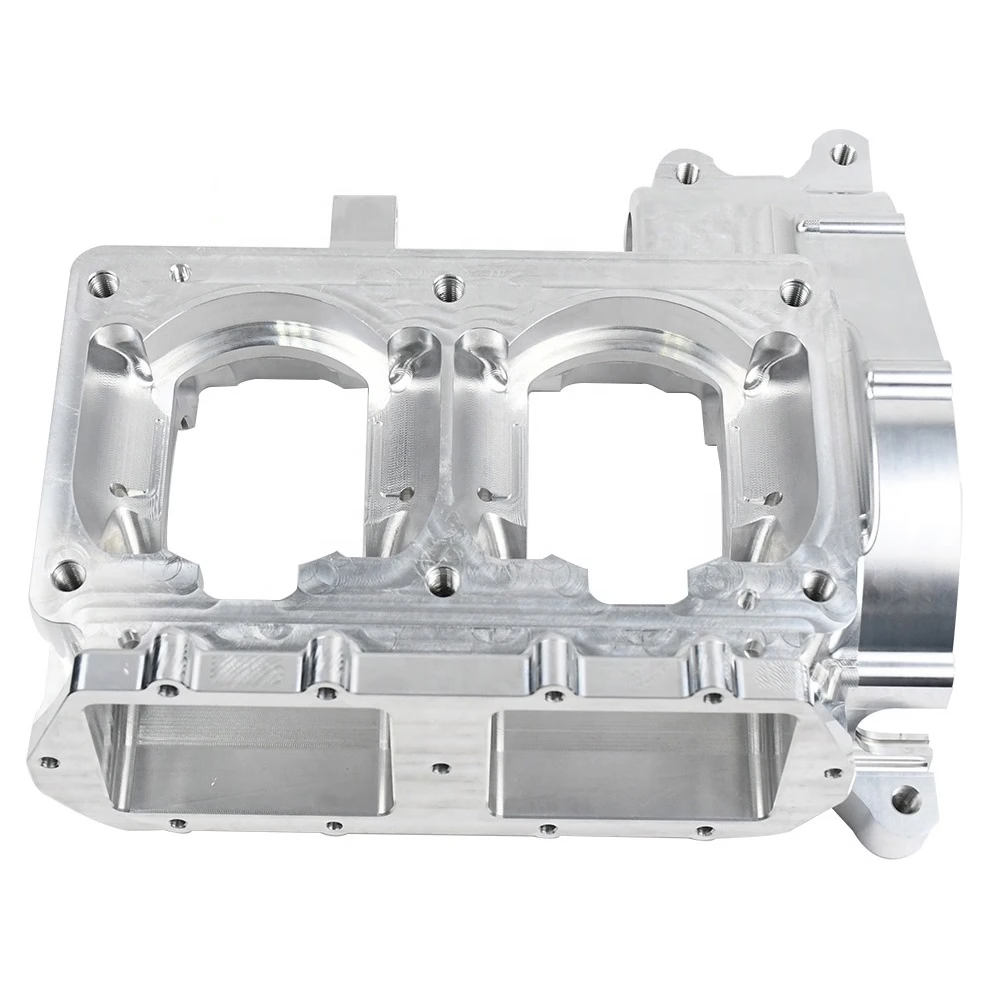
A three-axis mill moves the tool in X, Y and Z. A five-axis machine adds two rotations, usually A and B or B and C, so the tool can approach a face from an angle instead of straight down. That single change removes most of the repositioning that used to define complex work: undercuts, deep pockets, angled ports and blended fillets can often be cut in one setup.
Setup count is where the money hides. Every time a part is unclamped, rotated and re-datumed, the stack of small errors grows. A five-axis center holds one datum for the whole operation, so the error budget stays flat across features. For a housing with faces on four sides and a tilted flange, that is the difference between four setups and one.
Tolerance behaves differently too. Held in one setup, true position between features stays inside ±0.005 mm on a well-trammed machine. Break the same part across three fixtures and the stack alone can eat that budget before the cutter touches metal.
The trade-off is stiffness. With the table tilted, the tool hangs further from the spindle nose and the part sits off the machine's stiffest axis. Light finishing passes at high spindle speed, not heavy roughing, are where five-axis earns its place.
Fixturing decides whether the fifth axis pays off
A five-axis machine only reaches its potential if the part can be held clear of the table. The most common loss of value is a fixture that blocks the underside, forcing the machinist to flip the part anyway. If a design needs five-sided access, the blank should be planned around a dovetail, a tombstone or a self-centering vise with a Ø400 mm rotary table underneath.
Thin walls are the second constraint. Tilting the tool reduces radial engagement, but a 0.8 mm wall in aluminium 6061 will still deflect if the passes are heavy. Rough with the part supported and leave 0.3–0.5 mm of stock for a finishing pass at a shallow angle.
Deep cavities need tool reach checked before quoting. A long, slim cutter at an angle can chatter even when the nominal length-to-diameter ratio looks acceptable. Ask for the tool list, not just the spindle speed.
For parts under about 200 mm with features on two faces, a three-axis machine plus one flip is often faster and cheaper. The rotary axes add setup planning that a simple part does not repay.
Where Spanish CNC machining excellence stops helping
Five-axis work is not automatically more accurate than three-axis work. It is more capable. A hardened 60 HRC tool-steel insert with a single flat face is still better run on a rigid three-axis machine with a fly cutter. Adding rotation only introduces two more error sources that must be calibrated and maintained.
Material drives the decision more than geometry does. Titanium TC4 and Inconel 718 cut hot and work-harden, so a tilting tool path helps by keeping the cutter engaged and spreading flank wear. Free-machining brass C36000 gains almost nothing from rotation; the cycle time is dominated by tool change, not by approach angle.
Surface finish is a separate lever. Where a drawing calls for Ra 0.8–1.6 μm, a good five-axis path can reach it with a ball nose and a controlled stepover. Where it calls for Ra 0.2–0.8 μm, plan on a finishing operation or a polishing step regardless of axis count.
So the honest rule is this: five axes solve access and setup count. They do not fix a bad datum, a soft fixture or a tool that is too long for the cut.
Five-axis vs three-axis: which fits the part
Match the part to the machine before you match it to a price.
| Part feature | Five-axis | Three-axis |
|---|---|---|
| Faces on 4+ sides | One setup, one datum | Multiple flips, stacked error |
| Angled ports and undercuts | Cut at tool angle, no re-fixture | Often needs a second operation |
| Flat plate, 2 faces | Overkill, slower quoting | Faster and cheaper |
| Hardened insert, 60 HRC | Possible, check rigidity | Preferred route |
| Thin wall under 1 mm | Good, use shallow finishing pass | Risk of chatter on deep cuts |
| Prototype, 1 to 5 parts | Setup time shared, worth it | Fine if geometry is simple |
| Run of 10,000+ parts | Cycle time win on complex parts | Better when geometry repeats |
| Tolerance ±0.005 mm | Realistic in one setup | Realistic only with good fixtures |
The honest verdict
If the part has features on four or more sides, or an angled face that a three-axis spindle cannot reach, choose five-axis and hold one datum. If the part is flat, has two machined faces, or is a hardened insert, choose three-axis and spend the saved setup time on inspection.
Questions engineers ask before releasing a drawing
Can five-axis work hold ±0.005 mm on every feature?
It can, but only when the part is held in one setup and the machine has been trammed and calibrated recently. Every re-fixture adds stack-up that eats the budget.
If a drawing needs that tolerance across features cut in two different setups, expect to pay for a fixture that preserves the datum, or expect a looser result.
Which materials suit five-axis machining best?
Titanium TC4 (Ti-6Al-4V), Inconel 718 and hardened steels up to 60 HRC benefit most, because a tilting tool keeps engagement steady and spreads wear.
Aluminium 6061, 7075 and stainless 316L also run well. Free-machining brass C36000 gains little; the geometry is usually simple enough for three axes.
How do you keep thin walls from deflecting?
Leave 0.3–0.5 mm of stock after roughing, then finish with a shallow angle pass and a sharp ball nose cutter. Support the wall from behind where the geometry allows.
If the wall is under 1 mm and deeper than 20 mm, tell us at quoting stage. The tool list changes and so does the cycle time.
What do you need to quote a five-axis part?
A STEP or IGES file, the drawing with tolerances and surface finish callouts, the material grade, and the quantity from prototype to production.
We return a quotation and a free DFM analysis within 12 hours. Uploads stay confidential and an NDA is available on request.
Can a prototype and a production run use the same setup?
Usually yes for geometry, but not always for fixturing. A prototype may be held in a vise, while a 10,000-part run needs a dedicated tombstone or soft jaws to keep cycle time down.
We quote both stages separately so the tooling cost is visible rather than buried.
Release the drawing and get a real answer
Send the file and we return a quotation with a free DFM analysis within 12 hours, then hold one datum through the whole cut.
12-hour quote100% inspectionNDA on request
More from GreatLight
We publish setup notes, tooling trials and inspection data from the factory floor.











