
The Five-Axis Horizontal Machining Center in Precision Instrument Work
What actually changes when the spindle lies on its side and two rotary axes move under it. Written for engineers who have to pick a process, hold a tolerance, and explain the choice to a buyer.
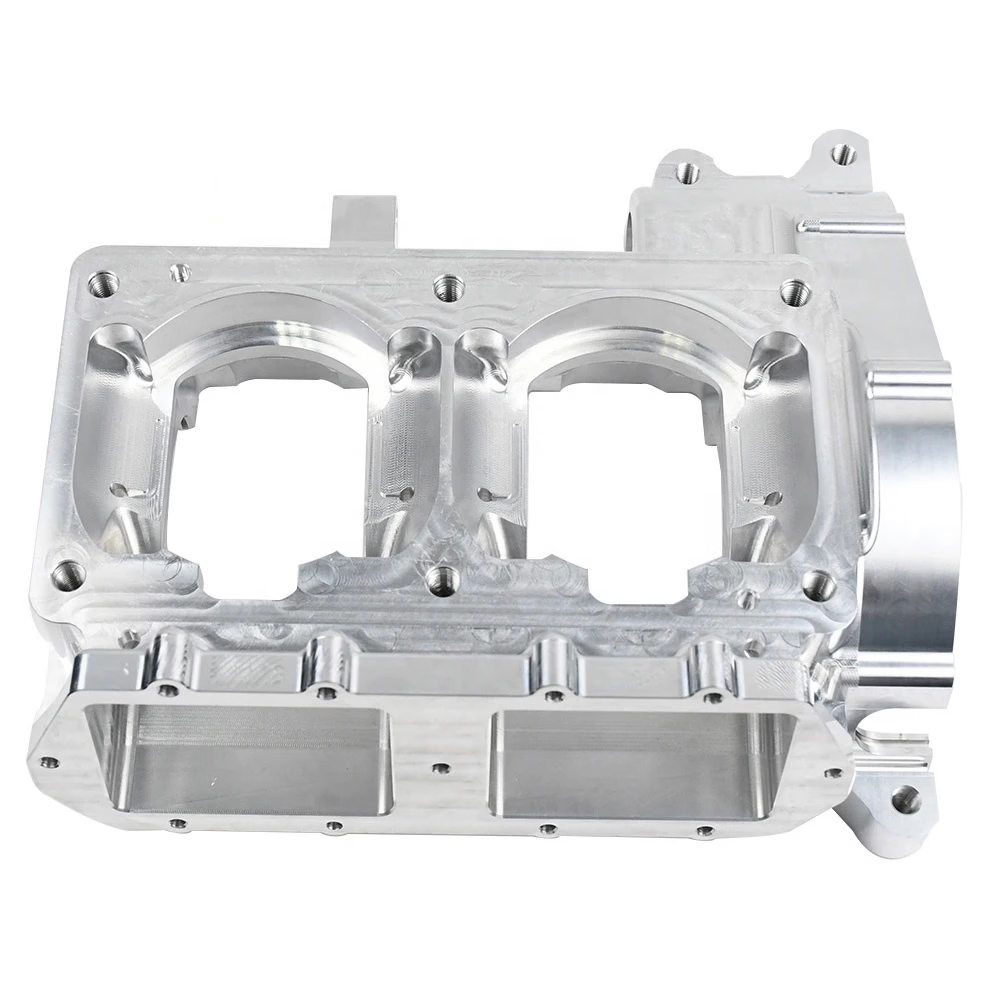
Why the five-axis horizontal machining center layout matters
A five-axis horizontal machining center puts the spindle on its side and the workpiece on a rotary table that tilts and indexes. The tool comes in from the side, not from above. That single change decides which parts belong on this machine and which do not.
On a vertical machine the workpiece sits on the table and the tool pushes straight down. Gravity pulls the part and the fixture in the same direction as the cut. On a horizontal machine the part usually hangs off a tombstone or a trunnion, so gravity acts across the cut instead of along it. For a 40 kg instrument housing with a thin wall, that difference shows up in flatness and in chatter.
The second effect is chip evacuation. On a horizontal spindle, chips fall away from the cutting zone instead of piling up around the tool. In deep pockets and long bores, that keeps recutting low. Recut chips are one of the quiet causes of poor surface finish on instrument bodies.
The third effect is access. Five faces can be reached in one setup when the rotary table is sized for the part. Every setup you remove is a datum you no longer have to re-establish. That is where the real accuracy gain sits, not in the axis count itself.
How two rotary axes change the cutting geometry
A five-axis machine adds two rotary axes on top of the three linear ones. On most horizontal centers these are a rotating table (C) and a tilting cradle (A or B). The control keeps the tool tip on a programmed path while the part turns underneath it.
The practical benefit is tool orientation. A ball nose cutter can be tilted so its effective cutting speed stays constant across a curved surface. On a three-axis machine the center of the tool runs at zero speed, which leaves a witness mark and burns the surface. On a five-axis machine the same surface comes off with a more even finish.
Tilting also lets the machine use the side of the cutter instead of the tip. A Ø12 mm tool with a 3 mm corner radius can reach a floor-wall junction that a straight tool cannot, without a long reach holder. Short holders mean less deflection.
This is why a five-axis horizontal machining center is not simply a faster three-axis machine. It changes which tools you can use, and therefore which tolerances are reachable on a given wall height.
Thermal drift, mass and the limits of the layout
Heat is the enemy of any claim below ±0.01 mm. Spindle bearings, ballscrews and motors all warm up. On a horizontal center the spindle housing sits in a fixed position while the column moves, so the heat path is more stable than on a vertical machine with a moving head. That is an advantage, but it is not immunity.
A machine that has been idle overnight is not at its working temperature. Running a warm-up cycle for 20–30 minutes before the first finishing pass is standard practice. On instrument parts held to ±0.005 mm, skipping warm-up can cost you the whole tolerance band on the first few parts.
Mass cuts both ways. A heavy, stiff structure resists chatter, which helps on thin-walled housings. But the same mass takes time to accelerate, so a horizontal center is usually slower on tiny, light parts than a compact machine.
The limit of the layout is reach and fixture cost. A part that needs five faces but weighs 2 kg and fits in your hand will be cheaper on a small trunnion machine. The horizontal tombstone only pays off when the part is heavy, awkward, or needed in volume.
Which machine suits the instrument part in front of you
Match the part to the process before you book capacity.
| Part condition | Five-axis horizontal | Three-axis vertical |
|---|---|---|
| Part weight over 20 kg | Preferred: mass is carried by the table | Risky: part sags on the fixture |
| Five faces in one setup | Preferred: datums stay fixed | Needs 2–3 setups, stacked error |
| Deep pockets, long bores | Preferred: chips fall clear | Chips recut, finish suffers |
| Small part under 2 kg | Overkill: fixture cost dominates | Preferred: faster and cheaper |
| Curved optical surfaces | Preferred: tool tilt holds speed | Ball nose tip marks the surface |
| Simple 2.5D plate work | No advantage, higher hourly rate | Preferred: fast and predictable |
| One prototype, tight budget | Possible, but quoting takes care | Preferred for first-off checks |
The call
Choose a five-axis horizontal machining center when the part is heavy, needs five faces, and holds a tolerance tighter than ±0.01 mm. Stay on a three-axis vertical when the part is light, flat, and needed fast.
Questions engineers ask next
Does a five-axis horizontal machining center hold tighter tolerance than a vertical?
Not automatically. The gain comes from fewer setups and a more stable thermal path, not from the axis count alone.
If a part fits in one vertical setup and stays cool, a vertical machine can hit ±0.005 mm too. The horizontal layout wins when the alternative is three setups on a heavy part.
What size part is too big for this layout?
It depends on the machine envelope, not the layout. Our largest travel is 4,000 × 400 × 150 mm, and the medium class is 750 × 1,150 × 550 mm.
Above that the part needs a different machine class. Below about 2 kg the fixture cost usually outweighs the benefit.
How much warm-up does a finishing pass need?
Plan 20–30 minutes of spindle and axis warm-up before the first tight feature. Check the part with a probe or a micrometer before you commit to the run.
On a cold machine, the first two or three parts often drift outside the band and have to be re-cut or scrapped.
Which materials behave best on a horizontal center?
Aluminium 6061 and 7075, stainless 304 and 17-4PH, and titanium TC4 all machine well when the tool is tilted correctly.
Inconel and magnesium AZ31B need more care on speed and chip control. Both are doable, but the process window is narrower.
Can you inspect a five-axis part without removing it?
On-machine probing is common for setting datums and checking key features. It is not a substitute for final inspection.
We run 100% inspection before shipment, with raw material checks, in-process monitoring and a final report on request.
What do you need to quote a five-axis horizontal job?
A 3D model or a 2D drawing with tolerances, the material, the quantity, and any surface finish callout.
Send those and we return a quotation with a free DFM analysis within 12 hours.
Send the drawing, get a real answer
Upload a model and we return a quotation with a free DFM analysis within 12 hours. No minimum order quantity, from one prototype to 10,000+ parts.
12-hour quote100% inspectionNDA on request
Follow the shop
We publish setup notes, tooling trials and inspection data from the factory floor.











