
The rise of chinas cnc machining industry
How chinas cnc machining industry moved from manual lathes to five-axis production in about twenty years. We wrote this for engineers and sourcing managers who need to judge whether a Chinese supplier can hold their tolerances. Read it and you can tell which capabilities are genuinely common now, and which ones are still rare.
In this article
- 1
- 2
- 3
- 4
- 5
- 6
- 7
What changed inside chinas cnc machining industry, and why it matters to your quote
How chinas cnc machining industry moved from manual work to CNC
In the 1990s most machine shops in the Pearl River Delta ran manual mills and lathes. Operators turned handwheels, read dial indicators, and judged finish by eye. Output depended on individual skill. A shop with ten good machinists could make good parts; a shop with ten average ones could not.
Two changes broke that pattern. First, CNC controls became cheap enough for small shops to buy. Second, foreign buyers started placing orders that required documented inspection. Once a supplier had to hand over a dimensional report with each lot, manual production stopped being competitive. The tooling and the paperwork arrived together.
By the early 2000s, Dongguan and Shenzhen had dense clusters of machining suppliers, tooling vendors, and surface finishing shops within a few kilometers. That density is the real structural advantage. A part can be milled, heat treated, anodized, and inspected without leaving the region.
Chinas cnc machining industry did not grow because one company got better. It grew because an entire supply chain learned to work to drawings and inspection reports at the same time.
- 1Cluster effectMachining, finishing and inspection sit within a short drive of each other.
- 2Documentation cultureExport orders forced dimensional reports and traceability into normal practice.
- 3Machine affordabilityDomestic and imported CNC controls reached small-shop price levels.
What chinas cnc machining industry can hold today
Tolerance is the first question every engineer asks. On aluminum and stainless parts, ±0.005 mm (±0.0002 in) is achievable on critical features when the shop controls temperature, tool wear and fixturing. It is not a default for every dimension on every drawing. A 200 mm bore and a 6 mm slot do not carry the same practical tolerance.
Surface finish follows the same logic. As-machined surfaces land around Ra 1.6–3.2 μm. A high-quality finish runs Ra 0.8–1.6 μm with the right cutter and stepover. Fine finishes of Ra 0.2–0.8 μm need slower feed rates, lighter passes, and often a separate finishing operation.
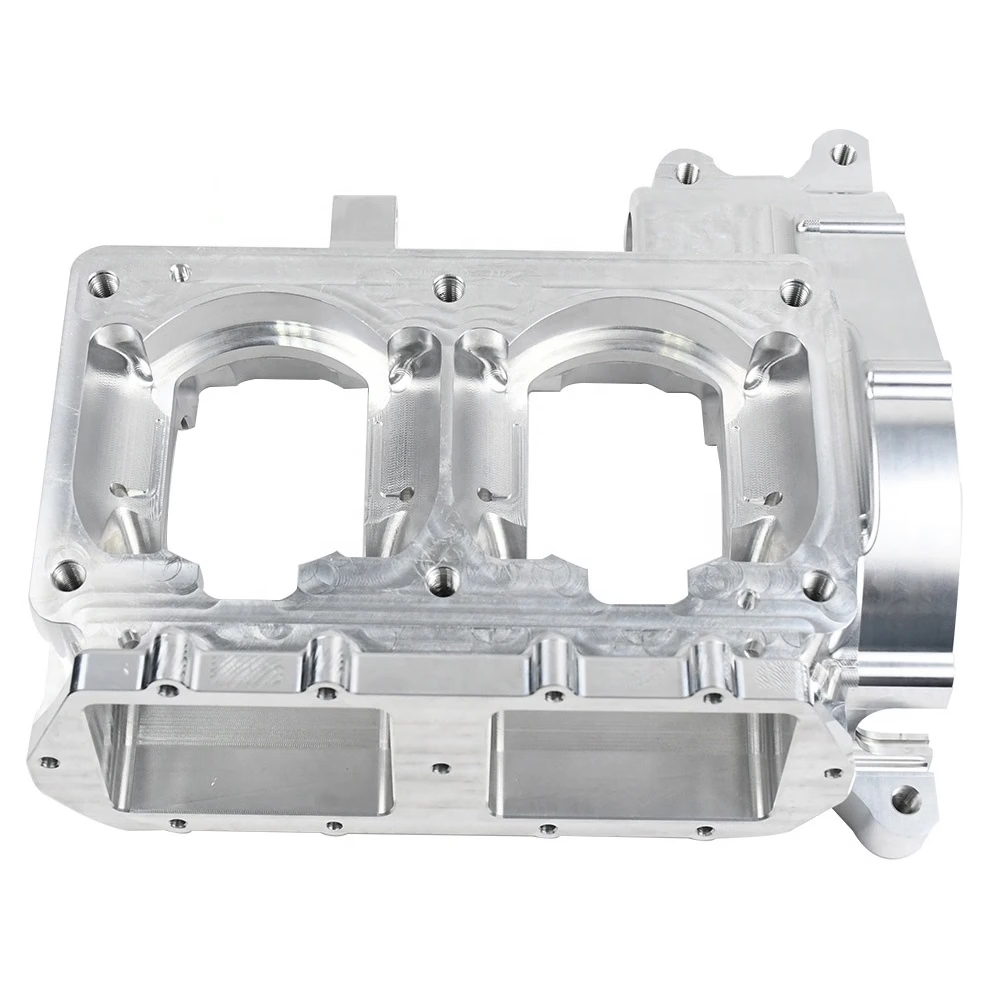
Five-axis work is now routine for complex geometry. Simultaneous five-axis machining lets a shop cut undercuts and angled faces in one setup, which removes the stacked error that comes from re-fixturing a part four times. That matters most on housings, impellers and medical instruments.
The limit is rarely the machine. It is the setup, the fixture, and whether the shop measured the part before shipping it. A ±0.005 mm claim without a CMM report is a marketing number.
- 1Tight tolerance±0.005 mm on critical features, with CMM verification.
- 2Fine finishRa 0.2–0.8 μm requires slower feeds and a finishing pass.
- 3Complex geometrySimultaneous five-axis cuts undercuts in a single setup.
Cost, MOQ and lead time in chinas cnc machining industry
Buyers often assume Chinese shops only make sense at high volume. That was true fifteen years ago. Today a shop with 127 machines can slot a one-off prototype into the queue without disrupting a production run, provided the shop schedules its own machines rather than subcontracting everything.
Cost drivers are the same everywhere: material, machine time, setup, finishing, and inspection. The savings in China come from machine-hour rates and supplier density, not from skipped steps. A quote that is 40 percent below the others usually omits deburring, inspection, or the finishing operation your drawing specifies.
Lead time is a scheduling question. A quotation and DFM review inside 12 hours, production starting within 24 hours, and parts shipping in 3–5 days are realistic when the shop owns the whole chain. It falls apart when the shop outsources anodizing or heat treatment to a vendor with a two-week backlog.
No minimum order quantity is now normal for prototype work, from one piece to runs over 10,000 parts. Ask whether the same shop will run both, or whether your prototype will be handed to a different vendor at production.
One practical test: ask what happens if the first article fails inspection. A shop that owns its machines, its CMM and its finishing line can rework and re-inspect in days. A trading company has to negotiate with three vendors.
- 1Quote speedQuotation and free DFM analysis within 12 hours.
- 2Order sizeNo MOQ, from one prototype to 10,000+ parts.
- 3ShippingParts ship in 3–5 days when the chain is in-house.
Challenges still facing chinas cnc machining industry
Skilled labor is the tightest constraint. Programming five-axis toolpaths and building fixtures for thin-wall parts takes years to learn. Shops compete for the same experienced people, and wages have risen steadily. A supplier with 150 technicians is not unusual at scale, but it is not the norm either.
Environmental rules have also changed the cost base. Anodizing, plating and painting are now regulated heavily. Shops that once ran plating lines in-house send work to licensed finishing partners, which adds transit time and a second inspection point.
Price competition is still fierce at the low end. Many suppliers quote below cost to win a first order, then recover margin through change fees. That is why a written drawing revision process matters more than the headline price.
Certification is the cleanest filter. ISO 9001:2015 covers general quality systems. IATF 16949:2016 is required for automotive work. ISO 13485:2016 applies to medical devices. A supplier that holds all three is running documented process control, not just inspecting at the end.
Ask for the certificate scope, not just the certificate. It should name the site that will make your parts.
- 1Skills gapFive-axis programming and fixture design take years to master.
- 2Environmental costRegulated finishing pushes work to licensed partners.
- 3Certification scopeCheck the certificate names the actual production site.
How to qualify a supplier in chinas cnc machining industry
Run these five checks before you release a purchase order.
- 1Send a drawing with real tolerancesInclude GD&T, material spec, finish callout and any critical-to-quality dimensions. A supplier that quotes without asking about datum structure is guessing.
- 2Ask which machine will run the partFor a 5-sided housing, that should be a simultaneous 5-axis center. For a turned shaft with cross holes, a mill-turn center. Vague answers usually mean subcontracting.
- 3Request the inspection planFirst article inspection with a CMM report, in-process checks on critical features, and a final report before shipment. Confirm the sampling rate, ideally 100 percent on critical dimensions.
- 4Confirm finishing stays in the chainAsk who does anodizing or heat treatment and what the turnaround is. If it is a third party, ask for their name and typical backlog.
- 5Test with one prototype firstOrder one piece at production tolerance. Compare the CMM report against your drawing before committing to a 500-piece run.
Matching part features to the right machining route
Use this table before you send an RFQ. It maps common part features to the process that holds them economically.
| Part feature | Recommended process | Why | Typical limit |
|---|---|---|---|
| Prismatic housing, 3 faces | 3-axis milling | Simple fixturing, fast cycle | ±0.01 mm |
| Part with holes on 4 sides | 4-axis mill | One setup, index between faces | ±0.008 mm |
| Undercuts, angled ports | 5-axis machining | Tool access without re-fixturing | ±0.005 mm |
| Shaft with turned and milled features | Mill-turn center | Turning and milling in one cycle | ±0.005 mm |
| Thin wall under 1 mm | 3-axis with light passes | Lower cutting force, less deflection | Ra 1.6 μm |
| Large frame, 4,000 mm long | Large-travel 3-axis | 4,000 × 400 × 150 mm envelope | ±0.02 mm |
When to source from China, and when not to
If your part needs five-axis geometry, tight tolerance with documented inspection, and you want to move from one prototype to a 10,000-part run at the same shop, chinas cnc machining industry is a strong fit. If you need same-week delivery of a single simple bracket and your local shop can do it, stay local. Freight and customs add days that a domestic supplier avoids.
Questions engineers ask about chinas cnc machining industry
Can a Chinese shop really hold ±0.005 mm?
Yes, on critical features, when the shop controls temperature and fixture rigidity and verifies with a CMM. It is not automatic for every dimension on the drawing.
Send a drawing that marks which dimensions are critical. A shop that applies the same tolerance to a mounting hole and a bearing bore is not reading the drawing carefully.
What is the minimum order quantity?
No minimum order quantity is standard now. One prototype and a 10,000-part run can both be quoted by the same shop.
Ask whether the prototype and the production run will use the same machines and the same inspection plan. That continuity is what protects your tolerance at scale.
How long does shipping take?
Production can start within 24 hours of a released order, and parts typically ship in 3–5 days when the shop owns its machining, finishing and inspection steps.
Add transit time for freight. If finishing is outsourced, add the finishing vendor's backlog on top.
Which certifications should I look for?
ISO 9001:2015 for general quality management, IATF 16949:2016 for automotive, ISO 13485:2016 for medical devices, and ISO 27001:2022 if you are sending sensitive CAD data.
Check the scope statement on the certificate. It should name the site that will actually produce your parts.
How do I protect my design?
Ask for a non-disclosure agreement before you upload CAD files. A written NDA plus secure file handling covers most of the risk.
Keep the release staged: send simplified geometry for the quote, and full models only after the NDA is signed.
What materials are commonly available?
Aluminum grades such as 6061-T6, 7075 and 2024; stainless 303, 304, 316L and 17-4PH; steels including 4140 and 4340; copper, brass, titanium Ti-6Al-4V, Inconel, and engineering plastics like POM, PEEK and PC.
Unusual grades are usually available but add lead time because the mill has to order stock.
Send a drawing and get a DFM review
Quotation and free DFM analysis within 12 hours. 100 percent inspection before shipment, with reports on request.
12-hour quoteNo MOQ100% inspectionNDA on request
More from the shop floor
We publish setup notes, tooling trials and inspection data from the factory floor.











