
The Rise of CNC Machining in China: What Changed on the Shop Floor
Why China became a default source for machined parts, and what that means on a drawing. We cover machine capacity, tolerance limits, material supply, and the cases where a China CNC shop is the wrong call.
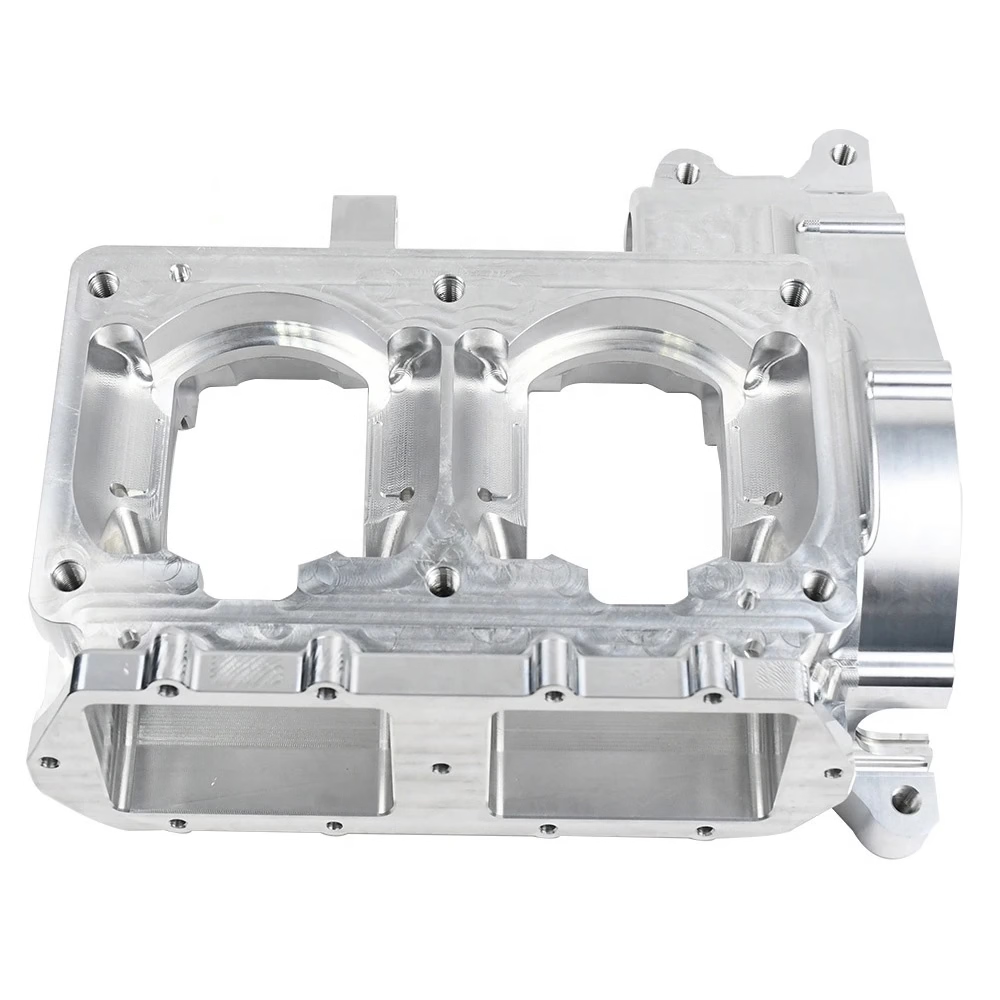
What the rise of CNC machining in China actually changed
A CNC machine does nothing a manual mill cannot do in principle. It follows coordinates. What changed is how cheaply and how repeatably those coordinates can be followed at volume, and where that capacity sits. Between the 1980s and today, China moved from mostly manual machining to a dense base of computer-controlled mills, lathes, and mill-turn centers.
The effect for a buyer in the US or Europe is not one low price. It is that a 200-piece run in 6061-T6 and a 5,000-piece run in 17-4PH can both be quoted in the same week, from shops that already stock the material and already own the fixture plates. That supply depth is what the rise of CNC machining in China really describes.
Look at a typical Dongguan shop today. A 127-machine floor with 16 simultaneous 5-axis centers, 12 four-axis mills, and 16 mill-turn centers is not unusual at the mid-size tier. Ten years ago that mix would have been one or two five-axis machines and a wall of three-axis VMCs. The tooling, CAM seats, and trained operators had to arrive first, and they did.
So when an engineer asks whether a China quote is real, the answer depends on the machine list and the inspection routine behind it. A tolerance of ±0.005 mm is a claim about the whole chain: spindle, thermal stability, probing, and the CMM at the end. Ask for those four things in writing.
- 1Capacity, not laborThe bottleneck moved from hands to spindles and CAM programmers.
- 2Material on the shelf6061, 304, 17-4PH, and POM are stocked, not ordered per job.
- 3Tolerance is a chain±0.005 mm needs probing, thermal control, and final CMM reports.
How the supply chain compounds: tooling, materials, and finishing under one roof
Machining is rarely the only operation on a real part. A bracket gets anodized. A housing gets bead blasted and laser marked. A medical component gets passivated and packed in a clean bag. In China these steps are usually within a 50 km radius, which is why a quote can include finishing without a second purchase order.
That proximity cuts two things engineers care about: handling damage and schedule risk. Every extra truck ride between vendors is another chance for a burr to catch a corner or a finish to get scratched. When anodizing, plating, powder coating, and laser marking sit in the same industrial cluster, the part travels less and the paperwork stays with one owner.
Material sourcing works the same way. A shop that stocks 6061, 2024, 5052, 6082, 7075, 303, 304, 316L, 17-4PH, 4140, and C36000 does not wait two weeks for a bar to arrive. It cuts from stock. For a prototype that means days, not weeks. For a 10,000-piece run it means the first article and the last article come from the same heat lot.
That depth also explains why China can quote low volumes without a setup penalty. There is no minimum order quantity at a shop set up for high mix. One prototype and a 10,000-piece run use the same CAM workflow and the same inspection gate.
- 1One region, many processesMachining, anodizing, plating, and marking within a short drive.
- 2Stocked alloysAluminum, stainless, steel, copper, and engineering plastics on hand.
- 3Same heat lotFirst and last article can trace to one material batch.
Where the advantage stops: part size, geometry, and quality systems
A China CNC shop is not automatically the right answer for every drawing. Geometry with deep, narrow pockets, thin walls under 0.8 mm, or features requiring five faces in one setup will still be limited by the machine envelope. GreatLight runs a 4,000 mm maximum processing size, with travels like 4,000 × 400 × 150 mm for long parts and 750 × 1,150 × 550 mm for boxy ones. Outside that, no price is low enough.
Surface finish is another boundary. A Ra 0.2–0.8 μm mirror finish takes slow feeds and a lot of spindle time, so the cost advantage narrows. If the print only calls for Ra 1.6–3.2 μm as-machined, the process is fast and the gap is wide. Engineers who match finish to function, not habit, get better quotes everywhere.
Quality systems are the third boundary. Aerospace, automotive, and medical work needs documentation, not just a good part. ISO 9001:2015 covers general work. IATF 16949:2016 is what automotive programs expect. ISO 13485:2016 applies to medical devices, and ISO 27001:2022 covers how your CAD files are handled. If a supplier cannot show the certificate, the low price is not comparable.
Finally, communication matters more than distance. A shop that answers DFM questions within 12 hours and sends first-article reports without being asked removes most of the risk people associate with overseas sourcing. A shop that goes quiet for three days adds it back.
- 1Size limitBeyond the machine envelope, geometry wins over price.
- 2Finish drives costRa 0.2–0.8 μm is slow; Ra 1.6–3.2 μm is fast.
- 3Certificates are filtersIATF 16949 and ISO 13485 are not interchangeable.
- 4Response time is a metricQuote and DFM feedback in 12 hours is the benchmark.
When a China CNC partner fits, and when it does not
Match the part and program to the sourcing model.
| Situation | Fits a China CNC shop | Better sourced locally |
|---|---|---|
| Prototype to 10,000+ pieces, high mix | Yes, no MOQ and fast setup | Only if the shop is next door |
| Tolerance tighter than ±0.005 mm | Rare, needs special discussion | Usually yes, metrology is closer |
| Thin walls under 0.8 mm | Possible, DFM first | Often yes for first articles |
| Part longer than 4,000 mm | No, outside machine travel | Yes, find a larger envelope |
| Automotive PPAP documentation | Yes, IATF 16949:2016 | Yes, if the tier is already local |
| Medical device components | Yes, ISO 13485:2016 | Yes, if sterilization is local |
| Anodize plus laser mark in one order | Yes, finishing is in-region | Depends on local finishers |
| Ra 0.2–0.8 μm on large faces | Cost gap narrows | Compare both quotes |
The verdict for engineers
If your part is 4,000 mm or smaller, needs ±0.005 mm or looser, and you want one supplier for machining and finishing, source it from a certified China shop. If it needs tighter than ±0.005 mm, thin-wall first articles, or a local audit trail, keep it close and use China for the volume later.
Questions engineers ask about machining in China
Is a ±0.005 mm tolerance realistic on a production run?
Yes, but it is a process claim, not a machine claim. It depends on probing on the machine, temperature control in the shop, and a final CMM check. Ask for inspection reports with the shipment.
If the print calls out ±0.005 mm on every dimension, expect the quote to reflect the extra spindle time and inspection. Call out critical dimensions only.
How do I keep my CAD files confidential?
Use a supplier with a documented information security system. ISO 27001:2022 covers how files are stored, accessed, and deleted. An NDA can be signed before you upload anything.
Do not send a full assembly when a single part drawing is enough. Send the minimum geometry the shop needs to quote.
What materials are normally stocked?
Aluminum 6061, 6061-T6, 2024, 5052, 5083, 6063, 6082, 7075, and ADC12. Stainless 303, 304, 316, 316L, 420, 430, 431, 440C, and 17-4PH. Steel 1018, 1045, 4130, 4140, 4340, and A36.
Copper and brass C101, C103, C110, C27400, C28000, C36000. Titanium TA1, TA2, TC4, plus Inconel and magnesium AZ31B and AZ91D. Plastics include ABS, PC, PMMA, POM, PA, PEEK, PP, and HDPE.
How fast can a job actually start?
Quotation and DFM analysis come back within 12 hours. Production can start within 24 hours of approval. Standard parts ship in 3–5 days.
Those numbers assume the material is in stock and the drawing is complete. Missing tolerances or an unclear finish will add a day of back-and-forth.
What finishes can be included in the same order?
Anodizing in clear, color, hardcoat, and conductive versions. Electroless nickel, zinc, silver, and gold plating. Powder coating and black oxide. Bead blasting, tumbling, brushing, and polishing.
Laser marking and engraving are also available, with a minimum character height of 1.5 mm. Anything smaller will not read cleanly.
Do I need a local inspector?
Not always. Request 100% inspection before shipment, plus raw material check, in-process monitoring, and a final inspection report. Reports are available on request.
For first articles, a third-party inspection or a video walkthrough of the critical dimensions is a reasonable middle step before you commit to volume.
Send the drawing, get a manufacturable answer
Upload your CAD files and get a quote plus DFM analysis within 12 hours. No minimum order quantity, from one prototype to 10,000+ parts.
12-hour quote100% inspectionNo MOQNDA on request
More machining notes
We publish setup notes, tooling trials and inspection data from the factory floor.











