
CNC HMC Manufacturers: How to Choose the Right Build Partner
Horizontal machining centers hold tight tolerances on heavy, boxy parts because the spindle sits horizontal and the pallet carries the workpiece. This guide is for engineers and buyers comparing CNC HMC manufacturers and job shops. Read it to judge spindle, pallet, accuracy, certification, and lead-time claims before you release a PO.
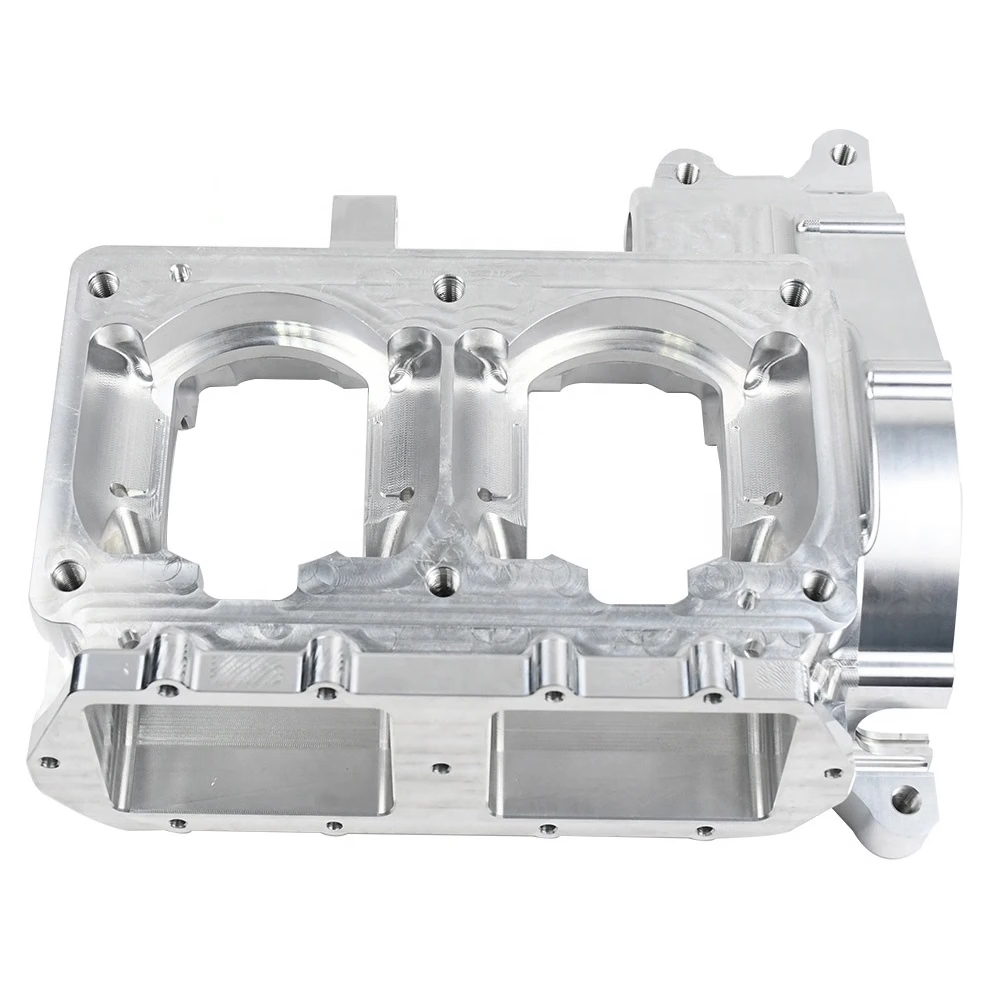
In this article
- 1
- 2
- 3
- 4
- 5
- 6
- 7
Key takeaways
What to compare across CNC HMC manufacturers
Use these rows as a scorecard when you shortlist suppliers.
| Check | What good looks like | Red flag | How to verify |
|---|---|---|---|
| Spindle torque | High torque at 500–2,000 rpm for steel | Only max rpm quoted | Ask for a torque curve |
| Pallet system | 2 or more pallets, repeatability under 0.01 mm | Single-table setup only | Request pallet repeatability data |
| Positional accuracy | ±0.005 mm on critical features | Tolerance given without a feature list | Compare CMM report to drawing |
| Max part envelope | Matches your largest part plus fixturing | Travel quoted without fixture space | Send a 3D model for DFM review |
| Quality system | ISO 9001 plus industry-specific certs | Certificates shown but not scoped | Check cert scope and expiry |
| Inspection | 100% inspection, reports on request | Sampling only, no records | Ask for a sample inspection sheet |
| Lead time | Quote in 12 hours, parts in 3–5 days | Vague delivery windows | Ask for historical on-time data |
| Order size | No minimum, one part to 10,000+ | High MOQ on prototypes | Confirm MOQ in writing |
Pick the shop, not just the machine
The best CNC HMC manufacturers give you a rigid machine. The right partner gives you a fixture plan, a DFM review, and an inspection report that matches your drawing. Judge both before you commit.
Why CNC HMC manufacturers build around the pallet
On a horizontal machining center the spindle points sideways and the part sits on a pallet that indexes around a vertical axis. Chips fall away from the cut instead of piling on the workpiece, so deep pockets and long boring cycles clear better than on a vertical machine. That geometry is why heavy cubic parts, gearbox housings, and manifold blocks are common HMC work.
The pallet changer is the real throughput lever. While one pallet is cutting, an operator loads the next part on the second pallet. On a 4,000 mm travel machine running large weldments, that overlap can matter more than a few thousand rpm of spindle speed. Ask how many pallets the supplier runs and how repeatable the pallet seating is.
A rotary table adds a fourth axis, letting the shop reach four faces of a part in one setup. Fewer setups mean fewer datum shifts and less accumulated error. For a part with bores on three or four sides, that is often the difference between holding ±0.005 mm and chasing it.
HMC work is not universal. A 2,000 mm shaft belongs on a lathe. A thin 1 mm plate will chatter and distort. When a shop pushes those jobs onto an HMC anyway, you pay for setup time and scrap.
- 1Best fitBoxy parts from 200 mm to 4,000 mm with bores on multiple faces.
- 2Poor fitLong slender shafts, thin sheet, and parts needing five-sided access.
- 3Watch forFixture space that eats into the quoted travel envelope.
Tolerance claims from CNC HMC manufacturers, tested
A tolerance number on a website means little without context. ±0.005 mm is achievable on a rigid setup, sharp tooling, and a stable thermal environment. The same machine will drift on a 40 °C afternoon with a dull insert and a part clamped at one corner. Ask which features the tolerance applies to and how it is measured.
Thermal growth is the quiet killer on horizontal centers. A spindle running for six hours grows, and the Z axis moves with it. Shops that hold tight tolerances compensate in the program or run warm-up cycles before the first cut. Ask if they do either.
Surface finish follows the same logic. Ra 0.8–1.6 μm is a normal machined finish on aluminum and mild steel. Ra 0.2–0.8 μm needs a finishing pass, a sharp tool, and often a different strategy. If a supplier quotes a fine finish on a deep pocket without explaining the tool reach, the number is optimistic.
The 99.99% qualification rate we work to comes from inspecting 100% of parts before shipment, not from a lucky batch. Raw material is checked on arrival, dimensions are monitored in process, and a final inspection closes the lot. Reports are available on request.
Certifications that matter when you vet suppliers
ISO 9001:2015 is the floor. It tells you a quality system exists and is audited. Without it, you are trusting a verbal process. With it, you still need to check that the scope covers the machining you are buying, not just a sister plant.
IATF 16949:2016 matters if your part ends up in a vehicle. It adds traceability, change control, and production-part approval discipline. For EV battery housings, motor mounts, and busbar parts, that paperwork is part of the deliverable.
ISO 13485:2016 applies to medical devices. It governs process validation and record retention. If a supplier holds it, they already run the documentation you will ask for. ISO 27001:2022 covers information security, which matters when you send CAD files and drawings.
Certificates expire and scopes change. Ask for the current certificate and read the scope line. A supplier who sends a PDF without being asked is usually one who runs the system daily.
- 1AutomotiveIATF 16949 with PPAP-level documentation on request.
- 2MedicalISO 13485 and validated processes for implant-adjacent parts.
- 3General industrialISO 9001 plus material certs and inspection reports.
- 4Data handlingISO 27001 for secure file transfer and NDA-backed work.
How to read a quote from a CNC HMC machine shop
A useful quote names the machine, the number of setups, the fixture approach, and the inspection method. If it lists only a price and a lead time, you cannot tell whether the shop understood the part. Send a 3D model and a drawing with datums and critical dimensions marked.
DFM feedback should arrive with the quote. A shop that flags a thin wall, a deep pocket needing a long tool, or a tolerance that drives cost is doing the work you are paying for. We return quotation and free DFM analysis within 12 hours, and production can start within 24 hours of approval.
Material choice moves the number more than most buyers expect. 7075 aluminum cuts cleanly and holds tolerance. 316L stainless work-hardens and needs slower feeds. Inconel and Ti-6Al-4V wear tools fast and push cycle time up. Say what the part must do, not only what alloy the last drawing used.
Order size is flexible here. There is no minimum order quantity, so a single prototype and a 10,000-part run go through the same process. That matters when you need to prove a design before committing to tooling.
Step by step: qualifying a horizontal machining supplier
Run these steps in order. Each one can remove a supplier before you spend time on samples.
- 1Send a real part, not a simple oneUse a part with at least three faces and one tight bore. A cube with a single hole tells you almost nothing about the shop.
- 2Ask for the machine and pallet planThey should name the machine size, pallet count, and fixture concept. Vague answers mean the quote is a guess.
- 3Request the inspection methodCMM, bore gauge, or surface tester, and which features get measured. Ask for a sample report from a similar part.
- 4Confirm tolerance and finish by featureMatch ±0.005 mm and Ra 0.8–1.6 μm to specific callouts, not to the whole drawing.
- 5Verify certifications and scopeCheck ISO 9001, plus IATF 16949 or ISO 13485 if your industry needs them. Read the scope line and expiry date.
- 6Fix the commercial termsMOQ, lead time, and payment. No minimum order quantity and a 3–5 day ship window should be in writing.
- 7Place a small trial orderTwo to five parts. Check dimensions, finish, burrs, and packaging before you release the full volume.
- 8Sign the NDA before sending full dataUploads are kept secure and confidential. An NDA is available on request for sensitive assemblies.
Questions buyers ask about CNC HMC manufacturers
What part size fits an HMC best?
Think cubic or prismatic parts with bores on several faces. A gearbox housing, a manifold block, or a pump body is typical.
Long shafts and thin plates are usually better on a lathe or a vertical machine. Ask the shop which machine they plan to use before you assume HMC.
Is ±0.005 mm realistic on a horizontal center?
Yes, on rigid setups with sharp tooling and a stable shop temperature. It is not automatic across every feature on a large part.
Ask which dimensions carry the tight tolerance and how they are measured. A CMM report for the lot answers that faster than a spec sheet.
How many pallets do I need for my volume?
For prototypes and small batches, two pallets are enough to keep the spindle cutting during load and unload.
Above a few hundred parts a month, ask about pallet pools and tool-life management. Fixture repeatability matters more than pallet count beyond that point.
Do I need IATF 16949 or ISO 13485?
Only if your part ships into automotive or medical supply chains and your customer requires it. ISO 9001 covers most industrial work.
If you do need them, check the certificate scope covers the machining site, not just the company name.
What lead time should I expect?
A quote and DFM review within 12 hours is a reasonable target. Production can start within 24 hours of approval, and parts typically ship in 3–5 days.
Complex parts with special material or finishing take longer. Get the schedule in writing rather than relying on a verbal estimate.
Can I order just one part?
Yes. There is no minimum order quantity, so one prototype and a 10,000+ part run use the same process.
For a first order, two to five parts is a practical trial size. It gives you enough samples to check variation, not just one good part.
Send your part and get a machining plan
Upload a 3D model and drawing. We return a quotation and free DFM analysis within 12 hours, with the machine, fixture, and inspection approach named.
12-hour quoteNo MOQ100% inspectionNDA on request
More from GreatLight
We publish setup notes, tooling trials and inspection data from the factory floor.











