
How to Vet ODM CNC Machining Makers Worldwide
This guide is for engineers and sourcing teams comparing ODM CNC machining makers worldwide. It covers the criteria that actually predict part quality, schedule risk and total cost, plus the questions that expose a weak supplier before you send a PO.
Key takeaways
What to check before you shortlist
Use this as a first-pass filter. A maker that fails two or more rows is usually not worth a sample order.
| Criterion | What good looks like | Red flag |
|---|---|---|
| Tolerance claim | ±0.005 mm stated with inspection method | Tolerance quoted without a measuring plan |
| 5-axis capacity | Simultaneous 5-axis for complex geometry | 3+2 only, no simultaneous capability |
| Max part size | 4,000 mm travel for large frames | Small travels, no oversized option |
| Quality system | ISO 9001 plus IATF 16949 or ISO 13485 | One certificate, no scope detail |
| MOQ policy | From one prototype to 10,000+ runs | Fixed tooling charge per revision |
| DFM feedback | Written analysis within 12 hours | Price only, no manufacturability notes |
| Inspection | 100% inspection with reports on request | Sampling only, no data shared |
| Confidentiality | NDA available, secure uploads | Email CAD files with no NDA |
The short version
Pick the maker whose machine list, certification scope and quote structure you can verify. Price follows those three, not the other way around.
What ODM work means on a CNC shop floor
An ODM partner owns more than the cutting. They read your CAD, flag features that will chatter or need a second setup, pick the material grade, run the parts, finish them and ship them. You hand over a design intent, not a fully toleranced print, and they return a working part.
That changes the vetting process. With a pure job shop, you check whether they can hold a tolerance. With ODM CNC machining makers worldwide, you also check whether they can make design calls you would have made yourself. Material substitution, wall thickness, thread depth, corner radii. Each of those decisions moves cost and lead time.
The practical test is simple. Send a part that has one awkward feature, such as a deep pocket with a 3 mm corner radius, and ask for DFM notes with the quote. A real ODM partner replies with a suggested radius, a tooling comment and a revised cost. A broker replies with a number.
- 1Scope covers design supportMaterial, finish and tolerance decisions are part of the quote.
- 2One accountable partyMachining, finishing and inspection under one roof reduces handoff risk.
- 3Feedback arrives with priceDFM notes should not be a separate paid service.
Read the machine park, not the website
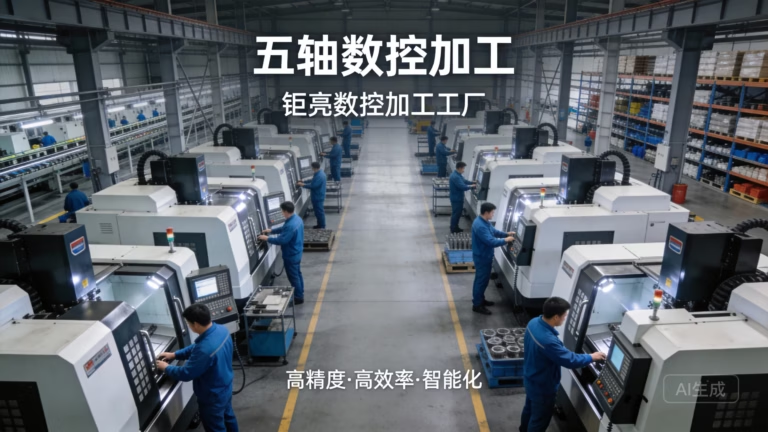
Spindle count is the easiest claim to inflate. Ask for the axis configuration and travels instead. A shop with 16 simultaneous 5-axis centers can cut contoured aerospace brackets in one setup. A shop with only 3-axis mills will need three setups and will stack tolerance error across each one.
Part size matters just as much. A 4,000 mm maximum processing size covers long extrusion frames and gantry rails. If your part is 900 mm long and the shop tops out at 600 mm, the quote will either be refused or subcontracted, and subcontracting is where schedules slip.
Mill-turn centers are worth asking about when your part has both turned and milled features. Running a shaft with cross-holes on a mill-turn eliminates one chucking step, which typically removes 0.01–0.02 mm of positional error and one queue wait.
For small lots, the machine list also tells you about changeover cost. Shops with flexible fixturing can run one part without charging a full setup day. Shops built around long production runs cannot.
- 1Ask for travelsMatch them against your largest envelope plus fixture allowance.
- 2Count simultaneous axes3+2 positioning is not the same as simultaneous 5-axis.
- 3Check mill-turnFewer setups means tighter position between features.
Match certifications to your end market
ISO 9001:2015 tells you a quality system exists. It does not tell you the shop can support a medical device submission or an automotive PPAP. For medical work, look for ISO 13485:2016. For automotive and EV parts, IATF 16949:2016 is the gate. If your drawings carry export-controlled or sensitive geometry, ISO 27001:2022 covers information handling.
Certificates are only useful if they are in scope. Ask whether the certification covers the site that will run your parts. A group can hold a certificate at one plant and machine your order at another.
Inspection practice is the second half of the quality question. 100% inspection before shipment, with raw material check, in-process monitoring and final inspection, is a different commitment from sampling. Ask for measurement reports on the first article and confirm they will share them without prompting.
Surface finish belongs here too. Ra 0.8–1.6 μm is a normal machined finish. Ra 0.2–0.8 μm requires a specific tool path and sometimes hand polishing. If the quote lists a fine finish but no added cost, ask how it will be produced.
- 1Scope the certificateConfirm the exact site and process it covers.
- 2Demand first-article dataCMM or optical reports, not a pass stamp.
- 3Question cheap fine finishesRa 0.2–0.8 μm takes time and a controlled tool path.
Lead time, MOQ and quote clarity
Lead time claims are easy to write and hard to verify. Ask what happens before the machine starts. Quotation and DFM analysis inside 12 hours, production start inside 24 hours and parts shipping in 3–5 days is a workflow, not a slogan. It means the shop has quoting engineers and material on the floor.
MOQ is the other number that shapes total cost. No minimum order quantity means you can buy one prototype and then a 10,000+ part run without a re-quote penalty. Fixed tooling charges per revision are the hidden cost that kills iterative programs.
Read the quote line by line. A clear quote separates material, machining time, finishing, inspection and freight. A vague quote bundles everything into one number and gives you nothing to negotiate when a revision lands.
Ask about late-delivery history. A shop that tracks its own on-time rate will answer with a figure. A shop that does not track it will answer with a promise.
- 1Time the quoteA slow quote usually signals a slow production start.
- 2Confirm revision pricingAsk what a design change costs after the first article.
- 3Insist on line itemsBundled pricing hides the cost of finishing and inspection.
Check material and finish coverage
A maker that only stocks aluminum will quote aluminum for every part. That is fine for enclosures and brackets. It is wrong for a wear surface or a high-temperature manifold. Check whether the shop routinely runs stainless 17-4PH, tool steel, titanium Ti-6Al-4V and Inconel, or whether those are occasional jobs.
Plastic coverage matters for prototypes and low-volume housings. POM, PEEK, PC and carbon fiber each cut differently and need different feeds. A shop that treats them like aluminum will burn the part or leave a rough finish.
Finishing is where quotes often hide gaps. Anodizing, electroless nickel, powder coating, bead blasting and laser marking all add a step and a queue. If the maker outsources finishing, your part leaves their building and the schedule risk moves with it.
Ask which finishes are done in-house. Integrated finishing is the main reason a single ODM partner can hold a delivery window that a broker cannot.
- 1Test the exotic listTitanium and Inconel need different tooling and coolant strategy.
- 2Separate plasticsFeeds and speeds for PEEK are nothing like 6061.
- 3Trace the finishing stepOutsourced anodizing adds a second schedule you cannot see.
Step by step
- 1Send a test part with one hard featurePick a part with a deep pocket, thin wall or tight position callout. Include the material and finish you actually need. This single RFQ replaces a page of capability questions.
- 2Time the DFM responseStart a clock when you send the file. A written manufacturability reply with tolerance and cost notes should arrive within 12 hours for a straightforward part.
- 3Read the quote structureCheck that material, machining, finishing, inspection and freight appear as separate lines. Ask for the assumed tolerance and finish on each line.
- 4Verify certification scopeRequest the certificate number and the site address it covers. Match it to the plant that will run your parts, not the group headquarters.
- 5Order one unit firstBuy a single part before a full run. Measure the features that matter to you and compare them to the first-article report.
- 6Confirm the revision pathAsk what a design change costs after the first article. A no-MOQ partner should re-quote the delta, not the whole program.
- 7Agree on inspection dataState up front which dimensions need a report. Confirm the shop can measure them in-house before you release the run.
- 8Sign the NDA before files moveIf the geometry is sensitive, get the agreement in place first and confirm uploads are handled under it.
Common questions
How do I compare ODM CNC machining makers worldwide on price fairly?
Compare the same revision of the same drawing, with the same material grade and the same finish callout. Ask each maker to state the assumed tolerance band and the inspection level included in the price.
A lower number usually means a looser tolerance assumption, a coarser finish or no first-article report. Normalize those three items before you compare totals.
Is a lower tolerance always the better choice?
No. Tightening a non-critical dimension adds machining time, inspection time and scrap risk without improving function. Reserve ±0.005 mm for features that locate, seal or mate.
Send your functional requirements and let the shop propose the tolerance per feature. That conversation is the clearest signal of whether they understand the part.
What MOQ should I expect for a first prototype?
For most machined parts there is no technical reason to force a minimum. A shop with flexible fixturing can run one part and still be efficient.
If a maker insists on a high MOQ for a machined prototype, they are likely set up for production runs and will treat your job as filler work. That affects scheduling priority.
Which certifications actually matter for my project?
Match the certificate to the end market. ISO 9001:2015 for general industrial work, IATF 16949:2016 for automotive and EV, ISO 13485:2016 for medical devices, and ISO 27001:2022 when the design data itself is sensitive.
Then confirm the certificate covers the specific site and process that will produce your parts.
How do I handle design changes mid-project?
Ask for the revision policy before the first PO. A workable policy re-quotes only the changed features and keeps the original setup where possible.
Keep a dated revision of the 3D model and drawing so both sides quote from the same file. Most disputes come from mismatched revisions, not from machining errors.
What should I do if my part is larger than the shop's travel?
Ask directly. A maker with a 4,000 mm maximum processing size can handle long frames and rails in one setup. If your part exceeds their travel, they may subcontract it, which adds a schedule you cannot see.
Confirm in writing whether the part is machined in-house before you release the order.
Send a part and test the process
Upload a drawing and get a quotation with DFM notes, a stated tolerance band and a line-item price.
12-hour quote100% inspectionNo MOQNDA on request
More from the shop floor
We publish setup notes, tooling trials and inspection data from the factory floor.











