
OEM Rapid Tooling Manufacturers: How to Compare Them Before You Send an RFQ
Most lists of OEM rapid tooling manufacturers rank brand names. This one gives you the checks that decide whether a supplier can actually hold your tolerances, hit your launch date, and survive an audit. Written for product engineers and sourcing teams who have to justify the pick.
In this article
- 1
- 2
- 3
- 4
- 5
- 6
- 7
- 8
Key takeaways
Supplier Type vs. What You Get
Three sourcing routes, judged on the things that show up late in a program.
| Route | Best for | Main risk |
|---|---|---|
| Direct CNC and tooling factory | Bridge and production tooling, 50–10,000 parts | Fewer process options in-house |
| Brokered manufacturing platform | One-off prototypes, fast first quote | Schedule shifts when the shop changes |
| Injection molding house only | High-volume parts, 100,000+ | Slow and costly for early iterations |
| Local job shop | Simple geometry, short distance | Thin DFM feedback, no material stock |
Decide the Tooling Route Before You Shortlist OEM Rapid Tooling Manufacturers
Rapid tooling is not one process. It covers machined aluminum cavities, cast zinc and beryllium copper inserts, soft steel molds, and short-run fixtures cut on a 3-axis mill. Each has a volume band where it makes sense, and picking the wrong band is the most expensive mistake in a launch program.
Start with the number of parts you actually need. Below roughly 30 pieces, machining the part directly is usually cheaper than building any tool. Between 50 and 10,000, a bridge tool in aluminum or soft steel pays back. Above that, a hardened production mold starts to win on cost per part.
The geometry decides the rest. Deep ribs, thin walls under 1.0 mm, and tight cosmetic surfaces push you toward a tool. Simple brackets and housings with generous draft can stay on the mill for the whole pilot build.
So when you evaluate OEM rapid tooling manufacturers, ask which route they propose and why. A supplier that quotes a mold for a 20-piece run is not listening. One that proposes machining for 5,000 identical parts is not doing the math.
Precision Claims: What Tolerance a Rapid Tooling Supplier Can Really Hold
Every supplier page says high precision. The useful question is which tolerance applies to which feature, on which machine, after finishing. A ±0.005 mm callout on a 4,000 mm part is not the same claim as ±0.005 mm on a 50 mm insert.
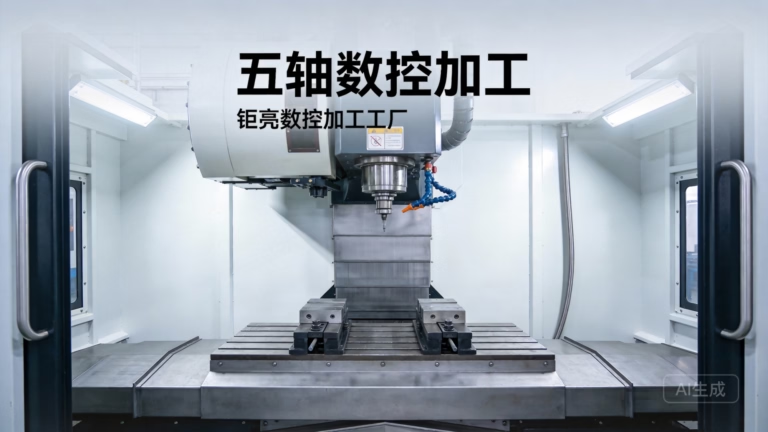
On a modern 5-axis center, a well-set-up aluminum part holds ±0.005 mm on critical bores and datums. General machined surfaces sit comfortably at Ra 1.6–3.2 μm. Decorative faces polished to Ra 0.2–0.8 μm need hand work, and hand work adds days.
Watch for tolerance stack. If the cavity is machined to ±0.005 mm and the insert pocket to ±0.01 mm, the molded part inherits both. Ask for the stack on the features that touch your assembly.
Get the inspection method in writing. CMM reports on the first article, in-process checks, and a final dimensional report on request. If the supplier cannot describe the measurement, the tolerance number is marketing.
Lead Time: Where the Days Actually Go
A 3–5 day ship date is realistic for machined parts once the program is released. That clock starts after the quote is approved, the material is in stock, and the model is frozen. Change any of those and the date moves.
Tooling runs longer. Cutting an aluminum cavity, spotting it, fitting the insert, and running first-shot samples is a sequence, not a single operation. Finishing steps such as anodizing, bead blasting, or laser marking each add their own slot in the queue.
The fastest suppliers are not the ones with the shortest quote. They are the ones who start cutting within 24 hours of approval because the DFM questions were answered up front. A 12-hour quote with real DFM notes beats a 2-hour price with no comments.
Ask about the historical late rate, not the promised date. A supplier tracking late deliveries below 2% has a schedule system. Ask how they measure it.
MOQ, Materials, and Finishing Under One Roof
No minimum order quantity sounds generous until you ask what happens at 1 piece versus 10,000. The real question is whether the same supplier can take you from one prototype to a pilot run without a re-quote, a new fixture, and a new inspection plan.
Material range matters more for tooling than for simple parts. Aluminum 6061 and 7075 cover most bridge tools. Zinc and beryllium copper inserts need a foundry relationship. Tool steel and 17-4PH show up in wear plates and slides. A supplier who stocks only 6061 will subcontract the rest.
Finishing is where schedules slip. Anodizing, electroless nickel, zinc plating, powder coating, and black oxide are common. Laser marking needs a minimum character height around 1.5 mm to stay legible. If finishing is outsourced, add buffer days.
Ask for a sample part in the actual material and finish before you commit to a tool. A machined coupon in anodized 6061 tells you more about surface quality than any page of specifications.
Certifications and Documentation: What Auditors Ask For
ISO 9001:2015 is the baseline. It says the supplier has a documented quality system. It does not say the system fits your industry.
Automotive programs usually require IATF 16949:2016, especially for parts that reach a vehicle. Medical device work points to ISO 13485:2016, which brings traceability and process validation expectations. If your drawings leave the building, ISO 27001:2022 for information security is worth checking.
Documentation is the part engineers forget. First article inspection reports, material certificates, and dimensional reports on request are standard asks. Agree on the report format at PO stage, not at shipment.
Confidentiality should be settled early. A mutual NDA before you upload CAD is normal practice. Uploads should be handled as confidential by default, not on request.
A 6-Step RFQ Process for Comparing Suppliers
Same package to every supplier. The differences in response tell you more than the prices.
- 1Freeze the model and the drawingOne STEP file, one PDF drawing with GD&T and datum callouts. Revision letter in the filename. Suppliers who quote against a moving model will re-quote.
- 2State the volume bandGive the first-run quantity and the 12-month forecast separately. A 50-piece bridge tool and a 5,000-piece run need different quotes.
- 3Ask for DFM notes, not just a priceRequest written comments on draft, wall thickness, and corner radii. Real DFM feedback usually arrives within 12 hours and often lists 3–5 changes.
- 4Request the tolerance and inspection planAsk which features get CMM inspection, what the first article covers, and whether a final report is included.
- 5Confirm material and finish availabilityName the alloy and the finish. Ask whether they are in stock or subcontracted, and how many days each adds.
- 6Compare total days, not unit priceAdd quote time, DFM turnaround, cutting, finishing, and inspection. The cheapest quote often loses on the calendar.
Questions Buyers Ask
How many OEM rapid tooling manufacturers should we quote?
Three is usually enough to see a pattern. Two replies that match on tolerance and lead time give you a benchmark; the third tests whether the first two are competitive.
More than four adds work without adding information, unless the parts are in a regulated category where certification options are limited.
Is a platform or a direct factory better for bridge tooling?
A platform wins when you need one quote across several processes and the geometry is simple. A direct factory wins when the schedule is tight, the tolerances are real, and you want to talk to the person setting up the machine.
For bridge tooling that feeds a pilot build, the direct route removes one handoff from the schedule.
What tolerance should we put on a rapid tool drawing?
Put tight tolerances only on the features that touch your assembly. Everything else gets a general tolerance block. Over-tolerancing a cavity drives up cost and inspection time with no functional gain.
A practical split is ±0.005 mm on critical bores and datums, and general machining tolerances elsewhere.
How do we handle confidentiality before sending CAD?
Sign an NDA before the upload. Treat the model, the drawings, and the volume forecast as confidential together. A supplier who shares your files across a broker network without telling you is a risk.
Ask how long files are retained after the project closes.
What adds the most time to a rapid tooling project?
Finishing and documentation, not cutting. Anodizing queues, laser marking setup, and first article inspection reports are the usual bottlenecks.
Agree on the report format and the finish spec at PO stage so neither becomes a surprise at shipment.
Can one supplier handle prototyping and the production run?
Often yes, if they cover machining, casting, and finishing in-house. That removes the re-qualification step between the prototype and the pilot build.
Ask early whether the production tool would be built at the same site as the prototype.
Send One Drawing, Get a Quote and DFM Notes in 12 Hours
Upload your model and we will reply with a price, a tolerance callout, and written DFM comments. No minimum order quantity, from one prototype to 10,000+ parts.
12-hour quote + DFMNo MOQ100% inspection±0.005 mm
More From the Shop Floor
We publish setup notes, tooling trials and inspection data from the factory floor.











