
What Are the Advantages of Special Machinery Processing Machines?
A machine built for one part family cuts setups, not just cycle time. This page explains where the advantages of special machinery processing machines come from, which parts benefit, and when a standard 3-axis or 5-axis machine is the better buy.
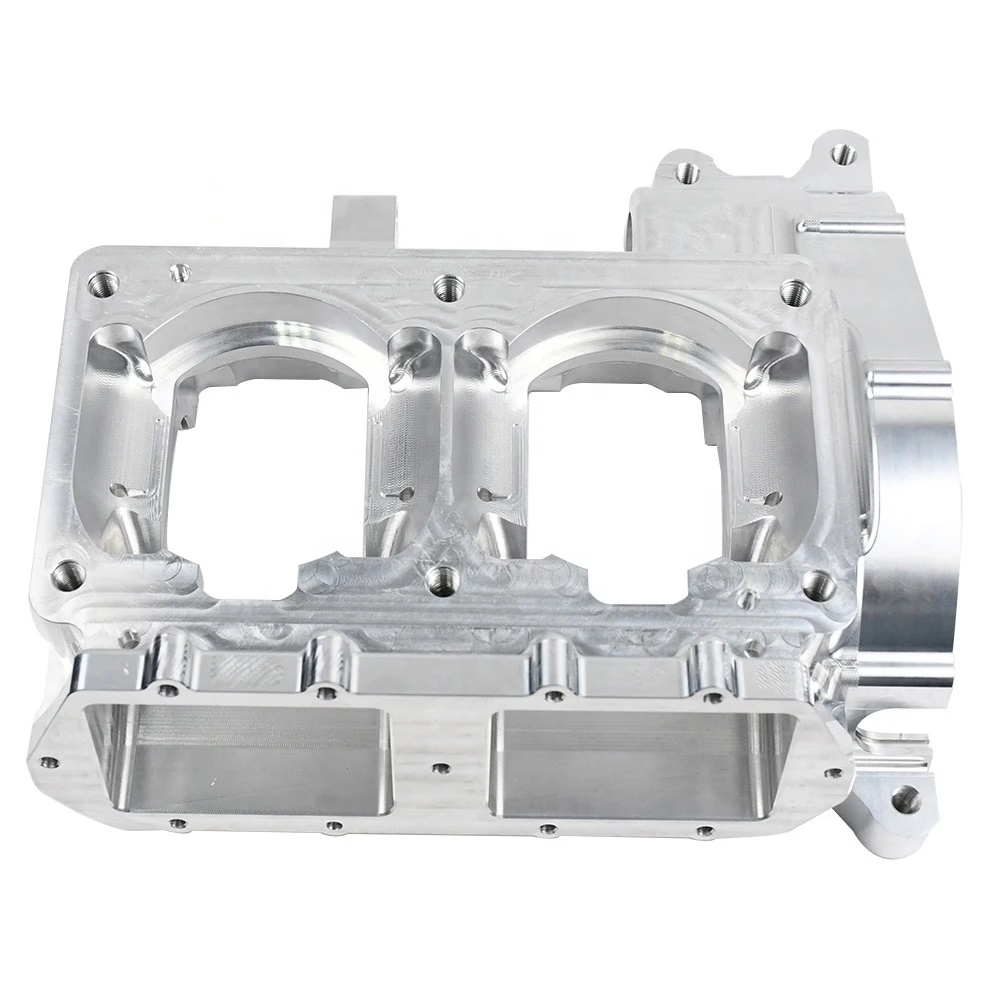
Why a Dedicated Machine Beats a General One
A general-purpose machining center has to be flexible. Its spindle, worktable and fixture are sized for the widest range of parts the shop might win. A special machinery processing machine is the opposite: it is designed around one part family, one material and one tolerance band. That single decision cascades through the whole process.
The first gain is stiffness. When the machine only has to reach a part that is 300 mm across, the column does not need 800 mm of travel, and the ram can be shorter and thicker. Higher static stiffness pushes the first natural frequency of the structure upward. Chatter that used to appear at 6,000 rpm moves out of the cutting range, so you can run a larger depth of cut without leaving witness marks.
The second gain is thermal stability. A dedicated machine runs one cycle, thousands of times. Its spindle and ballscrews warm up the same way every shift, so thermal drift becomes predictable and can be mapped and compensated. On a job shop machine that switches between aluminium and Inconel, that drift changes with every setup.
The third gain is the fixture. A dedicated fixture is a permanent piece of tooling, not a rebuild. It is usually cast or stress-relieved, then ground in place on the machine itself. Locating repeatability of 0.005 mm is normal because the fixture never leaves the table.
None of this is free. A special machine is expensive to build and slow to change. That trade-off is the whole point of this page, so it is worth being precise about where it pays off and where it does not.
- 1StiffnessShorter ram, thicker column, higher natural frequency
- 2ThermalSame cycle every shift, drift can be mapped
- 3FixturePermanent tooling, ground in place on the machine
- 4Trade-offHigh build cost, slow to retool
Setup Count and Positional Error
Every setup adds error. Not because the operator is careless, but because each reclamp re-references the part to a new coordinate system. Stack five setups on a bracket with true positions of Ø0.05 mm and you will fight the tolerance stack all day.
A special machine usually collapses those five setups into one or two. The part goes on a dedicated fixture, the tool comes from a fixed direction, and the datum never changes. Positional error stops being a sum of five distributions and becomes one number you can measure and hold.
This matters most for parts with features on multiple faces: hydraulic manifolds, gearbox housings, motor end bells, sensor bodies. If your drawing has a true position callout between two features that sit on different faces, count the setups first. That count often decides whether the part is manufacturable at ±0.005 mm at all.
There is a second effect. Fewer setups mean fewer chances for a chip to sit under a locating pad, fewer torque sequences to get wrong, and fewer in-process checks that only catch a problem after the part is already off the machine.
For low-volume prototype work we still run the same geometry on 5-axis centers with a modular fixture. The advantages of special machinery processing machines only appear once the volume justifies building the tooling.
- 1One datumFewer setups, less tolerance stacking
- 2Multi-face partsManifolds, housings, end bells, sensor bodies
- 3Prototype path5-axis plus modular fixture, no dedicated tooling
- 4Volume gateDedicated tooling pays back on repeat orders
Cycle Time, Tool Life and Chip Control
A dedicated machine can be tuned for one cut. Spindle speed, feed per tooth, coolant pressure and tool path are frozen after the first article is approved. Nobody re-programs it next week for a different alloy.
That lets you push parameters into a range a job shop would not risk. On 6061-T6 aluminium, a 16 mm carbide end mill at 12,000 rpm and 0.15 mm per tooth is a normal roughing cut on a stiff dedicated machine. The same tool on a flexible machine would chatter and break down the edge.
Tool life becomes predictable. Because the load is constant, you can index inserts on a count instead of on a sound. Shops that track this often see tool cost per part fall by a third, not because the tools are cheaper, but because they are used up completely instead of being pulled early out of caution.
Chip control is the quiet advantage. Deep pockets and long bores clear chips the same way every cycle, so you can design the coolant ports and air blast around one known chip shape. On a mixed-part machine, chip jams are a daily variable.
Cycle time gains of 20 to 40 percent over a general-purpose machine are realistic for the same part, same tolerance, same material. The gain comes from stiffness and from not re-proving the process every run.
- 1Frozen parametersSet once after first article approval
- 2Tool lifeIndex on count, not on sound
- 3Chip controlCoolant ports designed for one chip shape
- 4Realistic gain20–40 percent cycle time on repeat parts
Where the Advantages Disappear
Special machinery loses on three fronts. The first is changeover. If the part revision changes twice a year, the fixture and program have to be rebuilt, and that cost lands on the customer.
The second is volume. A dedicated line needs enough annual volume to amortize the tooling and the engineering time. When the program is 200 parts a year, a 5-axis center with a good modular fixture will beat it on total cost every time.
The third is material variety. A machine tuned for aluminium does not automatically run 17-4PH stainless or Inconel well. Different specific cutting force, different heat in the cut, different chip evacuation. If your part mix changes alloy, the dedicated machine becomes a constraint.
There is also a geometry limit. Very large parts, like a 4,000 mm frame or a Ø400 mm rotary table job, are usually better on a large travelling-column machine where the part moves and the spindle stays put. Building a special machine around a 4 m part rarely pays back.
So the honest rule is this: dedicated machines win on stable geometry, stable material and repeat volume. They lose when any of those three moves.
- 1ChangeoverEvery revision rebuilds fixture and program
- 2VolumeLow annual volume never amortizes the tooling
- 3Alloy mixA machine tuned for one material resists others
- 4SizeVery large parts suit travelling-column machines
Matching the Machine to the Material
Material decides how much of the advantage you can actually collect. Aluminium and brass are forgiving. High stiffness mainly buys you speed, because the limiting factor is spindle power and chip evacuation, not deflection.
Stainless 304 and 316L sit in the middle. They work-harden, so you want constant feed per tooth and no dwelling. A dedicated machine with frozen parameters is very good at this. The same part run on a job shop machine with varying feeds will show inconsistent surface finish and premature edge wear.
Titanium TC4 (Ti-6Al-4V) and Inconel are where stiffness matters most. These alloys convert almost all cutting energy into heat at the edge. A rigid machine lets you take a deeper cut and get the heat out with the chip instead of into the tool. This is the single biggest reason aerospace shops invest in dedicated setups.
Plastics and carbon fibre flip the problem. The cutting forces are low, so stiffness is not the constraint. Dust extraction, tool geometry and clamping pressure against delamination take over. A special machine for composites is really a dust and vacuum system with a spindle attached.
We machine all of these materials across 127 high-precision CNC machines, and the material list usually decides the machine choice before the tolerance does.
- 1Aluminium and brassStiffness buys speed, not accuracy
- 2304 / 316LConstant feed per tooth avoids work hardening
- 3TC4 and InconelRigidity carries heat out with the chip
- 4CompositesDust extraction and clamping dominate
How to Read the Cost Curve
Compare a dedicated machine with a 5-axis center on total cost per good part, not on hourly rate. Hourly rate hides the setup hours, the fixture build and the scrap.
Build the number in three parts. First, non-recurring cost: fixture design, fixture build, first article inspection, program prove-out. Second, recurring cost: cycle time, tool cost, inspection time. Third, risk cost: scrap rate and the cost of a late shipment.
The non-recurring part is where dedicated machines look bad. It is also the part that gets amortized. Divide it by annual volume and add it to the recurring cost. That is the only fair comparison.
Risk cost is the part most teams forget. A process with frozen parameters and one fixture has a much lower scrap rate than a process rebuilt every run. If your part is a safety-critical component in a medical device or an EV powertrain, that stability is worth more than the cycle time.
For programs under a few hundred parts a year, we usually recommend 5-axis with a modular fixture. Above that, a dedicated setup starts to win. The crossover depends on part complexity, not on a fixed number.
- 1Non-recurringFixture, program prove-out, first article
- 2RecurringCycle time, tool cost, inspection
- 3RiskScrap rate and late shipment exposure
- 4Rule of thumbLow volume: 5-axis. High repeat volume: dedicated
Dedicated Machine vs 5-Axis Center
Use this to pick a route before quoting.
| Factor | Dedicated machine | 5-axis center |
|---|---|---|
| Best annual volume | Thousands of identical parts | One to a few hundred parts |
| Setup count | One or two, fixed datum | Three to five, modular fixture |
| Geometry change | Fixture and program rebuild | Re-post, no tooling cost |
| Typical tolerance | ±0.005 mm, repeatable | ±0.005 mm with good fixturing |
| Cycle time | 20–40% faster on repeat parts | Baseline |
| Material change | Resists alloy changes | Handles mixed alloys easily |
| Tooling cost | High, amortized over volume | Low, shared across jobs |
| Best fit | Stable part, stable alloy | Prototypes and mixed batches |
The Short Answer
If your part geometry and alloy are stable and you run it at real volume, a dedicated machine wins on cycle time, scrap rate and tool life. If the design still moves or the annual volume is low, stay on 5-axis with a modular fixture and revisit the decision when the numbers change.
Questions Engineers Ask
Do I need a dedicated machine to hit ±0.005 mm?
No. A well-maintained 5-axis center with a rigid modular fixture holds ±0.005 mm every day. The advantage of a dedicated machine is that it holds that tolerance without re-proving the process each run.
The tolerance itself is not the deciding factor. Repeatability across thousands of parts is.
How many parts per year justify a dedicated setup?
There is no fixed number. It depends on part complexity and how much non-recurring tooling the job needs. A simple bracket crosses over much later than a multi-face housing with tight true position.
We usually model it as non-recurring cost divided by annual volume, then compare against the recurring cost of a 5-axis route.
Does a dedicated machine limit design changes?
Yes, and that is the main risk. A geometry change usually means a new fixture and a re-proven program, not just a re-post.
If your design is still in flux, run the first articles on 5-axis and freeze the design before committing to tooling.
Can a dedicated machine handle titanium and Inconel?
It can, and this is where it pays off most. Rigid structures let you take a deeper cut and carry heat away with the chip instead of into the cutting edge.
The machine has to be specified for it from the start. A frame tuned for aluminium is not automatically right for TC4 or Inconel.
What about very large parts?
Parts up to 4,000 mm are normally better on a large travelling-column machine where the workpiece moves. Building a special machine around a 4 m part rarely pays back.
The exception is a family of very large parts with identical geometry, where a dedicated line can still make sense.
How do you protect the design if we send files?
Uploads are secure and confidential, and we can sign an NDA on request. We only share drawings with the engineers who quote and program the part.
A DFM analysis and quotation come back within 12 hours, and production can start within 24 hours of approval.
Send the Drawing, Get a Process Route
Upload your part and we will tell you whether a dedicated setup or a 5-axis route is the better fit, with a DFM analysis inside 12 hours.
12-hour quoteDFM analysis includedNo minimum order quantity100% inspection
More Machining Notes
We publish setup notes, tooling trials and inspection data from the factory floor.











