
What CNC Machines Make Car Parts?
Not every car part needs a 5-axis center. This guide maps common automotive components to the machine that actually cuts them, with the tolerances and part sizes each type can hold.
In this article
- 1
- 2
- 3
- 4
- 5
- 6
- 7
What CNC machines make car parts, and why the answer depends on the cut
The shop floor answer to what CNC machines make car parts is not one machine. An engine block and a fuel injector body both live in a car, yet they are cut on different equipment because the limiting factor changes. One part is size-limited, the other is rigidity-limited. Machine choice follows the part geometry and the feature that must hold tolerance.
Three variables drive the choice: how many faces need work, whether the part rotates around a single axis, and how hard the material is. A bracket with holes on three sides wants a 4-axis mill. A shaft with a cross-drilled oil passage wants a mill-turn center or a lathe with live tooling. A hardened die insert wants EDM, not a cutter.
Tolerance capability matters here. Our standard production tolerance is ±0.005 mm ( ±0.0002 in), and that figure only holds when the fixture, tool and thermal state are stable. A 5-axis machine does not automatically hit it. Setup discipline does.
So the useful way to read this page is by part family. Each section below names the machine type, the automotive parts it typically cuts, and the point where it stops being the right choice.
Five-axis machining centers: complex geometry in one setup
A simultaneous 5-axis center moves the tool and the workpiece on five axes at once. For automotive work this matters most when a part has angled faces, contoured ports or features that would need four separate fixtures on a 3-axis machine. Cylinder heads, intake manifolds, turbo housings and suspension knuckles are the classic examples.
The real gain is setup count, not raw speed. Every re-fixture adds stack-up error. Cutting five faces in one clamping keeps datums consistent, which is why a head with valve seats and port geometry can hold position across the whole part instead of drifting from fixture to fixture.
Limits exist. Five-axis machines are slower per cubic centimeter of metal removed than a rigid 3-axis mill of the same spindle size, because the rotary axes flex. Deep pockets with a long reach tool are still a problem. For a flat plate with a single bored hole, a 5-axis machine is wasted capacity.
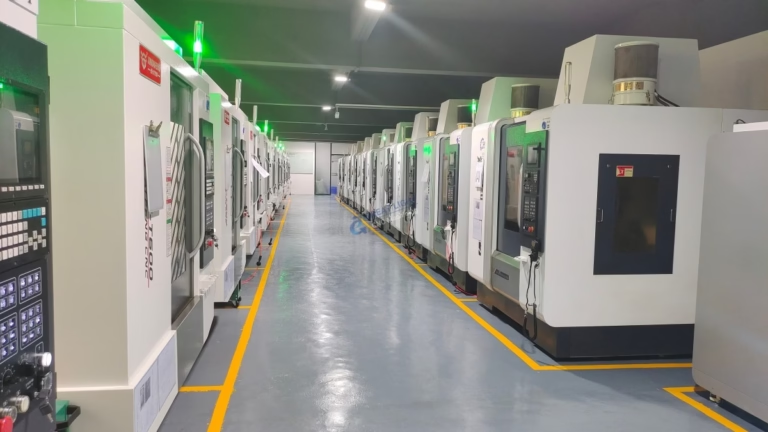
GreatLight runs 16 simultaneous 5-axis machining centers, with travels of 750 × 1,150 × 550 mm and 600 × 600 × 600 mm on the medium frames.
- 1Best fitHeads, housings and brackets with angled or contoured features on three or more faces.
- 2Poor fitSimple flat plates, long shafts, or parts where one face does all the work.
- 3Watch outLong tool reach in deep cavities still needs a smaller stepover and slower feed.
Three-axis and four-axis machines: the volume workhorses
A 3-axis mill cuts X, Y and Z only. The workpiece stays still. For automotive parts this covers a lot of ground: mounting brackets, cover plates, sensor housings, motor end bells and most flat machined faces. Setup is simple, fixturing is cheap, and the machine is rigid, so it removes metal fast.
A 4-axis mill adds a rotary table, usually Ø400 mm, that indexes or turns the part. That single addition lets the spindle reach four sides without a human touching the fixture. Drive shafts, steering knuckle blanks and transmission housings are typical 4-axis jobs. You get most of the multi-face benefit at a lower hourly rate than 5-axis.
Neither type can cut a feature that faces away from the spindle without a re-fixture. If the part needs five-sided access, the setup count climbs and so does the error budget. At that point, moving the job to a 5-axis center is usually cheaper than building three fixtures.
GreatLight keeps 27 three-axis machines and 12 four-axis mills. Small frames run 500 × 500 × 450 mm and 500 × 310 × 200 mm, which handles most bracket and housing work.
- 13-axis strengthHigh metal removal rate on single-face or stacked-plate parts.
- 24-axis strengthMulti-face work with a clear rotation axis and moderate complexity.
- 3Common errorIndexing a part four times when a 5-axis setup would hold position better.
Mill-turn centers: shafts and rotational parts with cross features
A mill-turn center combines a lathe spindle with milling capability and often a second spindle. The part turns for diameters and grooves, then the same machine mills flats, slots and cross holes without moving the workpiece. For automotive shafts, gears and axle components, this removes the lathe-to-mill handoff entirely.
The engineering payoff is concentricity. When a bearing journal and a cross-drilled oil passage are cut in one setup, the relationship between them is set by the machine, not by a fixture. That is hard to match when the part travels between two machines.
Cycle time is the trade-off. A dedicated lathe will out-turn a mill-turn center on a pure diameter-turning job. The mill-turn wins when the part has enough secondary milling to justify the combined setup. Count the features before choosing.
GreatLight runs 16 mill-turn centers. They handle gear blanks, drive shafts, bushings and hydraulic fittings where turning and milling both matter.
- 1Best fitRotational parts with flats, slots or cross holes cut in the same cycle.
- 2Poor fitPure turning jobs with no secondary features, or very long shafts.
- 3Watch outBar feeder capacity limits the raw stock diameter, not the finished part.
Swiss-type lathes and EDM: small parts and hard materials
Swiss-type lathes use a sliding headstock that feeds bar stock past a fixed guide bushing. The tool works right at the bushing, so a long, thin part does not deflect the way it would on a conventional lathe. This is how small automotive components hold tolerance: fuel injector bodies, sensor pins, valve stems, bushings and connectors.
The size limit is real. Swiss machines are built for small-diameter bar work, typically under 32 mm, and they are not the tool for a large housing. Their advantage is surface finish and repeatability on high-volume small parts, not envelope size.
Wire EDM cuts with a charged wire and no cutting force, so it machines hardened tool steel and complex profiles that a cutter cannot reach. Mirror-spark EDM finishes cavities down to a fine surface. In automotive work these processes make dies, molds and hardened inserts, plus prototypes in material that is already heat treated.
EDM is slow compared with milling. Use it when hardness, sharp internal corners or a burr-free edge make milling impractical, not as a general production method.
- 1Swiss best fitSmall-diameter, high-volume parts with tight concentricity and finish.
- 2EDM best fitHardened dies, sharp internal corners and features a cutter cannot reach.
- 3CombinationMill the soft shape first, then EDM after heat treatment to hold final size.
Material, tolerance and inspection: the boundaries that decide
Material narrows the machine list fast. Aluminium grades like 6061-T6, 7075 and ADC12 cut freely and suit high-speed milling. Stainless 303, 304 and 17-4PH work-harden, so feeds must stay aggressive enough to cut under the hardened layer. Titanium TC4 (Ti-6Al-4V) and Inconel generate heat at the edge and need lower surface speed and more coolant.
Tolerance is a system number, not a machine spec. A ±0.005 mm result depends on the fixture, the tool wear state, the spindle thermal state and the metrology. On a long aluminium part, thermal expansion alone can move a dimension more than the tolerance band if the shop is not temperature-stable.
Surface finish follows the same logic. Ra 0.8–1.6 μm is a normal machined finish. Ra 0.2–0.8 μm needs a finer stepover, a sharper tool and often a finishing pass with a smaller radius. It costs cycle time, so specify the finish only where it functions, such as a sealing face or a bearing bore.
Inspection closes the loop. GreatLight checks raw material on receipt, monitors in process and inspects 100% before shipment, with reports on request. Our qualification rate is 99.99%. For automotive programs, IATF 16949:2016 governs the process alongside ISO 9001:2015.
Which CNC machine for which car part
Match the part family to the machine type before requesting a quote.
| Machine type | Typical car parts | Best when | Avoid when |
|---|---|---|---|
| 5-axis center | Cylinder heads, intake manifolds, turbo housings | Angled or contoured features on 3+ faces | Part is a flat plate with one bored hole |
| 4-axis mill | Knuckle blanks, transmission housings, drive shafts | Multi-face work around one rotation axis | Features face away from the spindle |
| 3-axis mill | Brackets, cover plates, sensor housings, end bells | One face or stacked plates carry the work | Five-sided access is required |
| Mill-turn center | Gear blanks, axle shafts, bushings, fittings | Turning plus milling in one setup | Pure turning with no secondary features |
| Swiss-type lathe | Injector bodies, sensor pins, valve stems | Small bar stock, high volume, tight concentricity | Large housings or big diameter bar |
| Wire EDM | Dies, molds, hardened inserts | Hardened steel or sharp internal corners | Fast bulk metal removal is the goal |
| Mirror-spark EDM | Mold cavities, fine-finish inserts | Ra 0.2–0.8 μm on a hard cavity | Simple profiles a cutter can reach |
The short version
If the part has angled features on several faces, choose a 5-axis center. If it turns on one axis and also needs cross milling, choose a mill-turn center. If it is small bar stock at volume, choose a Swiss-type lathe. If it is hardened with sharp internal corners, choose EDM.
Frequently asked questions
What is the maximum part size you can machine for automotive work?
Our maximum processing size is 4,000 mm, with a large-frame travel of 4,000 × 400 × 150 mm. Medium frames run 750 × 1,150 × 550 mm and 600 × 600 × 600 mm.
If a part exceeds the travel of one machine, we review whether it can be split into sub-assemblies or moved to a larger frame before quoting.
Do you machine prototypes as well as production runs?
Yes. There is no minimum order quantity, so a program can start from one prototype and scale to 10,000+ part runs on the same process.
We return a quotation and free DFM analysis within 12 hours, and production can start within 24 hours of approval.
Which automotive materials do you machine most often?
Aluminium 6061, 6061-T6, 7075 and ADC12 for housings and brackets; stainless 303, 304 and 17-4PH for fittings and shafts; steel 1045, 4130 and 4140 for structural and driveline parts.
We also run titanium TC4, Inconel and magnesium AZ31B, plus engineering plastics such as POM, PEEK and PA.
How do you hold ±0.005 mm on a production run?
Tolerance is controlled through fixture rigidity, tool wear tracking, spindle thermal management and in-process measurement, not by the machine spec alone.
Parts are inspected 100% before shipment, with raw material check, in-process monitoring and final inspection. Reports are available on request.
Can you take a car part from CAD file to finished component?
Yes. Services cover 5-axis, 4-axis and 3-axis machining, CNC milling and turning, rapid prototyping, sheet metal fabrication, die casting, vacuum casting and surface finishing.
Finishing options include anodizing, plating, powder coating, black oxide, bead blasting, polishing and laser marking.
What certifications apply to automotive programs?
GreatLight holds ISO 9001:2015, IATF 16949:2016, ISO 13485:2016 and ISO 27001:2022.
Uploads are handled as secure and confidential, and an NDA is available on request for new automotive projects.
Send the drawing, get the machine recommendation
Upload a STEP file and we will tell you which machine type fits, then quote it with DFM feedback inside 12 hours.
12-hour quote100% inspectionNo minimum order quantity
More from the shop floor
We publish setup notes, tooling trials and inspection data from the factory floor.











