
What Is a One Piece Casting CNC Horizontal Machining Center?
A horizontal machining center whose bed, column and saddle come from a single cast iron pour instead of welded or bolted steel plates. This page explains how that structure changes rigidity, thermal behavior and multi-face accuracy, and when a one piece casting cnc platform is worth the tooling cost.
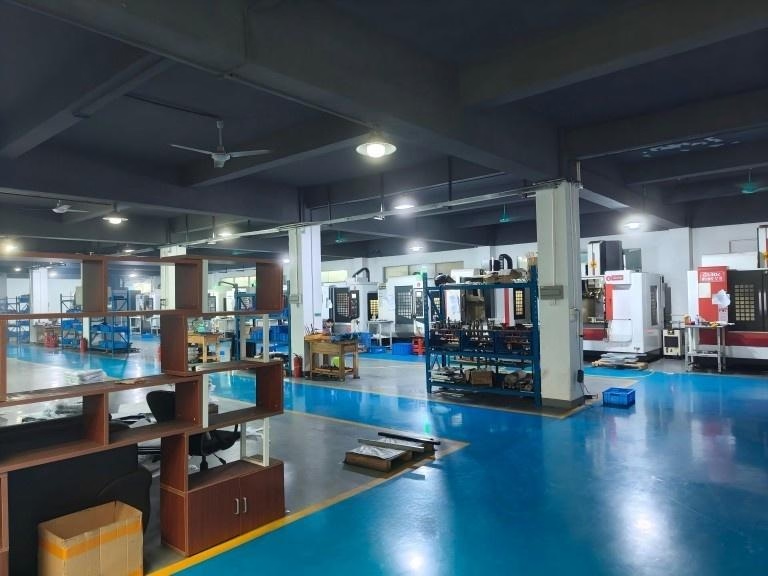
How one piece casting cnc structure works
A one piece casting starts at the foundry. The bed, column and often the saddle are poured from one mold in high-grade cast iron, then stress-relieved before any cutting happens. There is no weld seam and no bolted joint in the load path.
That matters because every joint in a machine frame is a spring. Under a 20 mm depth of cut in 4140 steel, the cutting force pushes the column back and the bed twists slightly. A welded frame has dozens of contact surfaces where that force can slip or open a gap. A single casting has none.
Cast iron also damps vibration well. Its flake graphite structure absorbs energy that would otherwise show up as chatter on the part surface. On a horizontal machine cutting a deep pocket in a hydraulic manifold, that difference is visible: the floor of the pocket stays at Ra 0.8–1.6 μm instead of tearing.
The trade-off is weight and lead time. A one piece casting for a 500 mm pallet machine can weigh several tonnes, and the mold takes weeks to make. For a builder, that is a capital decision made once per model, not a per-part choice.
What the horizontal spindle changes
On a horizontal machining center the spindle points sideways. The workpiece sits on a pallet on a rotary table, and the table indexes to present four faces to the tool. A cube-shaped part can be machined on all four sides plus the top in one setup, with no re-chucking.
That geometry suits boxy, cubic and cylindrical parts: gearbox housings, valve bodies, pump covers, engine blocks, manifold blocks. It suits them because the features that need to align sit on faces that the rotary table can reach without the operator touching the part.
Vertical machines can reach the same features, but usually across two or three setups. Each setup adds a re-clamp, a re-zero and a stack of tolerance. If a bore on face A must be coaxial with a bore on face C within 0.02 mm, doing both in one horizontal setup removes the stack entirely.
The limit is slender parts. A long shaft with a 10:1 length-to-diameter ratio is awkward on a horizontal table because the overhang grows as the table indexes. Those parts belong on a lathe or a mill-turn center.
Thermal drift and long-run accuracy
A casting holds its shape better than a fabricated frame when the shop warms up. The spindle runs, the ballscrews heat, the coolant warms the table, and the machine grows. On a welded frame the growth is uneven because the welds and bolted joints expand at different rates.
On a monoblock casting the mass is distributed more evenly, so the growth is closer to uniform. That does not make the machine immune to heat. It makes the drift predictable, and predictable drift can be compensated in the control.
For a run of 500 parts, the difference shows up in the last 100. A machine that drifts 0.015 mm over an eight-hour shift will start pushing the top of a ±0.005 mm tolerance band. A machine that drifts 0.005 mm stays inside it.
We keep the spindle warm-up cycle in the program and check a master part at the start and end of every shift. That is how the ±0.005 mm tolerance is held across a full day, not just on the first article.
Pallet changing and spindle uptime
The pallet system is what turns a stable frame into a productive one. While the spindle cuts on pallet A, the operator loads pallet B. When the cycle ends, the table swaps pallets in seconds. The spindle stops for the swap, not for the load.
On a high-mix shop this matters less because setups are short anyway. On a run of 2,000 aluminum housings, the difference between a 40-second manual load and a 6-second pallet swap is hours of spindle time per week.
A cast iron bed supports that cycle without flexing. Every pallet clamp seats against the same cast surface, so the position repeats. Pallet-to-pallet repeatability on a good machine sits in the 0.005–0.010 mm range, which is why the first part off pallet B matches the last part off pallet A.
The catch is the fixture cost. Each pallet needs its own tombstone or fixture plate. For a one-off prototype that cost is hard to justify. For a family of parts that share a fixture, it pays back in weeks.
When one piece casting cnc is the wrong choice
The frame is only half the decision. The other half is whether your part needs what the frame provides. If the part is a flat plate with holes on one face, a 3-axis vertical mill does the job at a lower hourly rate.
If the part is a thin-walled aluminum cover with 1.5 mm walls, a horizontal machine with high clamping force can distort it. Those parts often run better on a vacuum fixture or a 5-axis machine with light finishing passes.
If the part is a single prototype that will be redesigned next week, the fixture and programming time dominate. Rapid prototyping on a 3-axis or 5-axis mill gets you a part faster.
Where the one piece casting cnc platform earns its keep is volume plus multi-face geometry plus a tight tolerance that spans more than one face. When all three are present, the single structure and the single setup compound each other.
Horizontal casting frame vs. welded frame vs. vertical mill
Same part, three machine choices
| Factor | One piece casting HMC | Welded frame HMC | Vertical mill |
|---|---|---|---|
| Frame construction | Single cast iron pour | Welded steel plates | Cast or welded base |
| Vibration damping | High, flake graphite iron | Lower, joint dependent | Moderate |
| Faces per setup | 4 sides plus top | 4 sides plus top | 1 face per setup |
| Tolerance stack | Low, one setup | Low, one setup | High, re-clamp each face |
| Thermal drift | Uniform, compensable | Uneven at joints | Moderate |
| Best part type | Boxy, multi-face, volume | Boxy, less critical | Flat, single-face, low volume |
| Fixture cost | High, per pallet | High, per pallet | Low to moderate |
| Setup time per part | Seconds via pallet swap | Seconds via pallet swap | Minutes per re-clamp |
The call
If your part is boxy, needs four faces held to one tolerance, and runs in the hundreds, choose the one piece casting HMC. If it is flat, single-face, or a one-off prototype, a 3-axis vertical mill is cheaper and just as accurate.
Questions engineers ask
Does a one piece casting mean the whole machine is one piece?
No. It refers to the main structural parts: bed, column and sometimes saddle. Spindles, ballscrews, linear guides, pallets and enclosures are still separate assemblies bolted or fitted to the casting.
The point is that the load path from tool to floor passes through one continuous piece of iron, not through a stack of welded plates.
Is cast iron better than a polymer concrete base?
They solve the same problem in different ways. Polymer concrete damps vibration well and can be cast into complex shapes at low volume. Cast iron has higher stiffness per unit volume and is easier to re-machine if the machine is rebuilt.
For a production HMC running 24 hours, cast iron is the more common choice.
How does a cast frame affect surface finish?
Fewer joints means less micro-movement under the cutter. On finishing passes in aluminum or steel, that shows up as a more consistent Ra across the part.
We typically hold Ra 0.8–1.6 μm on machined faces and can reach Ra 0.2–0.8 μm where the drawing calls for it.
Can a horizontal machine hold ±0.005 mm across a full production day?
Yes, with the right routine. Warm up the spindle, check a master part at shift start and end, and keep coolant temperature stable.
Without those steps, thermal drift alone can eat most of the band by mid-afternoon.
What part sizes fit a horizontal machining center?
It depends on the pallet size. Machines with a Ø400 mm rotary table suit parts up to roughly 500 mm cube. Larger machines take parts up to 4,000 mm in one axis.
Send the drawing and we will confirm the machine and the fixture approach.
Do I need a horizontal machine for a 5-axis part?
Not always. If the part has features on many angles, a simultaneous 5-axis machine reaches them without special fixtures.
If the part is boxy and the features sit on four perpendicular faces, a horizontal with a rotary table is often faster per part.
Send us the drawing, get a process plan
Tell us the part, the tolerance and the quantity. We will come back with the machine, the fixture approach and a quote within 12 hours.
12-hour quote100% inspectionNo minimum order quantityNDA on request
More machining notes
We publish setup notes, tooling trials and inspection data from the factory floor.











