
What Is a CNC Milling Machine Used For?
A CNC milling machine used for production work removes material with a rotating multi-tooth cutter under program control. This page explains what it actually cuts, which parts fit the process, and where milling stops being the right answer. Written for engineers and buyers who have to choose a process, not read a brochure.
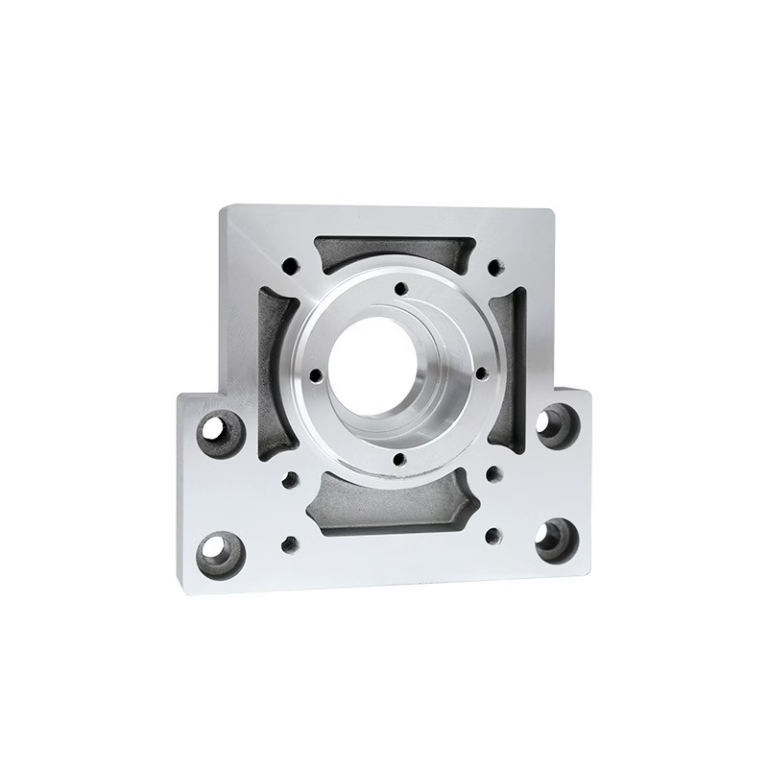
How a CNC Milling Machine Used for Cutting Metal Works
Milling is subtractive. A spindle holds a multi-edge cutter and spins it while the workpiece moves on a table along programmed axes. Each tooth takes a small chip. The machine repeats that cut thousands of times per minute, so the finished shape comes out of the tool path, not out of the operator's hands.
The cutting edges are the whole story. A 4-flute carbide end mill running at 0.05 mm per tooth on 6061 aluminium removes material fast and leaves Ra 0.8–1.6 μm without a second operation. Switch to Ti-6Al-4V and the same cutter must slow down and flood with coolant, because titanium carries heat into the edge instead of the chip.
Everything the machine does is fixed by the program. Change the feed, the spindle speed or the depth of cut and the next part changes too. Repeatability across a run of 10,000 parts depends on tool wear, thermal drift and how the fixture clamps the blank. Those three variables are why a 3-axis machine can hold ±0.005 mm on a simple prismatic part and struggle on a tall thin wall.
3-Axis, 4-Axis and 5-Axis: What the Extra Axes Buy You
A 3-axis mill moves X, Y and Z only. The tool always comes down from one direction, so every feature you cut must be reachable from that direction. Pockets, slots, bolt circles and flat faces are its natural work. Setup is simple and the fixture is cheap.
A 4-axis machine adds a rotary table, usually Ø400 mm, turning the part around one axis. Think of a shaft with flats milled at four positions, or a series of holes drilled around a cylinder. One setup replaces four, and the angular relationship between features stays tight because the part never leaves the chuck.
A 5-axis machine tilts the tool as well as the table. That matters when a part has undercuts, compound angles or deep cavities that a straight tool cannot reach. On an impeller or a medical bone plate, 5-axis cutting often removes the need for a custom electrode or a second fixture. It also lets the cutter stay tangent to the surface, which improves finish on curved geometry.
The trade-off is real. Five-axis programming takes longer, the machine is slower on simple faces, and a bad fixture can still scrap the run. If a part can be cut in three setups on a 3-axis machine, that is usually the cheaper route.
What Materials Go on the Table
Aluminium is the most common choice. Grades 6061, 7075 and 6082 cut cleanly at high speed and hold tight tolerances, which suits brackets, housings and heat sinks. Copper and brass, including C36000 and C110, machine easily and are often used for electrical contacts and RF parts.
Stainless steel covers 303, 304, 316L and 17-4PH. Grade 303 is free-machining and friendly; 316L work-hardens if the cutter rubs instead of cuts, so feed per tooth must stay high enough to stay under the hardened layer. Tool steel and alloys such as 4140 and 4340 appear in molds and structural parts, usually pre-hardened before the last passes.
Titanium and nickel alloys are the hard cases. Ti-6Al-4V and Inconel need low surface speed, rigid tooling and generous coolant. They are cut on the 5-axis centers rather than the smaller mills, because chatter on these materials ruins both the finish and the tool.
Plastics behave differently. POM and PEEK hold dimension well; ABS and PMMA can melt if the chip is not cleared. Carbon fibre is abrasive and eats cutters, so it is usually run with diamond-coated tooling and a dust extraction setup.
When a Part Belongs on a Mill, and When It Does Not
Milling wins when the part is prismatic, has pockets or slots, needs tight flatness, or exists in quantities from one to several thousand. Prototypes, jigs and fixtures, brackets, manifolds, valve bodies and heat sinks all fall into this group. A one-off prototype and a 10,000-part run use the same program, which is why the process scales without tooling cost.
Milling is the wrong call when the part is essentially a body of revolution. A shaft, bushing or threaded fitting is faster and rounder on a lathe, and a mill-and-turn center handles parts that need both. Very thin-walled tubes, deep small holes and parts with internal cavities that no cutter can reach also push you toward casting, turning or additive work.
Part size sets another boundary. GreatLight runs mills up to 4,000 mm of travel, but long thin parts deflect under cutting force. If a feature sits 800 mm from the nearest clamp, expect to add supports or accept a looser tolerance. This is a geometry problem, not a machine problem.
Surface finish follows the same logic. Ra 0.2–0.8 μm is reachable on aluminium with a finishing pass and fine stepover. On a deep pocket in 316L, the same finish takes much longer and may need a separate polish step.
Which Process Fits Which Part
A quick way to route a part before you ask for a quote.
| Part type | Best process | Why |
|---|---|---|
| Flat bracket with pockets | 3-axis milling | All features reachable from one direction |
| Shaft with cross holes | 4-axis milling or turning | Rotary table cuts all faces in one setup |
| Impeller with undercuts | 5-axis milling | Tilted tool reaches compound surfaces |
| Round bushing or fitting | CNC turning | Body of revolution, faster and rounder |
| Thin hollow shell | Die casting or 3D printing | Milling leaves too little wall to clamp |
| Low-volume metal cover | Milling from plate | No tooling cost, geometry changes freely |
| High-volume simple cover | Die casting | Tooling pays back over large quantities |
| Prototype before tooling | Milling or 3D printing | Both avoid hard tooling at low volume |
The Short Answer
If the part is prismatic and you need ±0.005 mm, mill it. If it is round, turn it. If it is a thin hollow shell, cast or print it. Milling is the most flexible subtractive process, not the universal one.
Common Questions
What materials can a CNC milling machine cut?
Aluminium grades 6061, 7075 and 6082, stainless 303, 304, 316L and 17-4PH, steels such as 1045 and 4140, copper and brass, titanium Ti-6Al-4V, Inconel, magnesium, and engineering plastics from POM to PEEK.
Carbon fibre can be milled too, but it is abrasive and needs diamond-coated tooling plus dust extraction.
How precise is CNC milling?
For prismatic parts on a rigid setup, ±0.005 mm is achievable. That equals ±0.0002 in.
Tolerance depends more on the part than the machine. A short, well-supported feature holds far tighter than a long thin wall.
Can CNC milling be used for prototyping?
Yes. There is no minimum order quantity, so a single prototype and a 10,000-part run use the same setup and program.
For a prototype the value is that the geometry can change between revisions without new tooling.
What is the difference between 3-axis and 5-axis milling?
A 3-axis machine moves in X, Y and Z, so every feature must face the tool from one direction. A 5-axis machine tilts the tool or table, which lets it reach undercuts and compound angles in one setup.
Five-axis costs more per hour and takes longer to program. Use it when the geometry demands it, not by default.
How does a shop check milled parts before shipment?
At GreatLight, every part is inspected before it leaves. That covers raw material verification, in-process monitoring and a final check, with reports available on request.
Uploads are kept secure and confidential, and an NDA is available if your drawings need one.
Send the Drawing, Get a Real Answer
Tell us the part and the tolerance that matters. We will say whether it belongs on a mill and quote it within 12 hours.
12-hour quoteFree DFM analysis100% inspectionNo minimum order quantity
More from the shop floor
We publish setup notes, tooling trials and inspection data from the factory floor.











