
What Is Rapid Tooling? How Rapid Mold Making Works
Rapid tooling is a family of mold-making methods that trade tool life for speed. This page explains the mechanisms, the materials, and the boundary where a rapid tool stops making sense. Written for design engineers, tooling engineers, and sourcing teams who need to choose a bridge tool, a pilot run, or a full production tool.
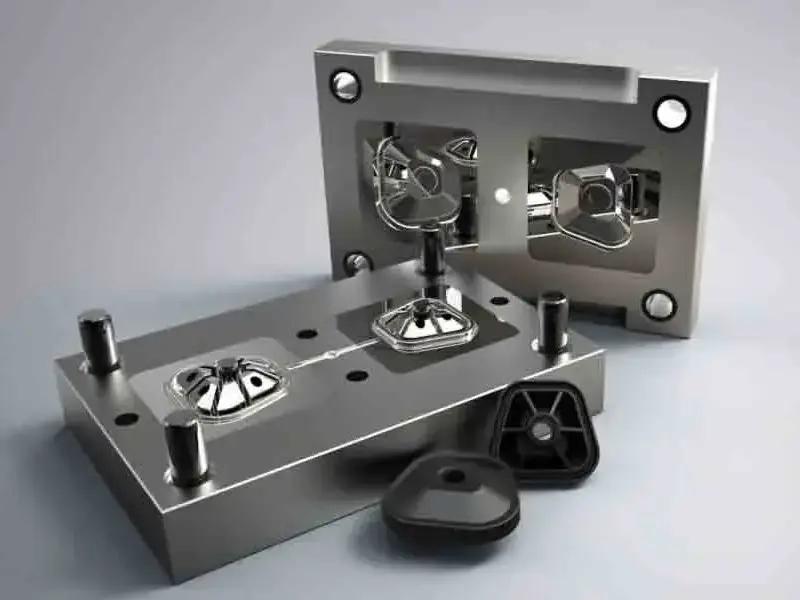
What Rapid Tooling Actually Means on the Shop Floor
Rapid tooling is a mold or die built with short lead time as the first priority. The cavity is usually machined from aluminum, copper alloy, or a low-hardness steel instead of a hardened tool steel block. Sometimes the insert is 3D printed and then finished by CNC. The tool still runs on a standard injection press, so parts come out with real mold shrinkage, real weld lines, and real gate marks.
That last point separates rapid tooling from prototyping. A vacuum cast or printed part looks like the final part. A rapid-tooled part behaves like it. You can measure cycle time, check ejection, and test the actual resin you plan to run in production.
The trade is tool life. An aluminum cavity might hold 5,000 to 20,000 shots depending on resin and gate design. A hardened P20 or H13 tool runs into the hundreds of thousands. For a pilot build, a clinical trial batch, or a bridge order before the steel tool is ready, the aluminum tool wins on schedule every time.
Rapid tooling is not one process. It covers CNC-machined aluminum inserts, cast resin tools, printed conformal-cooling inserts, and soft steel cavities. The right choice depends on resin, part geometry, and how many shots you actually need.
- 1Speed over lifeThe tool is designed to be replaced, not to last.
- 2Same resin, same pressParts carry real production characteristics.
- 3Bridge roleFills the gap while the hardened tool is cut.
How Rapid Mold Making Cuts Weeks Off the Schedule
A conventional steel tool goes through a long chain: mold design, steel ordering, roughing, heat treatment, finishing, EDM, spotting, and trial. Heat treatment alone can add a week, and it often moves the cavity a few thousandths of a millimeter, which means more spotting.
Rapid mold making skips or compresses those steps. Aluminum and copper alloys are machined soft and stay soft. There is no quench, no temper, no stress relief cycle. A 5-axis machining center cuts the cavity, the core, and the cooling channels in one or two setups, so the geometry stays consistent across the tool.
Conformal cooling changes the math further. A printed insert can follow the part contour instead of running in straight drilled lines. On a deep, thin-walled part, that can drop cycle time noticeably and reduce warpage at the same time. The insert still needs finish machining and polishing, but the cooling layout is already inside it.
The honest limit is thermal. Aluminum conducts heat roughly five times faster than steel. That helps cooling and hurts weld-line strength, because the melt freezes sooner as it travels. For thin walls and long flow paths, a tool designer may need to move the gate or raise the melt temperature.
Tooling lead time is only one input into the schedule. If the design is still moving, a fast tool just locks in a mistake faster. We prefer to run DFM analysis on the part first, then commit to the cavity layout.
- 1No heat treatmentRemoves a full week and the distortion that comes with it.
- 2Fewer setups5-axis machining holds cavity and core alignment.
- 3Conformal coolingPrinted inserts cool where the part actually is.
Tool Materials and the Shots They Realistically Survive
Material choice drives both cost and tool life. Aluminum 7075 and 6061 are the workhorses. They machine fast, polish well enough for most cosmetic surfaces, and take a decent texture. They are a poor match for glass-filled nylon at high shot counts because the abrasive melt erodes gate detail.
Copper alloys such as beryllium copper sit between aluminum and steel. They conduct heat even faster, which suits thick sections that are hard to cool. They cost more and are heavier, so they usually go into a specific insert rather than the whole tool.
Soft steels like P20 or 1.2343 pre-hardened to around 30 HRC are the next step up. They hold gate detail better than aluminum and can reach 50,000 shots or more with care. Lead time is longer than aluminum but still well short of a hardened H13 tool.
Printed inserts are a special case. The base is a maraging or tool steel powder, so the surface can be hardened after printing. The internal cooling is the real value. The outer skin still needs CNC finishing to hit the tolerance and surface finish the part requires.
- 1Aluminum 7075Fast to cut, good for 5,000–20,000 shots.
- 2Beryllium copperBest for hot, thick sections that resist cooling.
- 3P20 pre-hardHigher shot counts when gate wear matters.
Where Rapid Tooling Fits and Where It Does Not
Rapid tooling fits when the part design is close to frozen and the quantity is low to medium. Automotive interior clips, medical device housings for a trial, and consumer electronics enclosures for a launch batch are typical. The tool pays for itself because the parts are sellable, not just visual.
It also fits as a bridge. If the steel tool is six weeks out but the customer needs 2,000 units next month, an aluminum tool runs the gap. When the steel tool arrives, the aluminum one is retired or kept as a backup.
It does not fit when the geometry is still changing weekly. Every change to a machined cavity costs setup time, and a few rounds of that erase the speed advantage. It also does not fit for very high shot counts, abrasive resins, or parts with tight gate cosmetics that must stay sharp for hundreds of thousands of cycles.
Very large parts are another boundary. The tool has to fit the press platen and the machining envelope. We machine up to 4,000 mm, but a large aluminum cavity still needs a press big enough to clamp it, and that press may not be the one you planned to use.
The cleanest rule: count the shots you truly need before the design changes again. If that number is under about 20,000, rapid tooling is usually the faster and cheaper path.
- 1Good fitFrozen design, low to medium volume, fast launch.
- 2Poor fitChanging geometry, high shot counts, abrasive resin.
- 3Watch the pressTool size must match available clamping.
Rapid Tooling vs Hardened Steel Tooling
Use this to pick a path before you commit to a cavity.
| Factor | Rapid tooling | Hardened steel tool |
|---|---|---|
| Typical lead time | Days to a few weeks | Several weeks or more |
| Cavity material | Aluminum, copper alloy, soft steel | P20, H13, hardened inserts |
| Realistic shot life | About 5,000–20,000 shots | Hundreds of thousands of shots |
| Heat treatment | None required | Required, adds time and distortion |
| Cooling layout | Often conformal, printed inserts | Usually straight drilled lines |
| Best use | Pilot runs, bridge orders, trials | Long production, abrasive resins |
| Design change cost | Low, recut is quick | High, may need rework or new insert |
The Clear Trade
If you need sellable parts fast and the design is frozen, choose rapid tooling. If you need hundreds of thousands of shots from one cavity, or you are running glass-filled resin, choose a hardened steel tool and accept the longer lead time.
Rapid Tooling Questions Engineers Ask
How many shots can a rapid tool really run?
Aluminum cavities typically hold 5,000 to 20,000 shots before gate wear or surface damage shows up. Soft steel such as P20 can push past 50,000 with careful handling. The number moves with resin abrasiveness, melt temperature, and how well the tool is maintained between runs.
Can a rapid tool use the same resin as the production tool?
Yes, and that is the main reason to use one. The part sees real shrinkage, real weld lines, and real gate marks. You can validate fit and function against production material instead of a stand-in resin.
The one adjustment is thermal. Aluminum pulls heat out faster, so melt temperature and injection speed may need tuning to avoid short shots or weak weld lines.
Does a rapid tool need different draft or wall thickness?
The part geometry should stay the same, because the molded part is what you are validating. The tool design changes instead: more generous draft on deep ribs, a larger gate, and extra ejector pins, because the softer cavity can be damaged more easily during ejection.
What surface finish can a rapid tool deliver?
A machined and polished aluminum cavity can reach a fine cosmetic finish for most visible parts. Textures and deep grain are harder, because the soft surface wears faster than hardened steel. If the texture is critical, plan for a steel insert in the area that shows.
When should we skip rapid tooling and go straight to steel?
Skip it when the geometry is still moving, when the annual volume is high, or when the resin is abrasive. A fast tool on an unsettled design just locks in rework. In those cases the extra weeks for a hardened tool are cheaper than two rounds of cavity changes.
Can rapid tooling handle overmolding or insert molding?
Yes, with planning. The second cavity or the insert pockets need to be cut into the same soft material, so alignment between the two shots matters more. Expect a longer tool design review and a trial run before the production batch.
Send Your Part, Get a Tooling Plan
We review the geometry, resin, and shot count, then tell you whether rapid tooling or a hardened tool is the better path. Quotation and free DFM analysis within 12 hours.
12-hour quote100% inspectionNDA on request
More From GreatLight
We publish setup notes, tooling trials and inspection data from the factory floor.











