
What Is the Difference Between SMT and CNC?
SMT places electronic components on printed circuit boards. CNC cuts metal and plastic into finished parts. This page compares both processes side by side, so you can tell which one your project actually needs.
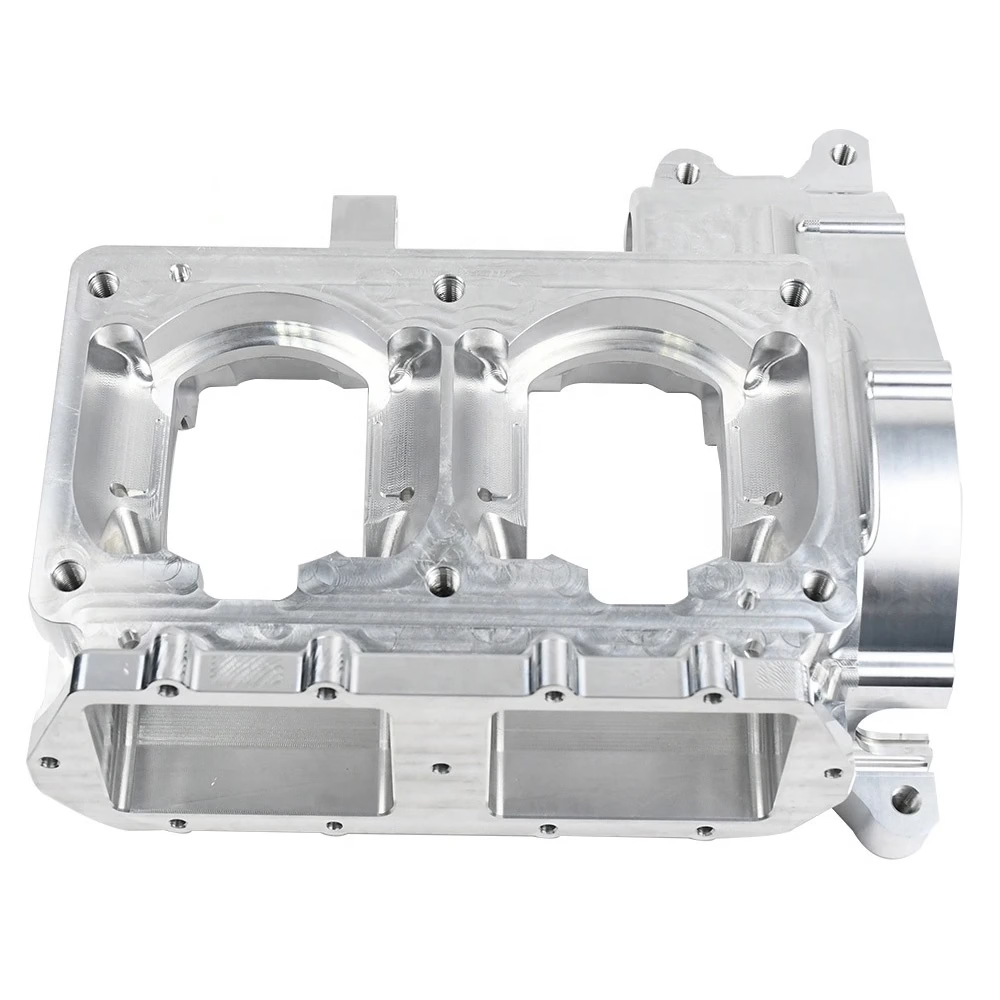
SMT vs CNC at a Glance
Use this table to rule one process out before you send files anywhere.
| Point | SMT | CNC machining |
|---|---|---|
| What it makes | Populated PCB assemblies | Solid parts from bar or plate |
| Core action | Solder paste print, place, reflow | Rotating cutter removes material |
| Input files | Gerber, BOM, pick-and-place | STEP, IGES, 2D drawing |
| Lead material | FR-4, copper, solder alloy | Aluminium, steel, titanium, plastics |
| Tolerance scale | Placement ±0.05 mm typical | ±0.005 mm on a good machine |
| Surface quality | Solder joints, conformal coat | Ra 0.8–1.6 μm as a rule |
| Main driver | Component count and board area | Part geometry and material |
| Who buys it | Electronics and PCB teams | Mechanical and hardware teams |
What SMT and CNC Each Mean
The difference between SMT and CNC is easier to hold on to once you name the output of each process. SMT stands for surface mount technology. It is the assembly step where components are placed on pads on a printed circuit board and fixed with solder paste, then reflowed in an oven. The board itself is made elsewhere. SMT is the part that puts the parts on it.
CNC stands for computer numerical control. It describes a machine tool that follows a program to move a cutter or a workpiece. In practice, CNC milling and CNC turning start from a solid block, bar, or casting and cut away material until the shape matches the drawing. Nothing is added; material is removed.
That single sentence covers most of the confusion. SMT is assembly. CNC is shaping. A project can need both. A CNC-machined enclosure often holds an SMT-assembled board, and the two are quoted by different suppliers with very different lead times.
One more boundary matters. SMT is not PCB fabrication. The bare board with copper traces comes from a PCB shop. SMT suppliers receive that board and populate it. If you ask an SMT house for a bare board and a CNC shop for a populated one, you are talking to the wrong supplier.
- 1SMT outputA finished, populated circuit board ready for test and enclosure.
- 2CNC outputA single part or a batch that meets a drawing and a tolerance.
- 3Shared inputBoth need a defined data package before quoting starts.
How Each Process Actually Runs
An SMT line starts with stencil printing. Solder paste is pushed through a stainless stencil onto the board pads. Paste volume drives defect rates more than any other variable, so stencil thickness and aperture design get checked first. A 0.12 mm stencil is common for fine-pitch work.
Placement follows. A pick-and-place machine picks components from reels and drops them onto the paste at high speed. Placement accuracy on modern equipment sits around ±0.05 mm, which is why 0201 and 01005 parts are feasible. Then the board enters a reflow oven with a controlled profile. Peak temperature depends on the solder alloy, and lead-free pastes usually peak near 245 °C.
Inspection closes the loop. AOI catches missing, shifted, or tombstoned parts. X-ray is used when a BGA or QFN hides its own solder joints underneath. Rework is possible but costs time, and every rework pass carries risk to the pad and the part.
CNC works in the opposite direction. A programmer writes toolpaths from the CAD model, chooses cutters, and sets speeds and feeds for the material. A roughing pass removes most of the stock, then a finishing pass brings the surface to size. On our 5-axis centers, a single setup can reach features that would need three or four setups on a 3-axis machine.
Accuracy depends on the machine, the fixture, and the material. We hold ±0.005 mm (±0.0002 in) on critical features, with as-machined finish at Ra 1.6–3.2 μm and Ra 0.8–1.6 μm when the drawing calls for it. Thin walls, deep pockets, and soft plastics are where tolerance claims get tested.
- 1SMT bottleneckStencil print quality and reflow profile control.
- 2CNC bottleneckFixture rigidity and tool access to the feature.
What You Send to Each Supplier
The data package tells you which process you are buying. SMT suppliers want a Gerber or ODB++ set, a bill of materials with manufacturer part numbers, and a pick-and-place file with rotations and coordinates. Missing rotation data is the most common reason a first article comes back wrong.
If you only have a schematic and a layout file, most SMT houses will still quote, but they will ask you to confirm the assembly drawing, the polarity of every polarized part, and which parts are do-not-populate. Those three answers remove most of the back-and-forth.
CNC suppliers want 3D geometry, usually STEP or IGES, plus a 2D drawing for anything the model cannot carry: tolerances, datum callouts, thread depth, surface finish, and edge break. A model without tolerances means the shop will use a general block tolerance, and that may not match your function.
Material and finish belong on the drawing too. Aluminium 6061-T6 behaves differently from 7075 or 17-4PH stainless, and anodizing adds a few micrometres per surface. If a bore is anodized after machining, the plater needs to mask it or the fit will change. Say so up front.
One practical note: both processes benefit from a short review before cutting starts. We return a quotation and a free DFM analysis within 12 hours, and that review often catches a tolerance or a component issue before it becomes scrap.
- 1SMT packageGerber, BOM, pick-and-place, assembly drawing.
- 2CNC packageSTEP model, 2D drawing with tolerances and finish.
Cost, Volume, and Lead Time
SMT economics are dominated by setup. Stencil fabrication, machine programming, and first-article inspection are one-time costs. Spread over 500 boards they almost vanish. Spread over 5 boards they dominate the invoice. That is why SMT quotes fall steeply with volume and why prototype runs often use a manual or semi-automatic line.
CNC economics work the other way at first, then flatten. There is no stencil and no tooling to build, so one part is cheap to start. But every part carries machining time. A complex 5-axis part might take 40 minutes of spindle time, and volume does not remove that. Above a few thousand identical parts, casting or molding usually wins.
Lead time reflects the same split. SMT depends on component availability, and a single missing IC can hold up an entire build. CNC depends on machine capacity and material stock. We can start production within 24 hours of an approved order and ship parts in 3–5 days for standard machining work.
There is no minimum order quantity on the CNC side, so a single prototype and a 10,000-part run sit on the same quotation path. That matters when a design is still moving and you need a physical part to test before committing to tooling.
Both processes punish late changes. A component swap after SMT programming means a new setup. A geometry change after CNC fixturing is built means a new fixture. Lock the design before you release it.
- 1SMT favorsVolume runs where setup cost is already paid.
- 2CNC favorsPrototypes, low volume, and tight-tolerance metal parts.
How to Choose for Your Project
Ask what the deliverable is. If the answer is a working circuit, you need SMT or another assembly route. If the answer is a bracket, a housing, a manifold, or a heat sink, you need CNC. Very few projects need the wrong one by accident, but plenty of teams mix up the quotation request.
Then look at tolerance and material. SMT placement lives near ±0.05 mm and the substrate is a laminate. CNC holds ±0.005 mm in aluminium, stainless, titanium, and engineering plastics. If a feature has to fit a bearing or seal a fluid path, that is CNC territory.
Next, check volume. Ten boards with 300 components each are an SMT job. Ten machined brackets are a CNC job. Ten thousand brackets should be reviewed for die casting, and we quote that too, because the right answer at that volume is not milling.
Finally, consider who owns the interface. When a machined enclosure must accept a populated board, someone has to own the connector alignment, the standoff heights, and the clearance around tall components. We machine the metal and can work from your board model to keep those interfaces consistent.
If the project needs both, split the work by process rather than forcing one supplier to do everything. It usually cuts both cost and risk.
- 1Choose SMTPopulated boards, component placement, reflow assembly.
- 2Choose CNCMetal or plastic parts with defined geometry and tolerance.
- 3Choose bothEnclosures, heat sinks, and fixtures that mate with a PCB.
The Short Answer
If you are building a circuit board, use SMT. If you are building a machined metal or plastic part, use CNC. When a product needs both, quote them separately: SMT for the board, CNC for the housing and hardware, and hold one drawing for the interface between them.
Common Questions
Is SMT the same as PCB fabrication?
No. PCB fabrication produces the bare board with copper traces, solder mask, and silkscreen. SMT is the assembly step that prints solder paste, places components, and reflows them onto that board.
A bare board supplier and an SMT assembler are usually different companies, and they need different files: Gerber for the board, plus BOM and pick-and-place data for assembly.
Can a CNC shop make a printed circuit board?
It can machine the substrate or a metal-core carrier, but it cannot populate components. Milling a board outline, drilling mounting holes, or cutting an aluminium heat spreader is normal CNC work. Soldering a 0402 resistor is not.
Teams often split the job: CNC for the metal carrier or enclosure, SMT for the electronics that drop into it.
Which process holds tighter tolerance?
CNC, by roughly an order of magnitude. SMT placement accuracy is typically around ±0.05 mm, which is set by the pick-and-place machine and the paste print.
On our machining centers we hold ±0.005 mm (±0.0002 in) on critical features. The gap matters when a part must fit a bearing, a dowel pin, or a mating machined surface.
What drives cost in each process?
SMT cost is front-loaded: stencil, programming, and first-article inspection are one-time. After that, per-board cost is mostly components and machine time, so it drops with volume.
CNC cost is spread across every part through spindle time. Setup and fixturing also matter, but a 40-minute cycle does not get shorter because you ordered more. There is no minimum order quantity on our CNC side, so single prototypes and 10,000-part runs are both routine.
What files do I need for a CNC quote?
Send a STEP or IGES model plus a 2D drawing that carries tolerances, datums, thread callouts, surface finish, and edge break. If the model is the only file, the shop will apply a general tolerance that may not match your function.
Tell us the material, the quantity, and any finish such as anodizing, electroless nickel, or black oxide. That is enough for a quotation and a free DFM analysis within 12 hours.
Do you handle both processes under one roof?
We machine the metal and plastic parts: 5-axis, 4-axis, 3-axis milling, mill-turn, sheet metal, die casting, and surface finishing. SMT assembly is a separate discipline, and we say so rather than pretend otherwise.
If your project needs both, we can machine the enclosure, heat sink, or fixture to your board model so the mechanical interface lines up on the first build.
Send Us the Right Files
Upload a STEP model or a Gerber set and we will tell you which process fits. Quotation and free DFM analysis within 12 hours, 100% inspection before shipment, NDA available on request.
12-hour quote100% inspectionNo minimum order quantity
More Process Notes
We publish setup notes, tooling trials and inspection data from the factory floor.











