
Where Are Haas CNC Machines Made?
Almost every Haas mill, lathe and rotary table is built in Oxnard, California. This page explains what that plant actually does, which parts come from outside suppliers, and how the answer changes what you should check when you buy or specify a Haas.
In this article
- 1
- 2
- 3
- 4
- 5
- 6
- 7
Where Are Haas CNC Machines Made? The Short Answer
Haas Automation builds its machine tools in Oxnard, California. The company was founded there in 1983 by Gene Haas and still runs its main manufacturing campus on the same site. Mills, lathes, rotary tables and most of the control hardware are assembled and tested in that plant before they ship.
That is the answer most buyers are looking for, but it is not the whole answer. A CNC machine is roughly 1,500 to 4,000 individual parts. No machine tool builder makes all of them. Haas makes far more than most competitors, which is the real story behind the question.
The origin matters to engineers for a practical reason. Where a machine is made tells you how much of the quality chain the builder controls, how fast spare parts arrive, and how much of the cost sits in labor, freight and tariffs. Those three things show up later in your part price and your uptime.
So when someone asks where are Haas CNC machines made, the useful reply is: castings, machined components, spindles, final assembly, software and testing happen in California. Electronics, bearings, fasteners, seals and some motors come from a global supplier base, the same as every other builder.
What the Oxnard Plant Actually Does In-House
The Oxnard campus is one of the more vertically integrated machine tool operations in the world. Haas runs its own foundry, so iron castings for beds, columns, saddles and tables are poured on site rather than bought from an outside foundry. Cast iron is a slow, dirty, capital-heavy process. Doing it in-house means the builder controls the metallurgy, the cooling cycle and the stress relief that decides how a machine holds geometry after five years.
From the foundry, castings move to machining. Haas machines its own bases and columns on Haas machines. That is the origin of the well-known 'machines building machines' description of the plant. It is not a marketing line so much as a description of a closed loop: the same CNC platform that customers buy is used to cut the parts that become new machines.
Spindles, tool changers, sheet metal enclosures, wiring harnesses and the control pendant all come together on the same campus. The control itself, the Haas Control, is developed and built by Haas rather than licensed from a third party. That is unusual in this industry and it means a software update does not wait on another company's release cycle.
Every machine is run and inspected before it leaves. Alignment is checked, the spindle is run in, the tool changer is cycled, and the geometry is verified against a test report. A machine that fails is not shipped. That final test stage is where most of the 'made in' claim is actually earned.
Which Parts Are Not Made in California
Vertical integration has limits. Haas buys bearings, linear guide rails, ball screws, servo motors, encoders, electrical components and fasteners from outside suppliers. Many of those suppliers are in Japan, Germany, Taiwan and other parts of Asia. This is standard practice across the machine tool industry and it is not a quality problem on its own.
The practical question is not whether foreign parts exist but how the builder manages them. A machine tool is a system. A high-quality Japanese bearing pair installed in a poorly scraped saddle will still produce poor geometry. Conversely, an average bearing in a well-aligned structure can hold tolerance for years.
Haas also operates international facilities for regional assembly, warehousing and support, including a large operation in Europe and a plant in China that serves the Asian market. Machines sold in those regions may be assembled or configured locally, so it is worth confirming the build origin for the specific model and serial number you are buying.
For a buyer, the sensible takeaway is this: ask for the country of final assembly, not the country of every component. Then ask which components are wear items and where those spares ship from. The second question usually predicts your downtime better than the first.
Why Machine Origin Matters to Engineers
Origin affects three things you can measure. The first is geometry retention. Castings poured and stress-relieved in a controlled process distort less over years of thermal cycling. A machine that holds ±0.01 mm after four years of two-shift work saves you rework and re-fixturing time, and that cost is far larger than the machine's sticker price.
The second is spare parts lead time. If a spindle or a servo drive fails, the question is how many days the machine sits idle. Domestic manufacturing with a domestic parts warehouse shortens that window. For a job shop running 20 hours a day, one week of downtime can exceed the annual maintenance budget.
The third is documentation and traceability. Machines built in a regulated, audited plant come with test reports, alignment records and a serial number history. If you machine aerospace or medical parts and your customer audits your equipment, that paperwork is part of your quality system, not a nice extra.
There is also a softer factor. A builder that owns its foundry and its control platform can change both without negotiating with a supplier. When a design revision is needed, the loop from problem to fix is short. That shows up in how quickly known issues get resolved in later production.
How to Judge Any Machine Tool Builder's Origin Claim
'Made in' labels are easy to print and hard to verify. There are three checks that separate a real manufacturing claim from an assembly-and-label operation. None of them require you to visit the factory, though that is the fastest route if the order is large enough to justify the trip.
First, ask for the casting source. If the builder buys castings from an outside foundry, ask for the foundry's name and location and whether stress relief is done before or after rough machining. A casting that is rough cut before stress relief will move after final machining. That is a design decision, and it is visible in the paperwork.
Second, ask what is machined in-house versus bought complete. A builder that only bolts together purchased subassemblies has less control over tolerance stack-up. Ask which of the three critical interfaces they machine themselves: the spindle nose, the linear rail mounting surfaces, and the ball screw bearing housings.
Third, ask where spares ship from and what the typical lead time is for a spindle or a drive. Then ask how many of that model are installed within a day's shipping distance. A large installed base means someone nearby has already solved your problem.
For a shop buying its first CNC, the practical threshold is simpler. Pick a builder whose control you can learn in a week, whose spares arrive in days, and whose geometry you can verify with a test cut on your own part. Origin supports all three, but it does not replace them.
What Machine Origin Means for the Parts You Buy
Origin of the machine tool matters most to the shop that owns it. If you are a buyer of machined parts rather than machines, the useful question shifts: does the shop's equipment let them hold your tolerance repeatably, and can they prove it?
A machine built to tight geometry and maintained on schedule holds ±0.005 mm on a 100 mm aluminum part without heroics. The same machine poorly leveled, with a worn ball screw and a chiller running warm, will not, no matter where it was assembled. Maintenance and metrology usually decide the outcome.
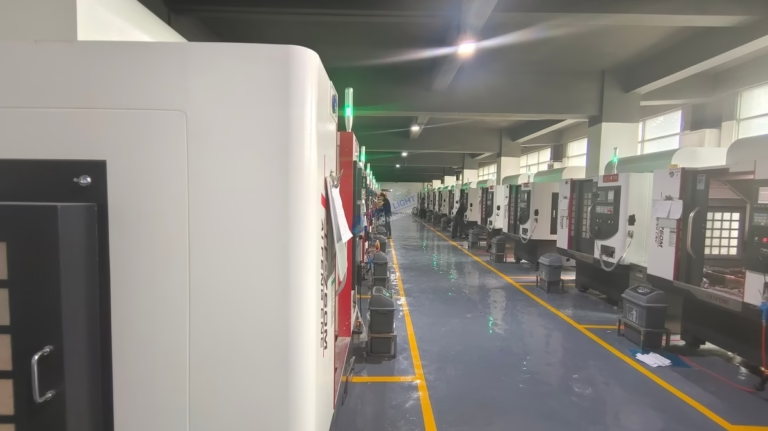
At GreatLight we run 127 high-precision CNC machines across three plants in Dongguan and Singapore, including 16 simultaneous 5-axis centers and a 4,000 mm maximum processing size. Tolerance is held to ±0.005 mm with surface finish from Ra 0.2–0.8 μm where the drawing calls for it.
Machine origin is one input into that capability, not the whole equation. We quote and return a free DFM analysis within 12 hours, start production in 24 hours, and ship parts in 3–5 days. Every part is inspected before it leaves, and inspection reports go out on request.
If your project needs a specific machine platform or a documented equipment list, say so at quoting. It is an easy thing to confirm up front and an expensive thing to discover after the first article inspection.
What Is Made In-House vs Sourced Globally
Typical pattern for Haas machine tools sold in North America
| Item | Where it comes from | Why it matters |
|---|---|---|
| Iron castings (bed, column, saddle, table) | Oxnard foundry, poured and stress-relieved in-house | Controls distortion and long-term geometry retention |
| Machined structural parts | Cut on Haas machines in Oxnard | Tight fit between mating surfaces, no vendor drift |
| Spindle assembly | Built and run-in at the plant | Runout and thermal behavior verified before shipment |
| CNC control and software | Developed and built by Haas | One owner for hardware and firmware updates |
| Final assembly and testing | Oxnard, California | Alignment and geometry checked against a test report |
| Bearings, rails, ball screws | Outside suppliers, largely Japan and Europe | Wear items; spares availability drives uptime |
| Servo motors, encoders, wiring | Global electrical supply base | Standard industrial components, widely stocked |
| Machines for other regions | Regional plants and assembly operations | Verify final assembly country for your serial number |
The Verdict
Buy a Haas for the closed-loop build quality and domestic spares network. Buy elsewhere if your parts need a control platform you already standardize on, or if a local service footprint matters more than the origin of the castings.
Frequently Asked Questions
Are all Haas machines built in the United States?
Machines sold in North America are built at the Oxnard, California campus. Haas also runs facilities in Europe and Asia for regional assembly, warehousing and support, so a machine delivered in those regions may have local final assembly.
If the build country matters for a contract or an audit, give the dealer the model and serial number and ask for the final assembly location in writing.
Does Haas make its own castings?
Yes. Haas operates its own foundry in Oxnard, pouring iron for beds, columns, saddles and tables. That is unusual for a machine tool builder; most buy castings from independent foundries.
In-house pouring lets the builder control alloy, cooling rate and stress relief, which is what governs how a casting behaves after machining.
Which components are imported?
Bearings, linear guide rails, ball screws, servo motors, encoders, electrical components and fasteners largely come from outside suppliers, many in Japan, Germany and Taiwan.
This matches standard machine tool practice. The important part is which supplier and whether spares are stocked regionally, not the country on the component label.
Does origin affect part accuracy?
Indirectly. Origin tells you how much of the quality chain one company controls, which affects geometry retention and spare parts response.
The direct drivers of part accuracy are alignment, thermal stability, tooling, workholding and inspection discipline. A well-maintained machine from any credible builder can hold ±0.005 mm on the right part.
How do I verify a machine origin claim before buying?
Ask three questions: where the castings are poured and stress-relieved, which critical interfaces are machined in-house, and where spares ship from with what lead time.
Request the test report and alignment record that ships with the machine. A builder that does this work in-house will have it. A builder that only assembles will not.
Can I request a machine tool list before placing a machining order?
Yes. Send the request with your RFQ and state which platforms you need documented. We will confirm the machine list and the inspection process for your parts.
We quote and return free DFM analysis within 12 hours, start production within 24 hours, and ship in 3–5 days. Uploads stay confidential, and an NDA is available on request.
Send Your Drawings, Get a Quote in 12 Hours
Upload your files and we will return a quotation plus free DFM analysis within 12 hours, with production starting in 24 hours and parts shipping in 3–5 days.
12-hour quote100% inspection±0.005 mm
More From GreatLight
We publish setup notes, tooling trials and inspection data from the factory floor.











